
Flabby arms, bat wings, upper arm fat — here’s what actually works

Arm fat — particularly the soft, jiggly area on the back of the upper arm — is one of the most commonly targeted and most misunderstood areas for fat loss. People do hundreds of tricep dips and arm circles hoping to specifically reduce fat from their arms, and then wonder why nothing changes.
The answer, as with all body-specific fat concerns, comes down to understanding what actually drives fat loss in any area — and what doesn’t.
Here’s the complete, honest guide to losing arm fat.
Why Arm Fat Accumulates (And Why It’s Stubborn)
Overall Body Fat
Arm fat is simply fat stored in the arms — and it accumulates for the same reasons fat accumulates anywhere: a sustained calorie surplus over time, hormonal factors, genetics, and age-related changes in body composition.
Unlike belly fat, arm fat isn’t particularly dangerous from a health perspective — it’s subcutaneous fat (stored under the skin) rather than visceral fat (stored around organs). But it is among the areas many people find most aesthetically concerning, particularly the loose skin and fat on the back of the upper arm.
Age and Muscle Loss
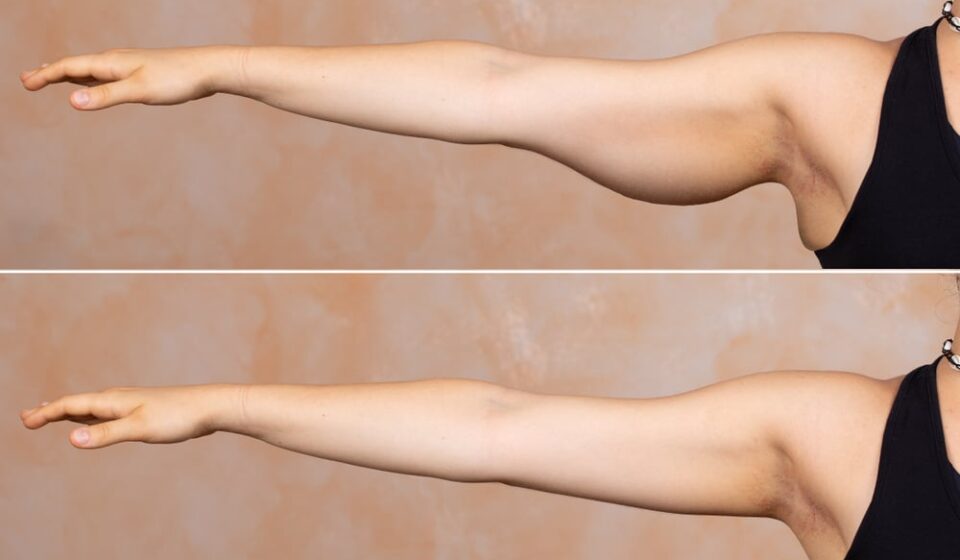
The bat wing appearance of upper arm fat becomes more pronounced with age — not just because fat increases, but because muscle decreases. As the triceps muscle underneath the fat loses mass through age-related sarcopenia (muscle loss), the overlying skin and fat hangs more loosely.
This means that addressing arm fat — particularly in people over 40 — requires both reducing fat AND building the underlying triceps muscle. Fat loss alone without muscle development often produces a deflated rather than toned appearance.
Genetics
Where your body stores fat and in what order it releases it has a strong genetic component. Some people are predisposed to carry more fat in their arms, while others naturally stay lean there even at higher overall body fat percentages.
This doesn’t make arm fat loss impossible — but it does mean that some people will need to reach lower overall body fat percentages before their arms respond visibly.
Hormonal Factors
In women, declining estrogen levels during perimenopause and menopause cause fat redistribution — including increased fat accumulation in the upper arms. As we cover in our article on how to lose weight during menopause, hormonal changes in midlife significantly affect body fat distribution and require specific strategies to address.
The Spot Reduction Reality
Before the solutions, the non-negotiable truth: you cannot specifically burn arm fat by doing arm exercises.
Tricep kickbacks, arm circles, bicep curls — these build the muscles in your arms (which is valuable) but they don’t preferentially burn the fat overlying those muscles. Fat is mobilized from stores throughout the body based on overall energy balance and hormonal signals — not based on which muscles are being used.
Research has tested this directly. Studies that had participants do hundreds of arm exercises over weeks found no preferential fat loss in the arms compared to control groups. The exercises built muscle — but the fat came off (or didn’t) based on overall calorie balance and genetics, not the exercises themselves.
This is actually good news in a way — the strategies that reduce arm fat are the same strategies that improve your overall body composition, health, and appearance everywhere.
What Actually Reduces Arm Fat
1. Overall Fat Loss Through a Calorie Deficit
The primary driver of arm fat loss is overall fat loss — and that requires a sustained calorie deficit through the combination of dietary and lifestyle strategies that drive fat loss everywhere.
For most people, arms are neither the first nor the last area to respond to fat loss — they tend to improve in the middle of a fat loss journey, after the face and upper body start responding but often before the lower body shows significant change.
The complete framework for fat loss is covered in our guide to how to get rid of belly fat — every principle applies to arm fat reduction equally.
2. Upper Body Strength Training — Building the Muscles That Define Your Arms
This is the component that most people underestimate — and it’s what separates people who get toned, defined arms from those who just get smaller arms.
Building the triceps, biceps, and shoulder muscles underneath the arm fat creates the shape and definition that emerges as fat reduces. Without this muscle development, fat loss from the arms often produces loose, undefined skin rather than the firm, toned appearance most people are aiming for.
The best exercises for arm definition:
Tricep Dips — the tricep (back of the upper arm) is the primary muscle responsible for the toned arm appearance. Tricep dips performed on a chair or bench are one of the most effective bodyweight tricep exercises. Hands on the edge of a bench behind you, feet extended forward, lower by bending elbows to 90 degrees, press back up.
Close-Grip Push-Ups — hands placed closer together than standard push-ups (index fingers touching or close) shifts more emphasis to the triceps. An excellent bodyweight movement that can be progressed from knees to full to decline.
Overhead Tricep Extension — hold a dumbbell or water bottle in both hands above your head, lower behind your head by bending elbows, extend back up. This puts the tricep in its fully stretched position and produces excellent muscle development.
Tricep Kickbacks — hinge forward with a flat back, upper arm parallel to the floor, extend the forearm back until the arm is straight. Squeeze the tricep at full extension. One of the most direct tricep isolation exercises.
Bicep Curls — while the tricep is more visible from behind and more responsible for the toned arm appearance, building the bicep rounds out the arm shape and contributes to overall arm definition.
Lateral Raises — raise arms out to the sides to shoulder height, controlling the descent. Builds the medial deltoid (shoulder) that creates the rounded, defined shoulder shape that makes arms look more toned overall.
Overhead Press — press weights from shoulder height to full extension overhead. One of the best compound movements for overall shoulder and arm development. Can be performed seated or standing with dumbbells.
Three sessions per week of these movements, progressively increasing resistance, produces meaningful arm muscle development within 8–12 weeks.
3. High Protein Intake
Protein is essential for building the arm muscle that creates the toned appearance alongside fat loss — and it simultaneously supports the overall fat loss that reduces the overlying fat layer.
As we cover in our guide to how much protein you actually need per day, adequate protein intake (0.7–1g per pound of bodyweight) is the most important dietary variable for body composition — and this applies specifically to the arm muscle development that makes arm fat loss look its best.
4. Don’t Neglect Cardio — But Don’t Overdo It
Cardio contributes to the overall calorie deficit that drives fat loss — including from the arms. However, excessive cardio without strength training produces the worst possible outcome for arm appearance: fat loss without muscle development, resulting in loose, undefined arms.
The optimal combination — as covered throughout this blog — is strength training as the primary exercise modality with cardio as a supplement. For arms specifically, this means the upper body strength exercises above are more important than any amount of cardio.
Daily walking (8,000–10,000 steps) as discussed in our guide to best exercises to lose belly fat for beginners provides meaningful calorie burn without the muscle-wasting risk of excessive cardio.
5. Address Loose Skin vs. Fat
As people lose weight — particularly significant amounts — what appears to be remaining arm fat is sometimes loose skin rather than fat. Loose skin occurs when the skin has stretched over years of carrying excess weight and then lost the elasticity to fully contract when the weight is lost.
Distinguishing loose skin from fat: if you can pinch a thick layer between your fingers, it’s more likely fat. If the skin is thin and hangs loosely with minimal substance when pinched, it’s more likely loose skin.
Strategies that help loose skin:
- Slow, gradual fat loss preserves more skin elasticity than rapid weight loss
- Building muscle fills the space under the skin, reducing the loose appearance
- Adequate protein supports collagen production and skin elasticity
- Hydration supports skin quality
- Strength training is the single most effective strategy for improving the appearance of loose skin through muscle development underneath
For significant loose skin that remains after reaching a healthy weight, cosmetic procedures (brachioplasty — arm lift surgery) exist as options, though this is a significant surgical intervention warranted only in cases of significant functional or aesthetic impact.
6. Reduce Sodium and Manage Fluid Retention
The arms — like the face and lower body — can retain fluid that adds to their apparent size. High sodium intake, hormonal fluctuations, and poor sleep all contribute to arm fluid retention.
Reducing sodium to under 1,500mg per day for a week produces visible reduction in arm puffiness for many people — particularly in the hands and forearms. The strategies for reducing water retention covered in our article on how to lose water weight fast apply directly to arm appearance.
The Most Effective Arm-Slimming Workout (No Equipment)
Here’s a complete bodyweight arm workout that can be done anywhere in under 25 minutes:
Warm-up (2 minutes): Arm circles, shoulder rolls, light push-ups
Circuit (repeat 3 times, 60 seconds rest between circuits):
- Close-grip push-ups: 10–15 reps (or as many as possible)
- Tricep dips (using a chair): 12–15 reps
- Overhead tricep extension (water bottle): 15 reps
- Lateral raises (light dumbbells or water bottles): 12 reps
- Bicep curls (dumbbells or water bottles): 12 reps
Cool-down (2 minutes): Tricep stretch (arm behind head), cross-body shoulder stretch
Three sessions per week of this circuit, progressively making it harder over time (slower tempo, heavier objects, more reps), produces meaningful results within 8–12 weeks.
What to Expect and When
Weeks 1–4: Early strength gains, slight reduction in water retention from dietary changes. Scale possibly moving. Arms don’t look dramatically different yet but are getting stronger.
Weeks 4–8: Visible muscle development beginning. Fat loss starting to show. Arms feeling firmer.
Weeks 8–16: Meaningful changes in arm shape and size with consistent effort. The combination of reduced fat and increased muscle producing the toned appearance.
Months 4–6: Significant improvement in overall arm appearance for most people who have been consistent.
For women, arm fat often responds before lower body fat — making it one of the more encouraging areas to track early in a fat loss journey.
The Role of Diet in Arm Fat Loss
Diet does the heavy lifting for arm fat loss — not arm exercises. Creating the calorie deficit that drives overall fat loss is primarily a dietary intervention, with exercise contributing to the deficit and to the muscle development that shapes the result.
The specific dietary strategies most relevant to arm fat:
- High protein to support muscle development and fat loss simultaneously
- Elimination of liquid calories — particularly alcohol, which contributes to upper arm fat accumulation in many people
- Reduced sodium to manage fluid retention
- Anti-inflammatory eating to reduce the puffiness that can exaggerate arm fat appearance
These are the same strategies covered throughout our blog — which is the point. The fat loss approach that works everywhere works for arms too.
The Bottom Line
Losing arm fat requires two things working together: overall fat loss that reduces the fat layer, and upper body strength training that builds the muscle underneath.
Neither alone produces the best result. Fat loss without muscle development leaves loose, undefined arms. Muscle development without fat loss builds muscle hidden under a fat layer. The combination — which is the same approach we recommend throughout this blog — produces genuinely toned, defined arms.
Three sessions per week of tricep and upper body training. A moderate calorie deficit. Adequate protein. Daily walking. Seven to nine hours of sleep. Be consistent for 12 weeks before judging results.
The arms respond — they just need the right approach applied with sufficient patience.
Which arm exercise do you find most effective? Share in the comments — and if you have a favorite arm workout that fits into a busy schedule, drop it below.