
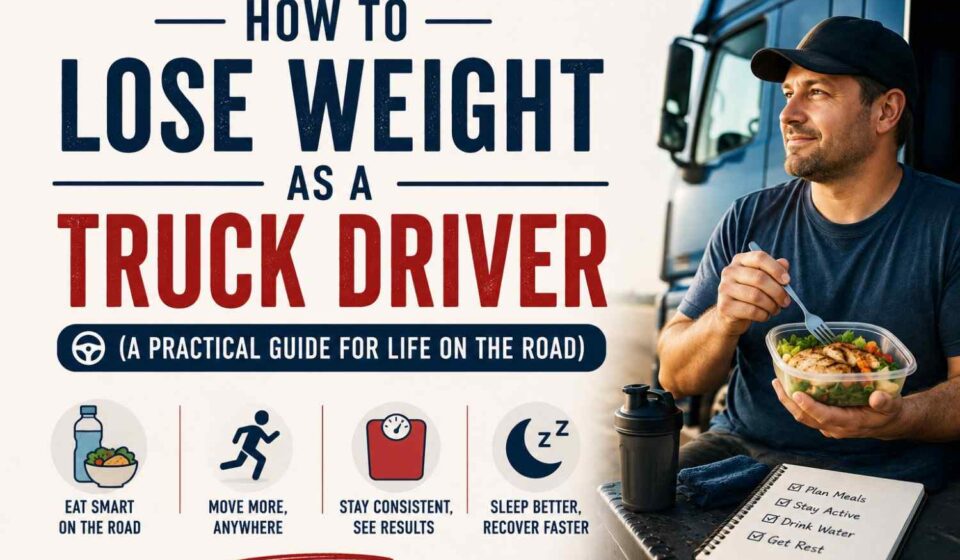

The unique challenges of truck driving and weight loss — and the specific strategies that work when you’re living out of a cab

Truck drivers face one of the most genuinely difficult weight loss environments that exists. Long hours of mandatory sedentary time. Limited access to healthy food. Disrupted sleep. High stress. Isolation. A schedule that makes consistent habits nearly impossible.
The obesity rate among commercial truck drivers is significantly higher than the general population — not because truck drivers lack willpower or don’t care about their health, but because the structural conditions of the job actively work against every healthy behavior.
This guide is written specifically for the realities of truck driving — not generic advice adapted from a gym-goer’s lifestyle, but strategies that work when you’re living out of a cab on interstates, eating from truck stops, and sleeping in 30-minute increments.
Why Truck Driving Makes Weight Loss So Hard
Mandatory Sedentary Time
A long-haul truck driver may be sitting for 10–11 hours per day while driving. This isn’t laziness — it’s the job. The sedentary time of driving dramatically reduces NEAT (non-exercise activity thermogenesis), which is the background daily movement that contributes significantly to calorie expenditure.
Someone who walks around an office job, takes stairs, and runs errands might accumulate 5,000–8,000 steps without trying. A driver might accumulate 1,000–2,000.
The Truck Stop Food Environment
Truck stops and interstate rest stops have improved somewhat — but the default food available remains heavily weighted toward fast food, processed snacks, and convenience store options that are high-calorie, high-sodium, and nutritionally poor.
Planning and preparation are essential — the food environment won’t cooperate without active intervention.
Disrupted and Insufficient Sleep
HOS (hours of service) regulations and delivery schedules mean sleep is often fragmented, insufficient, and at irregular times. Many drivers sleep in moving trucks with significant noise and vibration. As covered in our article on why sleep is the most underrated weight loss tool, poor sleep directly disrupts hunger hormones, worsens insulin sensitivity, and impairs fat loss — and it’s endemic to truck driving.
Chronic Stress
The cognitive demands of driving, traffic stress, delivery pressure, time away from family, and the isolation of long hauls produce chronic psychological stress that elevates cortisol — directly promoting fat storage, particularly visceral belly fat.

Irregular Meal Timing
Delivery schedules don’t accommodate regular mealtimes. Eating happens when it’s possible — which may be midnight, 5am, or whenever a delivery window allows. This irregular timing disrupts the body’s metabolic rhythms in ways similar to shift work.
Diet on the Road: The Foundation of Everything
Plan and Prepare Before You Leave
The single most important weight loss strategy for truck drivers: prepare food before each run. Whatever you bring in the cab is what you eat — and what you bring is entirely within your control in a way that truck stop options are not.
Cab-friendly food preparation:
Portable protein sources:
- Hard-boiled eggs (last 1 week refrigerated)
- Canned tuna, salmon, sardines (no refrigeration needed, fork or pull-tab opening)
- String cheese and babybel cheese (several days without refrigeration if kept cool)
- Protein shakes and protein powder (shake with water)
- Jerky (beef, turkey, or salmon — high protein, portable, no refrigeration)
- Rotisserie chicken (a whole one lasts 2–3 days refrigerated)
Portable healthy carbs and fiber:
- Apples, oranges, bananas — hardy fruits that travel well
- Baby carrots and celery sticks
- Whole grain crackers
- Individual oat packets (just needs hot water from a truck stop)
- Nuts (almonds, walnuts) — calorie-dense so portion control matters, but excellent nutrition
Truck cab equipment worth investing in:
- 12V refrigerator/cooler — this is the single most important equipment investment for a driver’s health. Models designed for truck cabs run off the cigarette lighter or APU and maintain food at safe temperatures. $150–$300 investment that pays for itself in food quality and savings.
- 12V kettle or travel mug warmer — allows oatmeal, instant soups, and hot drinks
- Small cooler with ice for daily use if a full refrigerator isn’t available
Make Truck Stops Work for You
When you do eat at truck stops, most have some healthy options if you know what to look for:
Best options at most truck stops:
- Subway (choose whole grain, lean protein, load on vegetables, avoid heavy sauces)
- Salad bars where available — load protein (grilled chicken, eggs, cheese) onto greens
- Rotisserie chicken sections in the food service area
- Greek yogurt from convenience sections
- Hard-boiled eggs from the refrigerated section
- Nuts and seeds from the snack section (avoid chips and processed snacks)
What to avoid:
- Fried foods — almost always available and almost always the worst choice
- Large fast food combo meals
- Energy drinks and sweetened beverages (switch to black coffee or water)
- Gas station pastries and donuts
The restaurant strategy: When you stop at a sit-down restaurant, order protein (grilled chicken, fish, lean beef) with vegetables rather than sandwiches, burgers, or pasta. Ask for sauces on the side. Skip the bread basket.
Protein First — Every Meal
Without access to carefully balanced meals, focusing on one simple rule makes decision-making easier: eat protein first at every meal.
Protein is the most satiating macronutrient — it suppresses hunger most effectively and for the longest time. A meal or snack built around protein produces better hunger management for the next several hours than an equivalent calorie meal built around carbohydrates.
On the road: a can of tuna, a handful of jerky, a protein shake, hard-boiled eggs, or rotisserie chicken as the core of every eating occasion keeps protein high even when food options are limited.
As covered in our guide to how much protein you actually need per day, 0.7–1g per pound of bodyweight is the target — and it’s achievable on the road with planning.
Eliminate Liquid Calories
This single change makes a larger caloric difference than most other interventions for many truck drivers. Energy drinks, sodas, sweetened coffee drinks, and juice add hundreds of calories per day with essentially no satiety benefit.
Switching to water, black coffee, or unsweetened tea as the default reduces daily calorie intake by 300–500 calories for heavy liquid calorie consumers — without changing a single food.
Keep a large water bottle in the cab and refill it at every stop. Adequate hydration also reduces the fatigue that drives energy drink consumption.
Movement as a Truck Driver: Making the Most of Limited Opportunities
You can’t walk 10,000 steps while driving. But you can use the stops, pre-trip, post-trip, and rest time for movement that accumulates meaningfully.
At Every Stop
Every fuel stop, weigh station, rest area, and delivery is an opportunity for movement. Even 5–10 minutes of walking at each stop accumulates meaningfully across a driving day.
At delivery locations: Walk the perimeter of the lot while waiting. Most drivers spend significant time waiting at docks — this time can include gentle walking.
At rest areas: A 10-minute walk around the rest area rather than staying in the cab adds 1,000+ steps and breaks up the sitting.
At fuel stops: Walk the distance between the truck and the store rather than taking the shortest path.
The goal: accumulate 5,000+ steps across all stops during a driving day — achievable with intentional movement at each stop, even without dedicated exercise time.
Pre-Trip and Post-Trip Exercise
The inspection at the start and end of each run requires walking around the truck — this is built in. Extend this with intentional exercise:
- 10–15 minutes of walking before a shift starts
- 10–15 minutes of walking after a shift ends
- Bodyweight exercises in the parking area: push-ups, squats, lunges, jumping jacks — no equipment required
As covered in our article on how to build a home workout routine, effective bodyweight exercise requires no equipment and minimal space — applicable to truck stop parking lots.
Resistance Bands in the Cab
A set of resistance bands ($15–20) fits in a small bag and enables a complete upper body and core workout anywhere. Bands can be used:
- Attached to the truck door frame for rows and pull-downs
- Underfoot for bicep curls and shoulder presses
- Around the thighs for hip exercises
15–20 minutes of resistance band training at a rest stop or before bed in the cab provides meaningful muscle maintenance that supports metabolic rate during otherwise sedentary driving days.
The 34-Hour Reset
When HOS regulations require a 34-hour restart, this is an opportunity for more substantial exercise. Use this time for longer walks, a gym visit (many truck stops have shower facilities that indicate gym access), or more demanding bodyweight training.
Sleep: Maximizing Rest Quality in the Cab
Sleeping in a truck cab is challenging — noise, vibration, temperature, and the necessity of parking in active lots all disrupt sleep quality. But improvement is possible:
Blackout curtains: Essential — a dark sleeping environment is critical for sleep quality, and truck cabs let in significant light without them. Purpose-made truck blackout curtains are available and worth the investment.
White noise: A fan or white noise app masks parking lot noise, other trucks, and traffic that disrupts sleep.
Temperature control: Keep the cab cool (65–68°F) for optimal sleep. The APU (auxiliary power unit) should run heating and cooling rather than idling the main engine where permitted.
Earplugs: Simple and cheap — dramatically reduce noise disruption.
Consistent sleep schedule: Where the schedule allows, sleeping and waking at similar times each day helps the circadian rhythm adapt to the driving lifestyle.
Stress Management on the Road
The isolation, family separation, delivery pressure, and cognitive demands of truck driving produce chronic stress that directly impairs fat loss. Active daily stress management is worth incorporating:
Phone calls with family and friends during breaks maintain the social connection that buffers stress. Don’t use driving time for this — use stops.
Podcasts and audiobooks provide cognitive engagement and connection to the broader world during driving hours — reducing the psychological isolation of long hauls.
Walking at stops is both exercise and stress reduction — the most accessible cortisol-lowering activity available.
Limit news and angry talk radio during drives — sustained engagement with stressful content elevates cortisol throughout the driving day.
Realistic Expectations
Given the structural challenges of truck driving, realistic expectations are important:
- Weight loss of 0.5–1 lb per week is achievable with consistent dietary management and movement at stops
- Progress will be slower than someone with a standard schedule and gym access — and that’s appropriate given the genuine difficulty of the environment
- Weeks with particularly demanding schedules or fewer stop opportunities will show less progress — this is situational, not permanent
The truck driver who loses 1 lb per week consistently achieves 50 lbs in a year — genuinely transformative results from consistent application of the strategies above.
When to Consider Medical Support
For truck drivers who have implemented dietary strategies and movement at stops consistently and still struggle with weight — particularly those who may have developed metabolic conditions (insulin resistance, sleep apnea, high blood pressure) from years of the truck driving lifestyle — medical evaluation is worth pursuing.
ClinicSecret offers telehealth medical evaluations that can be done anywhere with a phone or laptop — making it accessible even from the road. If prescription weight loss treatment is appropriate, medications can often be prescribed and delivered to a home address or arranged for pickup.
[Check if you qualify at ClinicSecret →]
This is a paid partnership. ClinicSecret is a licensed telehealth provider. Medication is only prescribed following a medical consultation and is not guaranteed.
The Bottom Line
Losing weight as a truck driver is genuinely harder than for most people — the environment actively works against every healthy behavior. But it’s not impossible. The approach that works:
- Prepare food before each run — what you bring is what you eat
- Invest in a cab refrigerator — the single most impactful equipment purchase
- Protein at every eating occasion — from portable, non-refrigeration sources
- Eliminate liquid calories — switch to water and black coffee
- Move at every stop — 5–10 minutes per stop accumulates meaningfully
- Resistance bands in the cab for strength training at rest stops
- Maximize sleep quality with blackout curtains, white noise, and temperature control
- Active stress management — calls with family, walking, audiobooks
For the foundational fat loss strategies that apply on the road, our guide to how to get rid of belly fat covers everything in one place.
Are you a truck driver who’s successfully managed weight on the road? Share your strategies in the comments — practical tips from people living this lifestyle are invaluable for others in the same situation.