
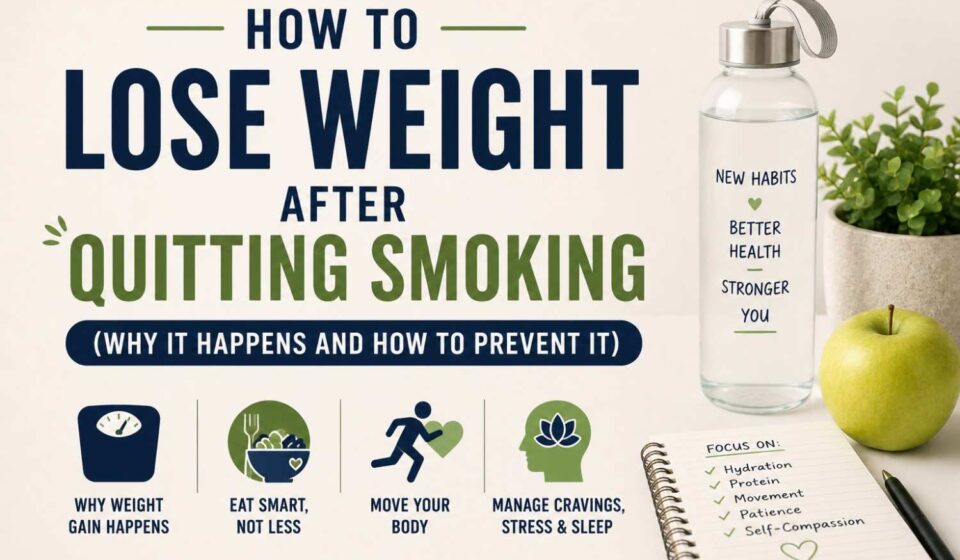
How to Lose Weight After Quitting Smoking (Why It Happens and How to Prevent It)

Weight gain after quitting smoking is real, common, and manageable — here’s exactly what causes it and what to do
Quitting smoking is one of the most significant health improvements a person can make. But one of the most common reasons people relapse or never attempt quitting is fear of weight gain — and the fear is not unfounded. The average person gains 4–10 lbs in the first year after quitting smoking.
Understanding exactly why this happens — and implementing specific strategies to address each cause — makes managing weight after quitting both possible and realistic without having to choose between your waistline and your health.

Why People Gain Weight After Quitting Smoking
Understanding the mechanisms makes the solutions make sense. Weight gain after quitting isn’t random — it has specific, addressable causes.
Nicotine’s Metabolic Effects
Nicotine is a metabolic stimulant. It:
- Raises resting metabolic rate by approximately 7–15% — meaning smokers burn 150–300 more calories per day than they would as non-smokers
- Suppresses appetite directly through effects on the hypothalamus
- Delays gastric emptying, reducing hunger
- Reduces the rewarding properties of food in the brain’s reward centers
When nicotine is removed, all of these effects reverse simultaneously:
- Metabolic rate drops back to baseline
- Appetite increases
- Food becomes more rewarding and pleasurable
- Hunger signals normalize (or overcorrect)
This metabolic shift alone — the drop in resting metabolic rate — accounts for approximately 2–3 lbs of weight gain in the first months without any change in eating behavior.
Oral Fixation and Behavioral Substitution
Smoking involves specific hand-to-mouth behaviors, oral stimulation, and regular behavioral breaks throughout the day. When cigarettes are removed, the behavioral pattern remains — seeking something to do with the hands, something for the mouth, something to fill the “smoke break” ritual.
Food — particularly snacks — is the most common substitution. Eating fills the same behavioral role, satisfying the oral fixation and providing a reason for the break. This behavioral substitution is a primary driver of post-cessation eating increases.
Increased Food Enjoyment
Smoking impairs taste and smell — significantly. Within days to weeks of quitting, taste and smell begin recovering toward normal. Food that tasted bland and uninteresting while smoking suddenly tastes genuinely better.
This sensory recovery makes food more rewarding and more enjoyable — naturally increasing the desire to eat more of it.
Stress and Emotional Eating
Smoking is a coping mechanism for stress, anxiety, and difficult emotions — nicotine produces genuine anxiolytic and mood-elevating effects. When this tool is removed, the stress and emotional regulation function it served needs to be replaced.
For many people, food fills this role — providing the comfort and immediate relief that cigarettes previously provided.
Reduced Activity
Many smokers take multiple smoke breaks throughout the day — these are actually breaks involving brief walking to a designated smoking area. Quitting removes these built-in movement breaks. For some people, the reduction in daily walking from eliminated smoke breaks meaningfully reduces daily step count.
The Honest Perspective: Weight Gain vs. Health Gain
Before strategies, a moment of honest perspective:
Even gaining 10–15 lbs from quitting smoking represents a net positive health outcome for most people. The cardiovascular risk of smoking is dramatically greater than the health risk of modest weight gain. Quitting smoking is almost always the right decision regardless of what happens to weight.
The goal of this guide is to minimize unnecessary weight gain — not to use weight concern as a reason to keep smoking or delay quitting. The two goals are compatible but quitting always takes priority.
Strategy 1: Address the Metabolic Rate Drop With Strength Training
The drop in resting metabolic rate when nicotine is removed is real — but it can be countered by building lean muscle through strength training.
Muscle tissue burns significantly more calories at rest than fat tissue. Three sessions per week of compound strength training — squats, deadlifts, rows, presses — starts building the lean muscle that raises resting metabolic rate and partially compensates for the nicotine-withdrawal metabolic drop.
Starting strength training at the same time as quitting smoking is one of the most effective dual strategies available — the exercise provides stress relief (a nicotine substitute function), builds muscle that counters the metabolic rate drop, and provides structure and purpose that helps fill the behavioral void left by cigarettes.
As covered in our guide to best exercises to lose belly fat for beginners, compound movements produce the most metabolic benefit per unit of training time.
Increase Daily Walking
Replacing the movement of smoke breaks with intentional walking maintains activity levels and adds calorie burn. A 5-minute walk every time you’d have taken a smoke break is both behavioral substitution (doing something with the break) and meaningful additional daily movement.
As covered in our guide to how to lose weight by walking, consistent daily walking is one of the most effective and sustainable fat loss activities — and the timing mirrors the behavioral pattern of smoke breaks in a way that helps manage cravings.
Strategy 2: Manage the Behavioral Substitution
The hand-to-mouth behavior and oral fixation of smoking need healthy substitutes — or food will fill that role by default.
Behavioral substitutes for smoking:

Gum and mints: Sugar-free gum provides oral stimulation without calories. Many former smokers keep gum available as a constant behavioral substitute.
Toothpicks and cinnamon sticks: Provide oral fixation without food.
Water: Drinking water through the moments of craving provides a hand-to-mouth behavior and oral activity that occupies the same behavioral space.
Vegetables as snacks: If you’re going to snack in response to the behavioral drive, celery sticks, carrot sticks, and cucumber provide crunch and oral satisfaction with essentially no caloric impact.
Non-food activities for break time: Walking, breathing exercises, stretching, brief phone calls — filling the behavioral “break” with movement or connection rather than food.
Strategy 3: Manage Increased Appetite
The appetite increase after quitting is real — but it’s manageable with the right dietary approach.
High protein intake is the most effective appetite management tool. As covered in our guide to how much protein you actually need per day, protein is the most satiating macronutrient — it suppresses ghrelin (hunger hormone) and stimulates fullness hormones more powerfully than carbohydrates or fat. Building every meal around adequate protein directly counters the appetite increase of nicotine withdrawal.
High fiber intake extends the feeling of fullness and slows digestion. Lentils, beans, oats, vegetables, and fruit provide the fiber that keeps hunger manageable between meals.
Regular meal timing prevents the extreme hunger that makes the behavioral urge to snack overwhelming. Arriving at any eating occasion very hungry when cravings are also running high makes dietary control significantly harder. Consistent mealtimes with protein and fiber maintain stable hunger levels.
Manage calorie-dense snacks. If the behavioral drive to eat at break times is strong, the calorie content of what you eat during those moments matters enormously. Replacing cigarettes with nuts (healthy but calorie-dense), biscuits, chocolate, or chips at multiple daily breaks adds hundreds of calories per day. Replacing them with vegetables, fruit, or a small protein source keeps the behavioral substitution without significant caloric impact.
Strategy 4: Address Stress and Emotional Eating
Quitting smoking removes a significant coping mechanism. The stress and emotional regulation function it served needs active replacement — or food will fill that role.
Exercise as the primary stress substitute: Physical activity produces genuine stress relief through the same neurochemical pathways that nicotine did — dopamine, endorphin, and serotonin release. Regular exercise during the quitting period provides both the behavioral substitution and genuine emotional benefit that supports staying quit.
Breathing exercises: The deep breathing of smoking (taking a slow drag) activates the parasympathetic nervous system. Deep breathing exercises replicate this physiological effect — the slow, controlled breath produces a real calming response. This can be practiced anywhere a craving hits.
Social support: The social ritual of smoking — going outside with others, shared breaks — is a genuine social loss when quitting. Intentionally replacing this with other social connection (walks with colleagues, phone calls, scheduled social activities) maintains the social function without the tobacco.
Professional support for nicotine replacement and cessation: Combining behavioral strategies with nicotine replacement therapy (patches, gum, lozenges) or prescription cessation medications (varenicline/Champix, bupropion) reduces withdrawal intensity and makes behavioral strategies more effective. These are genuinely effective tools — using them isn’t weakness.
Strategy 5: Don’t Diet Aggressively While Quitting
This is important: attempting aggressive calorie restriction at the same time as nicotine withdrawal creates unnecessary physiological and psychological stress that makes both efforts more likely to fail.
The priority during the first 1–3 months of quitting is staying quit. If some modest weight gain occurs during this period while focusing primarily on not smoking — this is acceptable and addressable later.
A moderate, sustainable dietary approach during this period — high protein, high fiber, minimal added sugar and processed food, no liquid calories — provides good nutritional quality without the added stress of strict calorie counting during an already demanding time.
Once quitting feels stable (typically 3–6 months in), weight loss becomes a more appropriate primary focus and more deliberate dietary management can be implemented.
Strategy 6: Plan for the Peak Craving Period
The first 2–4 weeks after quitting are typically the most intense for cravings and behavioral substitution eating. Planning specifically for this period reduces its impact:
- Stock the home with vegetables, fruit, protein-rich snacks, and gum — and minimize calorie-dense snack foods
- Plan exercise for break times where possible
- Tell people close to you what you’re doing and what support looks like
- Have breathing exercises and craving management strategies prepared before you need them
The peak period passes — craving intensity and frequency reduce significantly after the first month. Knowing this helps maintain perspective during the hardest weeks.
What If You’ve Already Gained Weight After Quitting?
If you’ve already quit and gained weight — congratulations on quitting. The weight gain is addressable without going back to smoking.
The approach is the standard fat loss approach — calorie deficit, high protein, strength training, daily walking — applied now that the quitting itself is established. The metabolic rate will have partially normalized within 6–12 months of quitting (though it won’t fully return to pre-smoking-career levels for everyone).
As covered in our guide to how to lose weight with a calorie deficit, a moderate deficit of 400–500 calories per day produces 0.5–1 lb of fat loss per week — entirely through the dietary and lifestyle approaches that work regardless of smoking history.
The weight gained after quitting can be lost. It’s not permanent and it doesn’t undo the health benefits of quitting.
The Bottom Line
Weight gain after quitting smoking is caused by specific, addressable mechanisms — nicotine’s metabolic effects, behavioral substitution, increased food enjoyment, and stress-related eating. Managing each mechanism with targeted strategies minimizes weight gain without sacrificing the quit.
The approach that works:
- Start strength training at the same time as quitting — counters the metabolic rate drop
- Replace smoking breaks with walking — behavioral substitution plus calorie burn
- High protein and fiber at every meal — manages the appetite increase
- Healthy oral substitutes (gum, vegetables, water) — addresses the behavioral fixation
- Exercise as primary stress substitute — replaces nicotine’s emotional regulation function
- Moderate dietary approach during the first 3 months — don’t over-restrict while withdrawal is intense
Quitting smoking is the right decision regardless of weight. But managing weight during and after quitting makes staying quit easier — and the strategies here support both goals simultaneously.
For the complete fat loss framework that applies after quitting, our guide to how to get rid of belly fat covers all the foundational strategies.
Have you quit smoking and managed to control your weight — or are you trying to? Share what strategies helped in the comments.
Stop Wondering What to Eat This Week
Get my free 7-Day High-Protein Weight Loss Meal Plan delivered straight to your inbox — a simple week of satisfying, protein-focused meals designed to make healthy eating easier without complicated calorie tracking.
- 7 full days of breakfast, lunch, dinner & snacks
- One complete shopping list for the whole week
- A quick high-protein food cheat sheet
- Simple daily tips to help you stay on track
Free PDF • Delivered by email • Unsubscribe anytime
Check your inbox 💜
Your free 7-day high-protein meal plan is on its way.