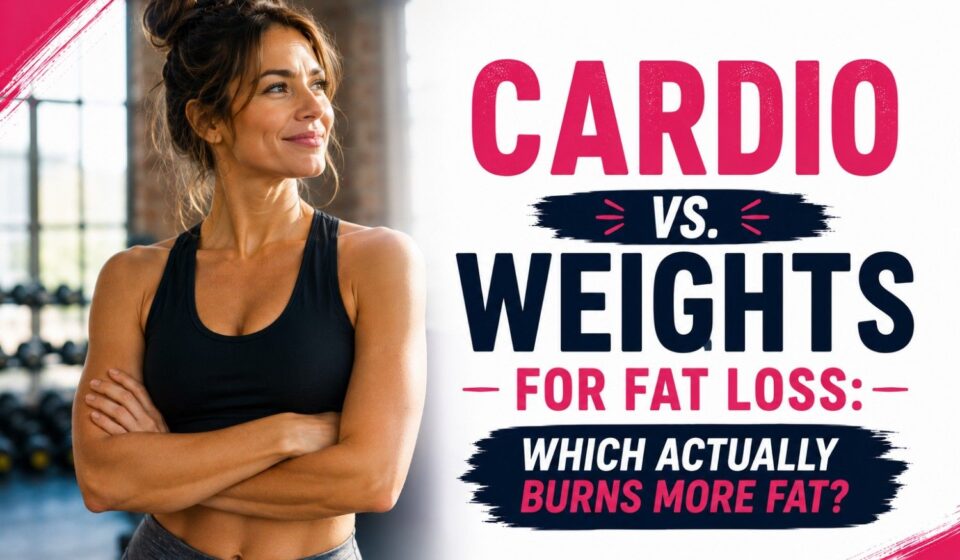
Cardio vs. Weights for Fat Loss: Which Actually Burns More Fat?

The gym debate that’s been going on for decades — here’s what the research actually says

Walk into any gym and you’ll find two camps: the cardio enthusiasts on the treadmills and bikes, and the strength training devotees on the weight floor. Both groups believe their approach is superior for fat loss. Both have a point — and both are missing the full picture.
The “cardio vs. weights” debate is one of the most persistent in fitness culture. Here’s what the research actually shows, why the framing of the question is part of the problem, and what the optimal approach for fat loss actually looks like.
What the Research Shows
Cardio Burns More Calories During Exercise
This part is straightforward and true: for the same duration of exercise, moderate-to-vigorous cardio typically burns more calories than strength training.
A 45-minute moderate run burns approximately 400–600 calories. A 45-minute strength training session burns approximately 200–400 calories. Head-to-head, cardio wins the calories-during-exercise comparison.
Strength Training Burns More Calories After Exercise
Here’s where it gets interesting. Strength training produces significant EPOC (Excess Post-Exercise Oxygen Consumption) — elevated metabolic rate for up to 24–48 hours after training as the body repairs muscle tissue.
This afterburn effect means the total calorie burn of a strength training session extends well beyond the gym. A session that burns 250 calories during training may burn an additional 100–150 calories in the recovery period.
Cardio produces EPOC too — but it’s smaller and shorter-lasting than the EPOC from intense strength training.
Strength Training Raises Resting Metabolic Rate Permanently
This is the most important long-term difference, and the one most often overlooked.
Each pound of muscle burns approximately 6 calories per day at rest. Adding 5 lbs of muscle — entirely achievable over several months of consistent training — raises resting calorie burn by approximately 30 calories per day, permanently, without any additional effort.
Over a year, that’s 10,950 additional calories burned — the equivalent of roughly 3 lbs of fat — from doing nothing except maintaining that muscle.
Cardio doesn’t build muscle. In fact, excessive cardio without adequate protein and strength training can contribute to muscle loss, which lowers resting metabolic rate over time.
Studies Comparing Both Directly
When researchers have conducted head-to-head comparisons:
For scale weight: Cardio typically produces more scale weight reduction in shorter studies — because it burns more calories per session and doesn’t add muscle weight.
For fat loss specifically: The outcomes are more comparable than the scale weight difference suggests. Strength training often produces similar or greater fat loss alongside muscle gain — meaning the scale shows less change despite better body composition improvement.
For body composition (the actual goal for most people): Strength training consistently wins. Studies comparing cardio-only, weights-only, and combined approaches consistently find that the combined approach produces the best body composition outcomes — and the weights-only approach often produces better body composition than cardio-only, despite similar or less scale weight loss.
The Body Composition Distinction
This is the key insight that the “cardio vs. weights” framing misses: scale weight and body composition are different things.
Cardio can produce a lower number on the scale while doing little to change the ratio of fat to muscle. Strength training can produce a similar or lower number on the scale with dramatically better fat-to-muscle ratios.
The “toned” appearance that most people are actually aiming for — visible muscle definition, less soft fat — comes from the combination of fat loss and muscle development that strength training provides. Cardio alone, even if it produces significant scale weight loss, often leaves people looking like a smaller version of the same body rather than a leaner, more defined version.
What Each Type of Exercise Is Actually Best For
Cardio Is Best For:
Cardiovascular health: Aerobic exercise produces specific cardiovascular adaptations — improved cardiac efficiency, reduced resting heart rate, better blood pressure regulation — that strength training doesn’t fully replicate.
High calorie burn per session: For people who want to eat more while maintaining a deficit, cardio provides more calorie burn per unit of time than strength training.
Mental health and stress reduction: Steady-state cardio — particularly walking, running, and cycling — has strong evidence for cortisol reduction and mood improvement.
Accessibility and habit formation: Walking, jogging, and cycling require minimal equipment and skill, making them accessible starting points for people new to exercise.
As covered in our guides to how to lose weight running, how to lose weight cycling, and how to lose weight swimming, these modalities all produce real fat loss results and cardiovascular benefits.
Strength Training Is Best For:
Long-term metabolic rate: Building muscle raises the calories burned at rest — the most sustainable fat loss strategy available.
Body composition improvement: Producing the lean, defined appearance that comes from less fat and more muscle simultaneously.
Insulin sensitivity: Skeletal muscle is the primary site of glucose uptake — more muscle means better blood sugar regulation and reduced visceral fat storage.
Bone density: Particularly important for women, especially post-menopause.
Functional strength: The strength that makes daily life easier and reduces injury risk.
EPOC: Extended post-exercise calorie burn that cardio doesn’t match.
The Real Answer: Both, Combined
The research on this is remarkably consistent: the combination of strength training and cardio produces better fat loss and body composition outcomes than either alone.
A meta-analysis of 66 randomized controlled trials found that combined exercise programs produced significantly greater fat loss than either cardio-only or resistance-only programs.
The optimal combination for most people:
3x strength training per week: Full body compound movements (squats, deadlifts, rows, presses). Builds the muscle that raises resting metabolic rate and produces body composition improvement.
Daily walking: As covered in our guide to how to lose weight by walking, consistent daily walking of 8,000–10,000 steps provides meaningful calorie burn, cortisol reduction, and cardiovascular benefit without the recovery demands of vigorous cardio. This is the cardio component most people can actually sustain every day.
1–2x HIIT or cardio sessions per week: For additional calorie burn and cardiovascular adaptation. As covered in our guide to HIIT for beginners, even one weekly HIIT session produces meaningful metabolic and cardiovascular benefits.
This combination — 3 strength sessions + daily walking + 1–2 cardio sessions — is the most evidence-backed exercise approach for fat loss and body composition improvement.
If You Can Only Do One
If time, access, or preference forces a choice between cardio-only or weights-only:
For long-term fat loss and body composition: choose strength training.
The resting metabolic rate benefits, body composition improvements, and long-term sustainability of strength training make it the higher-leverage choice for most people’s actual goals.
For cardiovascular health, stress management, and accessibility: choose cardio.
If cardio is what you’ll actually do consistently when strength training isn’t an option, consistent cardio produces real fat loss through the calorie deficit it supports — even without the metabolic rate and body composition benefits of weights.
The hierarchy:
- Combined approach (best)
- Strength training + daily walking (very good)
- Strength training alone (good)
- Cardio + daily walking (good)
- Cardio alone (acceptable)
- Nothing (not good)
Any exercise is better than none. The best exercise program is the one you’ll actually do consistently.
The Diet Factor — More Important Than Either
Here’s the uncomfortable truth that the cardio vs. weights debate often obscures: diet drives 70–80% of fat loss results, regardless of which exercise approach you choose.
Someone who strength trains 3x per week and maintains a 500-calorie dietary deficit will lose significantly more fat than someone who does cardio 6x per week with no dietary management. The exercise is not the primary driver — the diet is.
As covered throughout this blog, particularly in our guide to how much protein you actually need per day and our complete guide to how to get rid of belly fat, diet is the foundation that exercise supports — not the other way around.
Practical Recommendations by Goal
Goal: Maximum fat loss in minimum time → Strength training 3x + HIIT 2x + daily walking + calorie deficit
Goal: Body composition improvement (more muscle, less fat) → Strength training 3x + daily walking + adequate protein
Goal: Sustainable long-term weight management → Strength training 2–3x + daily walking + any cardio you enjoy
Goal: Cardiovascular health + fat loss → 3x cardio (running, cycling, swimming) + 2x strength training + daily walking
Goal: I hate the gym and just want to lose weight → Daily walking (8,000–10,000 steps) + dietary management. This alone produces real fat loss and is sustainable indefinitely.
The Bottom Line
Neither cardio nor weights is definitively superior for fat loss — the question is too simplistic.
Cardio burns more calories during exercise. Strength training burns more calories after exercise and permanently raises resting metabolic rate. Strength training produces better body composition outcomes. Cardio provides specific cardiovascular benefits that strength training doesn’t fully replicate.
The optimal approach uses both: strength training as the metabolic and body composition foundation, daily walking as the sustainable daily calorie burn, and cardio sessions for additional calorie deficit and cardiovascular health.
If you can only do one: strength training wins for long-term fat loss and body composition. Cardio wins for accessibility and cardiovascular health.
And regardless of which you choose: diet is more important than either.
For the complete fat loss framework that combines the right exercise approach with the dietary foundation that drives results, our guide to how to get rid of belly fat covers everything in one place.
Are you primarily a cardio person, a weights person, or do you combine both? Share in the comments — and whether you’ve noticed a difference in body composition results between the approaches.