
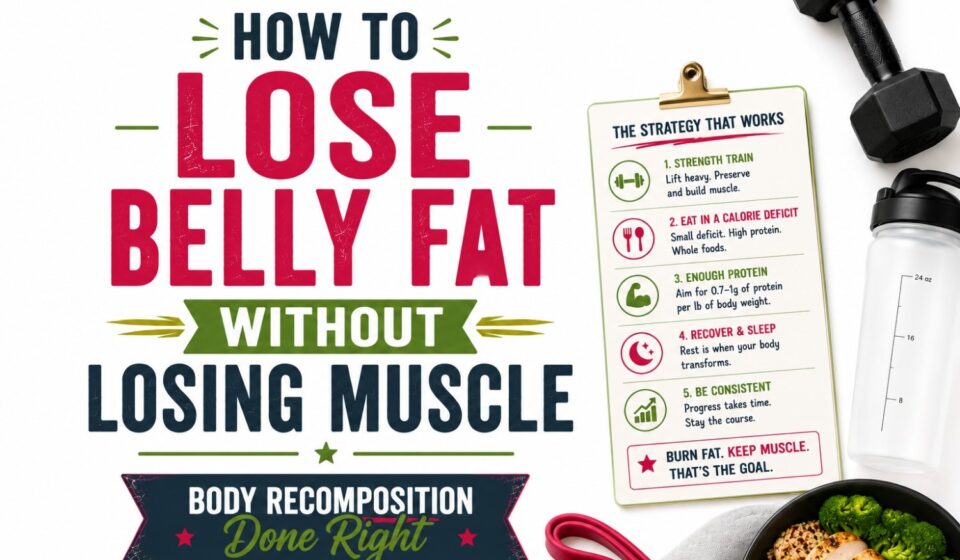

The goal isn’t just less fat — it’s less fat and more muscle. Here’s exactly how to achieve both.

Most people who say they want to “lose weight” actually want something more specific: they want less belly fat and more visible muscle. Less soft, more defined. The number on the scale matters less than the ratio of fat to muscle underneath it.
This is body recomposition — simultaneously reducing fat while preserving or building muscle — and it’s entirely achievable with the right approach. The wrong approach (aggressive restriction with no strength training) produces weight loss, but not the transformation most people are actually after.
Here’s exactly how to lose belly fat specifically while keeping the muscle that makes the result look good.
Why Standard Dieting Destroys Muscle
When you restrict calories without the right interventions, the body doesn’t exclusively burn fat for energy. It breaks down muscle protein alongside fat to meet its energy needs.
At a 500-calorie daily deficit without strength training or adequate protein, approximately 20–30% of weight lost comes from lean mass (muscle, bone mineral, organ tissue) rather than fat. For every 10 lbs lost this way, 2–3 lbs is muscle.
The consequences:
- Lower resting metabolic rate (less muscle burns fewer calories at rest)
- Worse body composition at the goal weight (smaller but not more defined)
- Greater risk of weight regain (lower metabolic rate makes maintenance harder)
- The “skinny fat” appearance — reduced weight but no visible muscle definition
The alternative — losing fat while preserving or building muscle — requires specific interventions that change what the body burns when in a calorie deficit.
The Four Pillars of Fat Loss Without Muscle Loss
Pillar 1: Adequate Protein — The Non-Negotiable
Protein is the most important single intervention for preserving muscle during fat loss. It works through two mechanisms:
Signaling: High dietary protein tells the body there’s adequate amino acid availability — reducing the stimulus to break down muscle protein for energy or gluconeogenesis.
Substrate: Adequate protein provides amino acids for muscle protein synthesis, supporting the maintenance and growth of existing muscle tissue.
The target: 0.8–1.2g of protein per pound of bodyweight per day during active fat loss. This is higher than standard recommendations because the calorie deficit itself increases protein needs — more protein is needed to prevent the muscle loss that a deficit would otherwise promote.
For a 170 lb person: 136–204g of protein per day, distributed across meals (ideally 30–40g per meal).
As covered in our guide to how much protein you actually need per day, this is the single most important dietary variable for body composition — and its importance increases during fat loss.
Best protein sources for body recomposition:
- Chicken breast (31g per 100g)
- Canned tuna (25g per can)
- Eggs (6g per egg)
- Greek yogurt (17–20g per cup)
- Cottage cheese (22g per cup)
- Salmon (25g per 100g)
- Lentils (18g per cup cooked)
Pillar 2: Strength Training — The Muscle Preservation Signal
Strength training provides the physiological signal that tells the body to preserve and build muscle even while in a calorie deficit.
Without this signal, the body has no reason to maintain metabolically expensive muscle tissue when calories are scarce. With consistent strength training, the body receives a clear message: this muscle is being used and needed, prioritize preserving it.
The minimum effective dose for muscle preservation:
- 3 sessions per week
- Compound movements (squats, deadlifts, rows, presses)
- Progressive overload (attempting to lift slightly more or do slightly more volume than the previous session)
Important nuance for belly fat specifically: You cannot spot-reduce fat from the belly through abdominal exercises. Crunches and planks don’t burn belly fat — they build the muscles underneath it. Belly fat reduces through overall calorie deficit. The abdominal muscles become visible when enough belly fat has been lost to reveal them.
That said, full body strength training — not just ab work — reduces visceral belly fat specifically through improving insulin sensitivity, and reveals muscle definition as fat reduces.
Pillar 3: A Moderate Calorie Deficit — Not Aggressive
The size of the calorie deficit directly affects the muscle-to-fat ratio of weight lost.
At 500 calories below TDEE: Approximately 10% of weight lost is lean mass At 750 calories below TDEE: Approximately 15–20% of weight lost is lean mass At 1,000+ calories below TDEE: Approximately 25–40% of weight lost is lean mass
More aggressive restriction accelerates total weight loss but dramatically worsens the quality of that loss — more muscle, less fat.
The optimal deficit for body recomposition is 400–600 calories below TDEE:
- Large enough to produce meaningful fat loss (0.5–1 lb per week)
- Small enough to minimize muscle loss
- Manageable enough to maintain without extreme hunger
As covered in our guide to how many calories should I eat to lose weight, calculating this based on your actual TDEE rather than generic targets produces better outcomes.
Pillar 4: Sufficient Sleep and Recovery
Sleep is where muscle protein synthesis peaks — growth hormone is primarily secreted during deep sleep, directing the body to repair and build muscle tissue from the protein consumed during the day.
Poor sleep:
- Reduces growth hormone secretion — impairing overnight muscle synthesis
- Increases cortisol — promoting muscle breakdown and fat storage
- Elevates ghrelin — increasing hunger and making the deficit harder to maintain
7–9 hours of quality sleep is not optional for body recomposition — it’s when much of the muscle-building work actually happens.
As covered in our article on why sleep is the most underrated weight loss tool, sleep quality directly determines the fat-to-muscle ratio of weight loss outcomes.
The Training Approach for Body Recomposition
Compound Movements First
The exercises that preserve and build the most muscle in the shortest time:
- Squats (quads, glutes, hamstrings)
- Deadlifts (hamstrings, glutes, back)
- Bench press or push-ups (chest, shoulders, triceps)
- Rows (back, biceps)
- Overhead press (shoulders, triceps)
These compound movements recruit the largest muscle groups and produce the most hormonal response (testosterone, growth hormone) — maximizing muscle stimulus per unit of training time.
Progressive Overload — The Key to Continuing Results
Progressive overload — consistently making training slightly harder — is what maintains the muscle-building stimulus over months.
Without progressive overload, the body adapts to the current training demand and stops building additional muscle. The signal to maintain muscle becomes less powerful.
Progressive overload methods:
- Add weight (2.5–5 lbs) when all sets are completed with good form
- Add reps before adding weight
- Add sets
- Reduce rest periods
- Slow the tempo
Log workouts to track what was done and aim to beat it the next session.
Volume and Frequency
3 sessions per week of full body training is the minimum effective dose for muscle preservation.
4–5 sessions per week with adequate recovery produces slightly better outcomes — but diminishing returns are significant. For most people managing diet, work, and life alongside training, 3 high-quality sessions outperform 5 mediocre ones.
Cardio’s Role in Belly Fat Loss Without Muscle Loss
Cardio contributes to the calorie deficit that drives fat loss — but excessive cardio can impair muscle preservation.
Problems with excessive cardio:
- Very high cardio volume (90+ minutes daily) produces significant cortisol — directly impairing muscle protein synthesis
- Excessive cardio without adequate food creates energy deficits that preferentially break down muscle
- Cardio competes with strength training for recovery resources — if both are excessive, both suffer
The balanced approach:
- Strength training 3x per week: primary muscle stimulus
- Walking daily: lowest-cortisol-per-calorie exercise, sustainable every day
- Moderate cardio 1–2x per week: additional calorie burn without excessive recovery demand
- Avoid extreme cardio volumes during aggressive fat loss phases
As covered in our guide to cardio vs. weights for fat loss, the combination of strength training + walking outperforms cardio-only approaches for body recomposition.
Belly Fat Specifically: What Reduces It Fastest
While overall calorie deficit drives fat loss throughout the body, specific factors directly target visceral belly fat:
Reducing refined carbohydrates and sugar: Visceral fat is directly driven by insulin resistance — and insulin-spiking refined carbohydrates are the primary dietary driver. Reducing them produces disproportionate visceral fat reduction.
Managing cortisol: Visceral fat cells have more cortisol receptors than other fat cells — chronic stress produces disproportionate belly fat. Daily walking, adequate sleep, and active stress management directly address this.
Strength training: Improves insulin sensitivity — directly reducing the hormonal environment that promotes visceral fat accumulation.
Adequate protein: High protein intake is specifically associated with reduced visceral fat in research — possibly through reduced insulin exposure and improved muscle mass.
As covered in our complete guide to how to get rid of belly fat, these belly-specific factors work alongside the general calorie deficit to accelerate the rate of belly fat reduction.
What Realistic Body Recomposition Looks Like
Body recomposition is slower than pure weight loss — because building muscle while losing fat is more metabolically demanding than losing weight with muscle loss.
Realistic timeline:
- Weeks 1–4: Small scale weight changes, but body composition improving
- Month 2–3: Visible body composition changes — clothes fitting differently, beginning muscle definition
- Month 3–6: Significant transformation — reduced belly fat, visible muscle, body that looks dramatically different even at similar weight
The scale paradox of body recomposition: Someone gaining muscle while losing fat may see minimal scale movement over months while their body is visibly transforming. The scale going from 180 to 178 lbs while gaining 4 lbs of muscle and losing 6 lbs of fat represents a dramatically better outcome than the scale showing 180 to 170 lbs while losing 5 lbs of fat and 5 lbs of muscle.
Track measurements, progress photos, and strength benchmarks alongside scale weight.
The Bottom Line
Losing belly fat without losing muscle requires four simultaneous interventions:
- High protein (0.8–1.2g per pound of bodyweight) — the most important single variable
- Strength training 3x per week with progressive overload — the muscle preservation signal
- Moderate calorie deficit (400–600 calories) — preserves muscle quality of weight lost
- 7–9 hours quality sleep — when muscle synthesis and fat mobilization peak overnight
Additionally for belly fat specifically:
- Reduce refined carbohydrates and sugar
- Manage cortisol through daily walking and stress management
- Track body composition measures (measurements, photos, strength) alongside scale weight
The result of this approach: a genuinely different body at a lower weight — leaner, more defined, metabolically healthier — rather than simply a smaller version of the same body.
Have you experienced the difference between losing weight with and without muscle preservation strategies? Share what the difference looked like in practice — this is one of the most important distinctions in weight loss that most people discover too late.