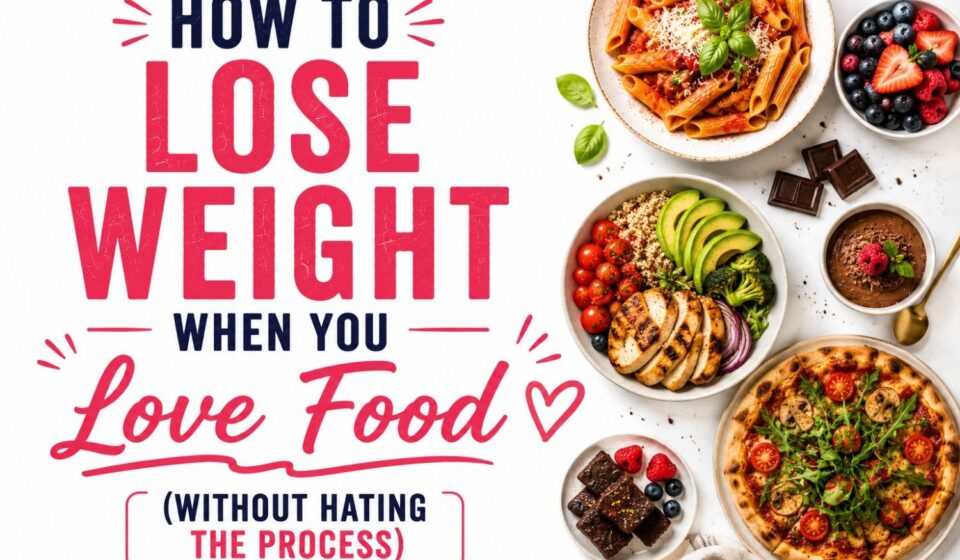

For people who genuinely, deeply love eating — here’s how to lose weight without losing what makes food enjoyable

Some people eat to live. Others live to eat.
If you’re in the second category — if food is one of your genuine pleasures, if you look forward to meals, if you care about what’s on your plate and not just how many calories it contains — standard weight loss advice can feel like it’s asking you to give up something fundamental about how you experience life.
This guide is for people who love food. Not to lecture you about loving it less, but to show how fat loss and food enjoyment are genuinely compatible — and how the people who succeed long-term almost always find a way to keep both.
The Fundamental Compatibility of Food Love and Fat Loss
Here’s the key insight that most weight loss culture misses: you don’t have to eat less enjoyable food to lose weight. You have to eat less total food — or more filling food — than you currently eat.
The goal isn’t a joyless diet of chicken breast and plain salad. It’s finding foods and eating patterns that satisfy your love of food while creating the calorie deficit that produces fat loss.
These goals are not in conflict. They require creative thinking — not deprivation.
Strategy 1: Eat More of the Right Things — Not Less of Everything
The standard diet approach (eat less of everything) produces the worst outcomes for food lovers — constant deprivation, constant awareness of what you’re missing, constant willpower expenditure.
A better approach: eat abundantly of foods that are low in calorie density, and moderate amounts of foods that are calorie-dense.
Calorie density is the key concept:
Low calorie density foods (eat freely):
- All vegetables — particularly leafy greens, cucumber, zucchini, tomatoes, peppers
- Fresh fruit — particularly berries, watermelon, citrus
- Broth-based soups — extraordinarily filling at minimal calories
- Lean protein (chicken, fish, shellfish, eggs, Greek yogurt) — high satisfaction per calorie
High calorie density foods (eat mindfully, in smaller amounts):
- Oils and fats — nutritious but extremely calorie-dense
- Nuts and nut butters — delicious and healthy but easy to massively overeat
- Cheese — worth including, worth portioning
- Pasta, bread, rice — enjoyable, worth including in moderate portions
- Chocolate, desserts — worth including occasionally, worth savoring slowly
A food lover who fills half their plate with vegetables and eats moderate portions of the things they genuinely love can eat a wide variety of genuinely good food — and still lose weight.
Strategy 2: Improve Quality, Not Just Quantity
One of the best-kept secrets of eating for fat loss: higher quality food is more satisfying per calorie than lower quality food.
The cheap, processed, fast food version of a dish produces less satisfaction and less lasting fullness than a well-made version using good ingredients. This means:
- A homemade burger with quality beef, fresh vegetables, and a good sauce eaten slowly is more satisfying than two fast food burgers eaten quickly
- A piece of good dark chocolate eaten mindfully is more satisfying than three pieces of cheap milk chocolate consumed absently
- A proper restaurant pasta with good olive oil and fresh ingredients eaten with attention is more satisfying than a processed instant version consumed while watching television
Food lovers who upgrade quality while moderating quantity often find they need less food to feel genuinely satisfied — because they’re actually tasting and experiencing what they eat.
The implication: Invest in food quality. Cook better. Use good olive oil. Buy better produce. The experience of eating genuinely good food, eaten with attention, is both more satisfying and more compatible with fat loss than eating large amounts of mediocre processed food.
Strategy 3: Eat Slower — Get More From Every Meal
This is one of the highest-return, lowest-cost changes available for food lovers: eating more slowly extracts more satisfaction from the same amount of food.
Satiety hormones take 15–20 minutes to register fullness. People who eat quickly consume significantly more before feeling satisfied. People who eat slowly experience genuine fullness from smaller portions.
More importantly for food lovers: eating slowly allows you to actually taste what you’re eating. The flavors, textures, and aromas that make food enjoyable are experienced more fully when eaten mindfully rather than consumed rapidly.
Practical slow eating:
- Put utensils down between bites
- Chew thoroughly (aim for 20+ chews for dense food)
- Take a genuine pause halfway through the meal
- Eat at a table without screens
- Appreciate what’s in front of you
This isn’t ascetic — it’s the opposite. Slow eating is how food lovers get maximum enjoyment from what they eat. The paradox: eating more slowly and mindfully often produces more satisfaction from smaller portions than eating quickly and distractedly produces from large ones.
Strategy 4: Make Peace with Hunger — It’s Not an Emergency
Food lovers often have a difficult relationship with hunger — not because they’re weak, but because the anticipation of food is enjoyable and hunger is the precondition for that enjoyment.
But gentle hunger between meals is not an emergency. It doesn’t require immediate resolution. Learning to tolerate 2–3 hours of moderate hunger between meals — knowing a good meal is coming — is the behavioral adaptation that makes fat loss compatible with a food-loving lifestyle.
The reframe: hunger before a good meal enhances the eating experience. The meal you sit down to when genuinely hungry tastes better than the meal eaten without appetite. Food lovers can appreciate this.
The practical shift: Instead of snacking at the first sign of hunger, let mild hunger build until mealtime — then eat a genuinely satisfying, high-quality meal. This produces better total daily calorie management and better meal enjoyment simultaneously.
Strategy 5: Build Meals Around Volume and Protein
The dietary structure that works best for food lovers produces maximum eating satisfaction within a calorie deficit:
Start with volume: A large salad, a broth-based soup, or a generous portion of vegetables before the calorie-dense part of the meal physically fills the stomach, activates stretch receptors, and reduces the portion of higher-calorie food needed to feel satisfied.
Build around protein: Protein is the most satiating macronutrient per calorie. A meal centered on adequate protein (chicken, fish, eggs, legumes) produces longer-lasting fullness than a carbohydrate-centered meal of equivalent calories. This means the time between meals is more comfortable — reducing the background hunger that drives impulse eating.
Enjoy what you actually love: Once the volume and protein foundation is in place, the foods you genuinely love — the pasta, the cheese, the bread, the chocolate — can be included in amounts that fit the remaining calorie budget.
The meal structure: vegetables first → protein next → everything else in moderate portions.
As covered in our guide to how much protein you actually need per day, protein at every meal is the most important dietary change for both satiety and fat loss quality.
Strategy 6: The Restaurant Strategy for Food Lovers
Food lovers often eat out frequently — and restaurant eating is where calorie management most commonly collapses.
The food-lover’s restaurant approach:
Order what you genuinely want — but make one strategic modification. The modification that produces the largest calorie reduction without compromising enjoyment: ask for sauces and dressings on the side. Restaurant sauces and dressings routinely add 200–400 calories invisibly. Controlling them — dipping rather than drowning — lets you enjoy the full flavor while managing the caloric addition.
Skip the bread basket — or have one piece and ask for the basket to be removed. Bread before a meal adds 200–400 calories of food eaten before genuine hunger is engaged at the meal itself.
Share a dessert — if dessert is what you love about a restaurant meal, order one and share it. The first few bites of dessert produce the most enjoyment; the last few are consumed more out of habit than pleasure. Sharing produces 90% of the enjoyment at 50% of the calories.
Eat slowly and stop at satisfied, not stuffed — restaurants tend to serve large portions. Eating until comfortable (not full, not stuffed) and boxing the rest is a food lover’s strategy that extends the enjoyment to a second meal.
Strategy 7: Cook More, Eat Out Less
This is the counterintuitive food lover’s weight loss strategy: people who cook most of their own meals lose weight more easily than those who eat out frequently — not because home cooking is less enjoyable, but because:
- You control the ingredients, portions, and preparation methods
- Home cooking is often less calorie-dense than restaurant equivalents (less butter, less oil, fewer calorie-adding steps)
- Cooking itself is enjoyable for food lovers — the process, not just the result
Cooking is a food lover’s advantage, not a burden. Learning to cook the foods you love in ways that are slightly less calorie-dense is one of the most sustainable long-term fat loss strategies available.
What Food Lovers Should Never Do
Never try to stop loving food. It won’t work and the attempt produces the deprivation mindset that eventually collapses into compensatory overeating.
Never eat foods you don’t like because they’re “healthy.” If kale smoothies make you miserable, don’t drink them. There are enough genuinely delicious healthy foods that you never have to eat things you hate.
Never eat quickly. For food lovers, this wastes both the food and the eating experience.
Never skip meals to “save” for a big meal. Arriving ravenously hungry at any meal produces overconsumption that typically exceeds what the skipped meal contained.
The Long-Term Vision
The most sustainable approach to weight loss for food lovers isn’t a diet — it’s a gradual refinement of how you eat that preserves what you love while managing what produces the excess.
More vegetables alongside the things you love. More protein before the calorie-dense parts of meals. Slightly smaller portions of the richest dishes. Better quality food eaten more slowly. Cooking more of your own food. Strategic restaurant approaches.
None of these require giving up food as a genuine pleasure. They require becoming a more intentional, more attentive, and arguably more sophisticated eater — which is exactly what a food lover should aspire to.
As covered in our guide to how to lose weight naturally without dieting, the most sustainable approach to fat loss builds habits rather than rules — and these habits are entirely compatible with a deep appreciation for food.
For the complete framework that makes fat loss compatible with real food enjoyment, our guide to how to get rid of belly fat covers everything in one place.
What’s the food you were most afraid you’d have to give up to lose weight — and did you have to? Share in the comments. Food lovers helping food lovers is some of the best content this community produces.