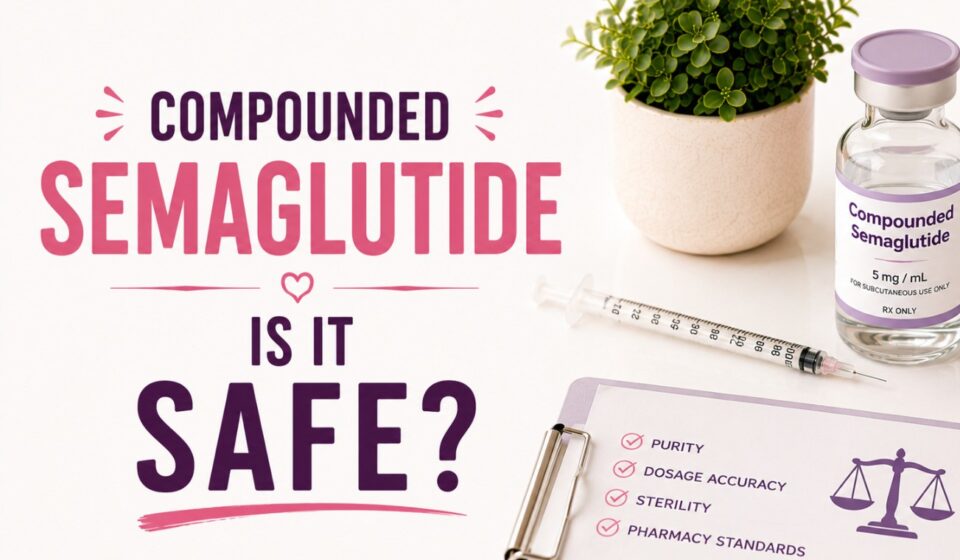

The honest answer on quality, regulatory status, risks, and how to tell a legitimate provider from a dangerous one
Compounded semaglutide has made weight loss injections accessible to millions of people who couldn’t afford or access brand name Wegovy or Ozempic. It’s also generated significant controversy — with the FDA issuing warnings, news stories about adverse events, and legitimate questions about quality and safety.
The honest answer is more nuanced than either “it’s completely safe” or “it’s dangerous.” Here’s the complete, evidence-based guide.
What Is Compounded Semaglutide?
Compounded medications are custom-prepared formulations made by specialized compounding pharmacies — as opposed to mass-manufactured brand name medications from pharmaceutical companies like Novo Nordisk.
Why compounded semaglutide exists:
When demand for Wegovy and Ozempic dramatically exceeded supply — the FDA placed semaglutide on its drug shortage list. Under FDA regulations, compounding pharmacies can legally produce copies of shortage-listed medications to address supply gaps.
This legal framework created the compounded semaglutide market — allowing pharmacies to produce semaglutide at a fraction of brand name cost ($150-350/month vs. $1,300+/month for Wegovy).
The legal foundation:
- 503A compounding pharmacies: Patient-specific, smaller scale, prescription required
- 503B outsourcing facilities: Larger scale, FDA-registered, higher manufacturing standards — the preferred source for compounded GLP-1 medications
The Regulatory Landscape — What’s Changed
The compounded semaglutide landscape has evolved significantly and continues to evolve — understanding the regulatory context is essential.
The Drug Shortage Period
During peak semaglutide shortage (2022-2024), compounding of semaglutide was broadly legal under the shortage exemption. The FDA tolerated widespread compounded semaglutide production as a necessary response to supply constraints.
FDA Actions and Shortage Resolution
As brand name semaglutide supply improved, the FDA took action:
February 2024: FDA declared the semaglutide shortage officially resolved — removing it from the shortage list.
This triggered a cascade:
- Compounding of semaglutide based solely on shortage status became legally questionable
- FDA issued guidance indicating that 503B outsourcing facilities should discontinue compounded semaglutide production
- Enforcement actions against some compounders began
The ongoing complexity:
- Some 503A pharmacies argue they can still compound for individual patients with specific medical needs
- Legal challenges to FDA’s actions are ongoing
- The regulatory status remains contested at time of writing
The practical implication: Compounded semaglutide availability is changing — some providers have discontinued it, others continue. Discuss current regulatory status explicitly with any telehealth provider.
Tirzepatide Status
At time of writing, tirzepatide remains on the FDA shortage list — meaning compounded tirzepatide continues to have clearer legal standing than compounded semaglutide. This has caused some providers to shift toward compounded tirzepatide.
The Salt Form Controversy — Semaglutide Base vs. Sodium vs. Acetate
This is one of the most important — and most confusing — safety considerations in the compounded semaglutide space.
What the Salt Form Means
Brand name Wegovy and Ozempic use semaglutide base — the pure free acid form of semaglutide, without a salt counterion. This is the form that was clinically tested in all the major trials.
Some compounding pharmacies have used different salt forms:
- Semaglutide sodium — semaglutide combined with sodium
- Semaglutide acetate — semaglutide combined with acetate
Why This Matters
The FDA’s concern: The FDA has specifically warned that semaglutide salts (sodium, acetate) are different chemical entities from semaglutide base. They:
- Have not been tested in clinical trials for safety or efficacy
- May have different absorption, distribution, and pharmacokinetic profiles
- Cannot be assumed equivalent to the clinically tested form
The dose equivalence problem: If a pharmacy uses semaglutide sodium and doses as if it were semaglutide base — the actual dose of active semaglutide delivered may be different. This creates dosing uncertainty that doesn’t exist with brand name medication.
The reputable provider response: Legitimate compounding providers use semaglutide base — the same chemical form as brand name medication — from FDA-registered API (active pharmaceutical ingredient) suppliers.
What to ask your provider: “Does your compounded semaglutide use semaglutide base, or a salt form such as semaglutide sodium or semaglutide acetate?”
If they can’t answer clearly — this is a concern.
Known Safety Issues With Compounded Semaglutide
The honest safety picture requires acknowledging both the theoretical concerns and the documented problems.
Documented Adverse Events
The FDA has received adverse event reports associated with compounded semaglutide — some serious. Reported issues include:
Dosing errors:
- Compounded semaglutide is often provided as a multi-dose vial requiring patient self-dosing with a syringe — rather than the pre-filled, pre-measured pen of brand name medication
- Patient errors in measuring doses from multi-dose vials have resulted in significant overdosing
- Overdose reports include severe nausea, vomiting, hypoglycemia, and other serious events
Contamination concerns:
- Some compounded medications have been found to contain contaminants or incorrect active ingredient concentrations
- FDA inspection findings at some compounding pharmacies have identified sterility concerns
Incorrect ingredients:
- FDA testing found some products sold as semaglutide contained different substances entirely
- The unregulated end of the market (not legitimate pharmacy compounders but unlicensed sellers) has produced counterfeit products
The Unregulated Periphery
This is the most serious safety concern — and it’s important to distinguish between:
Legitimate compounders (503A and 503B facilities): Regulated, inspected, licensed pharmacies that compound prescription medications under FDA oversight. These represent the compounded semaglutide available through legitimate telehealth providers.
Illegitimate sellers: Websites, social media sellers, and unlicensed operations selling “semaglutide” without prescriptions, without pharmacy oversight, and without quality controls. These products carry serious risks including:
- Unknown active ingredients
- Contamination
- Incorrect dosing
- No sterility guarantees
The rule: Compounded semaglutide should only come from a licensed compounding pharmacy — with a prescription from a licensed prescriber. Any “semaglutide” available without prescription, through social media, or from overseas websites is not legitimate compounded medication and carries serious unknown risks.
What Separates Safe from Unsafe Compounded Semaglutide
The quality of compounded semaglutide varies enormously — and the difference between a safe and unsafe source is significant.
Markers of a Legitimate, Quality Compounded Semaglutide Source
503B outsourcing facility: The highest standard for compounded medications. 503B facilities are FDA-registered, subject to regular FDA inspections, required to meet Current Good Manufacturing Practice (cGMP) standards — approaching pharmaceutical manufacturing quality.
Semaglutide base API (not salt forms): As discussed above — legitimate providers use the same chemical form as brand name medication.
Third-party testing: Reputable compounders test finished products for identity, potency, sterility, and endotoxin levels. Some providers share certificates of analysis (COA) — documentation of testing results.
Prescription required: Any legitimate compounded semaglutide requires a valid prescription from a licensed prescriber. No prescription = not legitimate.
Transparent pharmacy information: Legitimate providers disclose which pharmacy compounds their medication and can provide pharmacy license information.
Medical oversight: Reputable telehealth providers employing actual licensed prescribers — not algorithm-based approval systems.
Red Flags That Indicate Unsafe Sources
❌ No prescription required
❌ Available through social media, online marketplaces, or non-medical websites
❌ Claims to be “research chemical” or “for research use only”
❌ Cannot identify which pharmacy compounds the medication
❌ Uses semaglutide salt forms without disclosure
❌ Price dramatically below market ($50-80/month vs typical $150-350)
❌ Ships from overseas without prescription
❌ No medical evaluation required before purchase
The Multi-Dose Vial Safety Issue
This is a specific safety concern that’s important for anyone using compounded semaglutide:
Brand name Wegovy and Ozempic use pre-filled, pre-measured injection pens — the dose is set, there’s no calculation required, and the risk of dosing error is minimal.
Compounded semaglutide is typically provided as a multi-dose vial — the patient draws medication into a syringe and self-injects. This introduces dosing error risk:
The error scenarios:
- Drawing the wrong volume (measuring 0.5ml instead of 0.25ml)
- Misunderstanding the concentration (a 2mg/ml vs 5mg/ml vial requires different volumes for the same dose)
- Unit confusion (ml vs units vs mg)
The consequence of overdose: Severe nausea, vomiting, dehydration, hypoglycemia — potentially serious enough to require medical attention.
How to minimize vial dosing risk:
- Ensure you understand the concentration of your specific medication
- Use the exact syringe type your provider recommends
- Calculate your dose carefully — and verify with your provider
- Start with the smallest dose as directed regardless of what you think you need
- Never increase dose without prescriber guidance
The best practice: Ask your provider to provide written dosing instructions with the specific volume to draw for each dose — not just the dose in mg.
Efficacy — Does Compounded Semaglutide Work as Well?
No head-to-head clinical trials comparing compounded to brand name semaglutide exist — both because it’s practically difficult to conduct such trials and because the regulatory history has complicated research.
The pharmacological argument for equivalent efficacy:
If compounded semaglutide uses:
- Semaglutide base (same chemical form as brand name)
- Correct concentration and dosing
- Appropriate formulation and excipients
- Sterile manufacturing conditions
…the active ingredient delivered to the body should be equivalent — and the efficacy should be comparable.
The real-world evidence:
Large-scale real-world data on compounded semaglutide efficacy is limited — but clinical experience from the large telehealth providers offering it suggests results consistent with brand name clinical trial data for most patients.
The honest caveat:
Without controlled comparison data — some uncertainty remains. The theoretical case for equivalence is strong; the empirical confirmation is limited by the absence of trials.
The Current Regulatory Future — What to Expect
The compounded semaglutide landscape will continue evolving:
If FDA enforcement tightens: Compounded semaglutide availability will decrease — access will shift to brand name (higher cost) or compounded tirzepatide (where shortage status remains).
If legal challenges succeed: Compounders arguing that 503A patient-specific compounding remains legal may continue to provide compounded semaglutide under prescription for patients with specific needs.
The emerging alternatives:
- Oral semaglutide at weight loss doses (currently in trials, not yet approved)
- Generic semaglutide (patent protection extends for years — not imminent)
- Compounded tirzepatide (currently clearer legal standing)
The practical advice: Stay informed through your telehealth provider about the current regulatory status — and have a plan for accessing medication if compounded semaglutide becomes unavailable.
How Breeze Meds Approaches Compounded Medications
Breeze Meds offers licensed telehealth evaluation for GLP-1 weight-loss treatment, with prescriptions provided when medically appropriate.
Check eligibility & pricing at Breeze Meds →Affiliate disclosure: We may earn a commission if you use this link. Breeze Meds provides telehealth weight-loss services. Prescription medication is only provided following an evaluation by a licensed healthcare professional and is not guaranteed.
The Bottom Line
Is compounded semaglutide safe?
From a legitimate source — generally yes, with caveats:
✅ Compounded semaglutide from FDA-registered 503B facilities using semaglutide base, with appropriate quality controls and a valid prescription, carries a reasonable safety profile
✅ Real-world clinical experience suggests efficacy comparable to brand name for most patients
⚠️ Multi-dose vial dosing requires care — dosing errors are the primary documented safety concern with legitimate compounded products
⚠️ Regulatory status is evolving — availability may change
❌ Compounded semaglutide from illegitimate sources (no prescription, social media, overseas, no pharmacy) carries serious safety risks and should be avoided entirely
The decision framework:
| Source | Safety Assessment |
|---|---|
| 503B FDA-registered facility, semaglutide base, prescription required | Reasonable — primary risk is dosing error |
| 503A licensed pharmacy, semaglutide base, prescription required | Reasonable — lower manufacturing standard than 503B |
| Salt form semaglutide (sodium/acetate) | Uncertain — not equivalent to tested form |
| No prescription required | Avoid — not legitimate compounding |
| Social media / overseas / no pharmacy | Avoid — serious safety risks |
The most important questions to ask your provider:
- Is your semaglutide compounded by a 503B facility?
- Does it use semaglutide base (not sodium or acetate salt)?
- Can you provide pharmacy license information?
- What quality testing is performed?
For the complete cost picture, see our guide to how to afford weight loss injections without insurance.
Have you used compounded semaglutide — and what questions did you ask to verify the quality of your source? Share in the comments.
Stop Wondering What to Eat This Week
Get my free 7-Day High-Protein Weight Loss Meal Plan delivered straight to your inbox — a simple week of satisfying, protein-focused meals designed to make healthy eating easier without complicated calorie tracking.
- 7 full days of breakfast, lunch, dinner & snacks
- One complete shopping list for the whole week
- A quick high-protein food cheat sheet
- Simple daily tips to help you stay on track
Free PDF • Delivered by email • Unsubscribe anytime
Check your inbox 💜
Your free 7-day high-protein meal plan is on its way.