
Fully plant-based and want to lose fat? Here’s exactly how to make it work.
A vegan diet — no animal products whatsoever — can absolutely support meaningful fat loss. The research on vegan diets and body weight is consistently positive: people who eat vegan tend to have lower BMIs and lose weight more easily than omnivores in comparative studies.
But “vegan” doesn’t automatically mean “weight-loss-friendly.” Vegan Oreos are still Oreos. Vegan pizza is still pizza. And a diet built around refined carbohydrates, processed meat substitutes, and sugar without any animal products produces similar fat loss results to its omnivore equivalent — which is to say, poor ones.
Done right, vegan eating is one of the most effective dietary patterns for sustainable fat loss. Here’s how to do it right.
Why Vegan Diets Support Fat Loss
Whole Plant Foods Are Naturally High in Fiber and Low in Calorie Density
Vegetables, legumes, whole grains, and fruits provide large amounts of food for relatively few calories, alongside significant fiber that keeps hunger well-managed. This combination makes overeating significantly harder on a whole food vegan diet.
Elimination of High-Calorie Animal Products
Dairy, cheese, meat, and eggs can be calorie-dense — removing them naturally reduces calorie intake for many people, without requiring deliberate restriction.
Anti-Inflammatory Effects
Whole plant foods are powerfully anti-inflammatory — reducing the chronic inflammation that impairs insulin sensitivity and promotes fat storage. People transitioning from Western omnivore diets to whole food vegan eating frequently see dramatic improvements in metabolic health markers within weeks.
The Central Challenge: Protein
This is the most important section of this article — and the one most vegan fat loss guides underemphasize.
Removing all animal products eliminates the most convenient, bioavailable protein sources available. Without deliberate protein strategy, a vegan diet easily becomes a low-protein diet — and low protein means:
- Reduced satiety (protein is the most filling macronutrient)
- Muscle loss during a calorie deficit
- Slower metabolism over time
- More difficulty maintaining fat loss
The solution: Make protein the intentional anchor of every meal.
Best vegan protein sources:
Tempeh — the highest protein density of common vegan foods at approximately 19g per 100g. Fermented, which improves digestibility and gut health. Versatile — can be crumbled, sliced, marinated, and cooked many ways.
Seitan — made from wheat gluten, approximately 25g of protein per 100g. The most protein-dense vegan option. Not suitable for people with celiac disease or gluten sensitivity.
Tofu (firm and extra firm) — 10–17g per 100g depending on firmness. Absorbs flavors well, works in almost any cuisine.
Edamame — 11g per 100g shelled. A complete protein. One of the best portable vegan protein snacks.
Lentils — 18g per cup cooked. Also extraordinarily high in fiber. One of the most nutritionally valuable foods in any diet.
Beans and chickpeas — 15g per cup cooked. Versatile, cheap, and fiber-rich.
Pea protein powder — 20–25g per scoop. One of the best vegan protein powders in terms of amino acid profile and digestibility.
Hemp seeds — 10g per 3 tablespoons. A complete protein. Easy to add to smoothies, oatmeal, and salads.
Quinoa — 8g per cup cooked. The only complete protein grain.
Nutritional yeast — 8g per 2 tablespoons. Adds a cheesy flavor and provides B vitamins including B12 in fortified versions.
Aim for adequate protein spread across meals — our guide to how much protein you actually need per day covers the targets. On a vegan diet, hitting these targets requires intentional meal planning rather than casual eating.
Combining Proteins for Complete Amino Acid Profiles
Most plant proteins are “incomplete” — they lack one or more essential amino acids. The solution is combining complementary sources throughout the day:
Classic combinations:
- Rice + beans or lentils
- Hummus + whole grain pita
- Peanut butter + whole grain bread
- Lentil soup + whole grain bread
- Tofu + edamame in a stir-fry
You don’t need to combine at every single meal — eating a variety of plant proteins throughout the day ensures you get all essential amino acids. But being aware of the principle helps you build more complete meals.
The exception: tempeh, edamame, quinoa, and hemp seeds are complete proteins on their own.
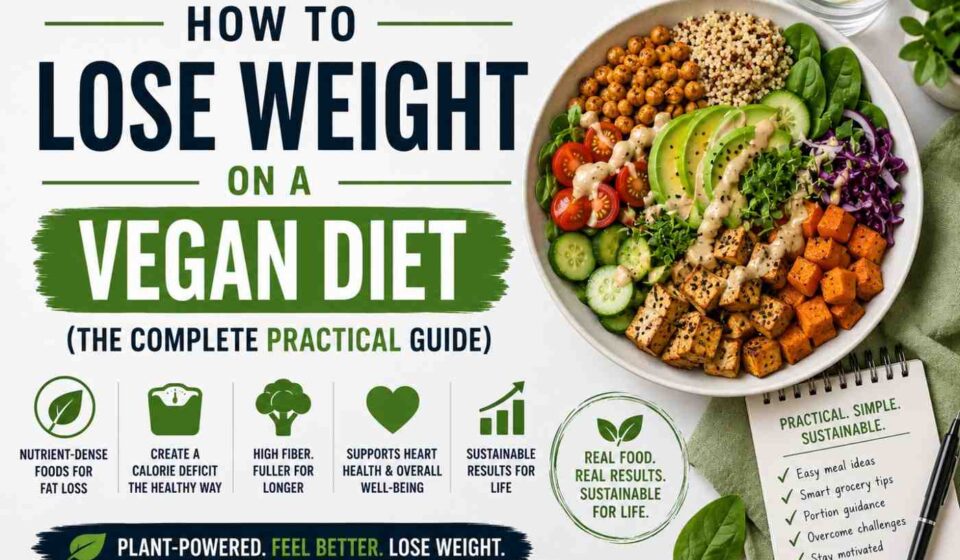
What to Eat: The Vegan Fat Loss Plate
Half the plate: Non-starchy vegetables — leafy greens, broccoli, cauliflower, zucchini, peppers, tomatoes, mushrooms, asparagus
Quarter of the plate: Plant protein — tofu, tempeh, seitan, legumes, edamame
Quarter of the plate: Quality carbohydrates — whole grains, sweet potato, legumes (which do double duty as both protein and carb)
Plus: Healthy fat — olive oil, avocado, nuts, seeds (in measured portions — these are calorie-dense)
This structure provides maximum satiety, adequate protein, significant fiber, and appropriate calorie management without counting anything.
A Week of Vegan Fat Loss Eating
Monday:
- Breakfast: Overnight oats with pea protein powder, berries, hemp seeds
- Lunch: Lentil soup with whole grain bread
- Dinner: Tofu and broccoli stir-fry with brown rice
- Snack: Edamame
Tuesday:
- Breakfast: Smoothie with soy milk, spinach, banana, pea protein
- Lunch: Large salad with roasted chickpeas, quinoa, cucumber, tahini dressing
- Dinner: Tempeh and vegetable curry with cauliflower rice
- Snack: Apple with almond butter
Wednesday:
- Breakfast: Tofu scramble with spinach, tomatoes, and nutritional yeast
- Lunch: Black bean and sweet potato bowl with salsa
- Dinner: Seitan stir-fry with mixed vegetables and noodles
- Snack: Handful of mixed nuts
Thursday:
- Breakfast: Chia pudding made with soy milk, topped with berries
- Lunch: Hummus wrap with roasted vegetables and spinach
- Dinner: Lentil and vegetable stew with whole grain pita
- Snack: Rice cakes with peanut butter
Friday:
- Breakfast: Overnight oats with almond milk, chia seeds, and mango
- Lunch: Tempeh Buddha bowl with roasted vegetables, quinoa, and tahini
- Dinner: Black bean tacos with guacamole, salsa, and corn tortillas
- Snack: Edamame
Essential Supplements on a Vegan Diet
Several nutrients are either absent or poorly absorbed from plant sources — and deficiencies in these can impair energy, metabolism, and fat loss:
Vitamin B12 — found almost exclusively in animal products. Deficiency causes fatigue, brain fog, and neurological issues. Supplement without exception — this is the one non-negotiable for every vegan.
Vitamin D — deficiency is common generally but more likely without fatty fish, eggs, and dairy. Test and supplement if deficient.
Omega-3 fatty acids (DHA and EPA) — from algae rather than fish. Important for inflammation reduction and metabolic health. Algae-based omega-3 supplements provide the same DHA and EPA as fish oil — the fish get it from algae anyway.
Iron — plant-based iron (non-heme) is less bioavailable than animal iron. Eat iron-rich plant foods (lentils, spinach, tofu, pumpkin seeds) with vitamin C sources to improve absorption.
Zinc — less bioavailable from plant sources. Soaking and sprouting legumes improves absorption. A multivitamin covers gaps.
Iodine — if not using iodized salt, supplement. Important for thyroid function and metabolism.
Calcium — found in fortified plant milks, tofu (calcium-set), leafy greens, almonds, and seeds. Adequate total intake across the day covers needs for most people.
The Processed Vegan Food Trap
This is where many vegan fat loss attempts fail — replacing animal products with processed vegan alternatives rather than whole foods.
Common processed vegan products to minimize:
- Vegan burgers and sausages (often high in sodium, fat, and processed ingredients)
- Vegan cheese (low protein, high calorie)
- Vegan deli slices and nuggets
- Vegan desserts and baked goods (same sugar and calorie content as conventional)
- Sweetened plant milks (choose unsweetened versions)
These products make veganism convenient — and they’re fine occasionally — but they shouldn’t be the foundation of a fat loss diet. Whole food vegan eating produces dramatically better results than processed vegan eating.
The rule: If it comes in a package with a long ingredient list, it’s probably not the foundation of your fat loss diet — animal-free or not.
Vegan Eating and Exercise
A vegan diet is entirely compatible with all exercise forms — with some additional attention to protein:
For strength training: Adequate protein is achievable but requires planning. Tempeh, tofu, seitan, legumes, and protein powder all contribute. Spreading protein across multiple meals matters more on a vegan diet than an omnivore diet.
For endurance exercise: Vegan diets are actually well-suited — the high carbohydrate content of whole plant foods provides excellent glycogen stores for aerobic exercise.
Recovery: The anti-inflammatory properties of whole plant foods support recovery from training.
As covered in our guide to best exercises to lose belly fat for beginners, the exercise approach works regardless of dietary pattern — the protein sourcing just requires more intentionality on a vegan diet.
Common Vegan Fat Loss Mistakes
Not eating enough protein. The most common and most impactful mistake. Every meal needs a deliberate protein source — not just vegetables and grains.
Relying on processed vegan products. As above — these undermine fat loss while technically maintaining veganism.
Eating too many calorie-dense whole foods without portion awareness. Nuts, seeds, avocado, nut butters, and coconut products are nutritious but calorie-dense. They belong in a vegan fat loss diet — in measured portions.
Not supplementing B12. Non-negotiable. Deficiency develops over months and affects energy and metabolism before obvious symptoms appear.
Assuming vegan = healthy. It can be. It isn’t automatically.
Skipping strength training. Muscle preservation during fat loss requires protein AND resistance training. Without both, vegan fat loss can produce muscle loss that slows metabolism over time.
Vegan vs Vegetarian for Fat Loss
The distinction worth making: vegetarians who include eggs and dairy have a significantly easier time hitting protein targets, as eggs and Greek yogurt are two of the most protein-dense, convenient options in any fat loss diet.
If you’re considering plant-based eating for fat loss and are flexible about eggs and dairy, a lacto-ovo vegetarian approach is meaningfully easier to optimize for fat loss than fully vegan — without sacrificing most of the health benefits.
Our article on how to lose weight as a vegetarian covers this approach in detail if you want to compare.
What to Expect
Week 1–2: Digestive adjustment to dramatically increased fiber — some bloating is normal and temporary. Energy may shift as food patterns change.
Weeks 2–6: Fat loss beginning with appropriate calorie management. Many people notice reduced bloating and improved energy relatively quickly on whole food vegan eating.
Weeks 6–12: Meaningful body composition changes with consistent protein intake and calorie awareness.
Beyond 3 months: For people who genuinely adopt whole food vegan eating, the cumulative benefits — fat loss, anti-inflammatory effects, improved gut health — become significant and compound over time.
The Bottom Line
A vegan diet can be excellent for fat loss — with whole plant foods, deliberate protein sourcing, essential supplementation, and avoidance of the processed vegan food trap.
The keys:
- Make tempeh, tofu, seitan, legumes, and edamame the anchor of every meal
- Supplement B12, vitamin D, and algae-based omega-3s
- Build meals around whole foods, not packaged vegan alternatives
- Combine varied plant proteins throughout the day
- Add strength training to preserve muscle during fat loss
For the complete fat loss framework that applies across all dietary patterns including vegan, our guide to how to get rid of belly fat covers everything in one place.
What’s your go-to vegan protein source for fat loss? Share in the comments — practical vegan cooking tips from real experience are some of the most valuable content this community produces.