
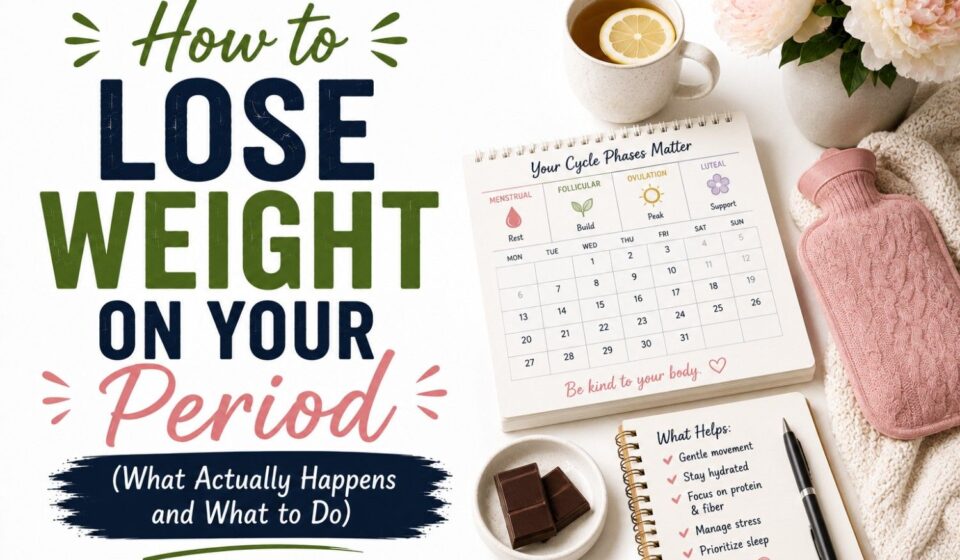

The scale goes up, cravings hit hard, and motivation disappears — here’s the science behind it and exactly how to navigate it

Your period is one of the most challenging times to stay on track with weight loss — and for completely legitimate physiological reasons. The scale climbs, cravings intensify, energy drops, and everything feels harder. Understanding why this happens makes it significantly less frustrating — and knowing what to do about it makes a real difference.
What Actually Happens to Your Body During Your Period
The menstrual cycle involves significant hormonal fluctuations that directly affect weight, appetite, energy, and metabolism:
The Four Phases and Their Metabolic Effects
Phase 1 — Menstruation (Days 1–5): Estrogen and progesterone are at their lowest. Prostaglandins (inflammatory compounds that trigger uterine contractions) are elevated — causing cramping, bloating, and often fatigue and low mood.
Phase 2 — Follicular phase (Days 6–13): Estrogen rises steadily. Energy improves, mood lifts, insulin sensitivity is at its best. This is typically the easiest phase for weight loss — hunger is more manageable and exercise feels better.
Phase 3 — Ovulation (Day 14 approximately): Estrogen peaks, LH surges. Many women feel their best — highest energy, strongest motivation, best performance in the gym.
Phase 4 — Luteal phase (Days 15–28): Progesterone rises significantly alongside estrogen before both drop sharply before menstruation. This is the most challenging phase:
- Progesterone increases appetite significantly — particularly for carbohydrates and fat
- Resting metabolic rate actually increases slightly (200–300 calories) but appetite increase typically exceeds this
- Insulin sensitivity decreases — blood sugar is less stable
- Serotonin decreases — driving sugar and carbohydrate cravings
- Cortisol sensitivity increases — stress has greater metabolic impact
- The body retains more sodium and fluid — causing bloating and scale weight increase
Most period-related weight loss difficulties occur in the luteal phase (the two weeks before menstruation) — not during the period itself.
The Scale Increase: What It Actually Is
One of the most demoralizing experiences for women trying to lose weight: the scale jumping 2–5 lbs in the days before and during menstruation despite no change in diet or exercise.
What’s actually happening: This is almost entirely fluid retention — not fat gain.

The hormonal changes of the luteal phase and menstruation cause:
- Increased aldosterone (a hormone that promotes sodium and water retention)
- Increased prostaglandins that affect fluid balance
- Decreased albumin (a protein that helps regulate fluid balance)
The result: 1–5 lbs of retained fluid that appears on the scale and produces bloating and puffiness — but contains no actual fat.
The good news: This fluid releases naturally in the days following menstruation — the scale drops back without any extra effort. If you’re tracking weight, expect this cyclical pattern and don’t react to it.
The practical approach: Weigh yourself consistently at the same time and track weekly averages rather than daily numbers. A monthly weight chart showing the cyclical pattern is far less distressing than day-to-day scale obsession.
Period Cravings: Why They’re So Intense
The food cravings that accompany the luteal phase and menstruation have legitimate physiological drivers:
Serotonin drops: The brain compensates by craving carbohydrates — which trigger serotonin release. This is a real neurochemical hunger, not a character flaw.
Magnesium drops: Magnesium deficiency (which worsens premenstrually) drives chocolate cravings specifically — dark chocolate is high in magnesium, and the body appears to recognize this.
Metabolic rate increases: The slight increase in resting metabolic rate (200–300 calories) creates genuine increased caloric need.
Prostaglandins: Inflammatory compounds that cause cramping also affect mood and appetite regulation.
Understanding that cravings have real physiological drivers — rather than being weakness — allows a more compassionate and strategic response.
How to Lose Weight During Your Period and Throughout Your Cycle
1. Don’t Panic About the Scale
The scale increase before and during your period is water, not fat. Reacting to it by dramatically cutting calories or doing extra exercise is counterproductive — it increases stress and cortisol at an already hormonally challenging time.
Instead: acknowledge the pattern, expect it, and track monthly trends rather than daily fluctuations. Your true weight loss progress is visible when you compare the same phase of each cycle — follicular phase to follicular phase.
2. Increase Protein to Manage Cravings
Higher protein intake specifically reduces the carbohydrate cravings driven by serotonin changes — protein supports serotonin production and provides more sustained satiety than carbohydrates.
As covered in our guide to how much protein you actually need per day, targeting 0.8–1g per pound of bodyweight helps — but during the luteal phase specifically, prioritizing protein at every meal and snack provides the most practical craving management.
3. Don’t Restrict Calories Aggressively During This Phase
Aggressive calorie restriction during the luteal phase and menstruation increases cortisol — which is already sensitized during this period. The result: more cravings, worse mood, more fluid retention, and impaired sleep.
A moderate maintenance or very slight deficit (200–300 calories below maintenance) during the most difficult premenstrual and menstrual days is more productive than aggressive restriction — because it reduces stress-driven cortisol while still not producing significant fat gain.
Aggressive calorie restriction can wait for the follicular phase when insulin sensitivity is better and mood and energy support better adherence.
4. Satisfy Cravings Intelligently
Completely ignoring legitimate physiological cravings during menstruation tends to produce eventual overconsumption. Better approach: satisfy cravings with better options.
For chocolate cravings: 1–2 squares of 85% dark chocolate — satisfies the craving, provides magnesium, and contains 100–170 calories rather than 500+ from a chocolate bar. As covered in our article on is dark chocolate good for weight loss, dark chocolate is one of the more genuinely beneficial sweet options.
For carbohydrate cravings: Sweet potato, oats, or fruit — whole food carbohydrates that satisfy the serotonin-driven craving with fiber and nutrients rather than the blood sugar spike of refined carbohydrates.
For salt cravings: Olives, edamame, salted nuts — provide the salt satisfaction with protein and healthy fat rather than chips or processed snacks.
5. Supplement Magnesium
Magnesium levels drop premenstrually and during menstruation — and magnesium deficiency worsens cramps, mood, sleep, and cravings simultaneously.
300–400mg magnesium glycinate daily (taken at bedtime) reduces PMS symptoms, improves sleep quality, reduces cramping, and addresses the chocolate cravings that are partly driven by magnesium deficiency.
This is one of the highest-return supplements specifically for the menstrual phase — with benefits that extend beyond weight loss to overall period experience.
6. Reduce Sodium to Minimize Fluid Retention
High sodium intake significantly worsens the fluid retention of the premenstrual and menstrual phase. Reducing processed food (the primary dietary sodium source) in the week before and during menstruation meaningfully reduces bloating and scale weight increase.
Not: Completely eliminating sodium — electrolytes remain important. Rather: Avoiding unusually high sodium foods (restaurant meals, processed snacks, salty packaged foods) during this phase specifically.
7. Stay Active — But Adjust Intensity
Exercise helps with period symptoms (reduces cramping, improves mood through endorphins, reduces water retention) — but intensity should follow the hormonal cycle:
Menstruation (Days 1–5): Lower intensity — walking, yoga, light cycling. High-intensity training when experiencing significant cramping or fatigue is counterproductive. Listen to your body.
Follicular phase (Days 6–13): Best time for high-intensity training — energy is high, recovery is better, strength performance tends to be better.
Ovulation (Day 14): Peak performance phase — highest energy and strength.
Luteal phase (Days 15–28): Moderate intensity — the body is working harder metabolically and recovery is slightly impaired. This is not the time to push PRs.
8. Prioritize Sleep During Your Period
Sleep quality often suffers premenstrually and during menstruation — from discomfort, temperature changes, and mood disruption. Poor sleep during this phase worsens cortisol, insulin resistance, and cravings.
Prioritizing sleep during the menstrual phase — even if it means going to bed earlier — supports better metabolic function and makes dietary adherence significantly easier. As covered in our article on why sleep is the most underrated weight loss tool, sleep quality directly affects hunger hormones and fat metabolism.
9. Stay Well Hydrated
Counter-intuitively, drinking more water reduces fluid retention — the body retains water more aggressively when it senses insufficient intake. 3+ liters of water daily during the premenstrual and menstrual phase minimizes bloating.
Herbal teas (particularly ginger and peppermint) can provide anti-cramping and anti-inflammatory benefits alongside hydration.
10. Track Your Cycle and Plan Around It
Knowing your cycle allows you to plan:
Follicular phase (Days 6–14): Most favorable for aggressive fat loss — better insulin sensitivity, higher energy, stronger motivation. Push dietary adherence and training intensity here.
Luteal phase (Days 15–28): Maintain rather than aggressively lose. Focus on protein, moderate deficit, managing cravings intelligently.
Menstruation (Days 1–5): Damage control mode — prevent overeating, stay active at manageable intensity, don’t react to scale increases.
Cycle-syncing your approach to weight loss — rather than expecting uniform progress every day — dramatically reduces frustration and improves overall outcomes.
Does Your Period Affect How Fast You Lose Weight?
Yes — the menstrual cycle creates real variation in weight loss rate that isn’t visible in daily scale readings. What you’ll typically see over a full cycle:
- Days 1–3 (menstruation): Scale may be elevated from fluid retention
- Days 4–7: Fluid releases, scale drops — sometimes dramatically
- Days 8–14: Steady fat loss visible on scale — best scale movement phase
- Days 15–21: Scale stable or slightly elevated as luteal phase begins
- Days 22–28: Scale may climb 1–3 lbs from premenstrual fluid retention
- Day 1 (next cycle): Pattern repeats
The total monthly trend is what reflects true fat loss — not the day-to-day variation within the cycle.
The Bottom Line
Losing weight during your period is harder — for real, legitimate physiological reasons:
- Fluid retention adds 1–5 lbs to the scale (water, not fat)
- Progesterone increases appetite and carbohydrate cravings
- Serotonin drops drive sugar cravings neurochemically
- Insulin sensitivity decreases
- Energy and motivation decrease
The most effective approach:
- Don’t react to scale increases — it’s water
- Increase protein to manage cravings
- Avoid aggressive calorie restriction during this phase
- Satisfy cravings intelligently (dark chocolate, whole food carbs)
- Supplement magnesium (300–400mg glycinate)
- Reduce sodium to minimize fluid retention
- Adjust exercise intensity to your energy level
- Prioritize sleep
- Track monthly trends rather than daily fluctuations
- Plan your most aggressive fat loss for the follicular phase
For the complete weight loss framework that accounts for hormonal factors, our guide to how to lose weight with hormonal imbalance covers everything in one place.
How do you manage weight loss around your cycle — and what’s made the biggest difference for navigating the most difficult days? Share in the comments.