
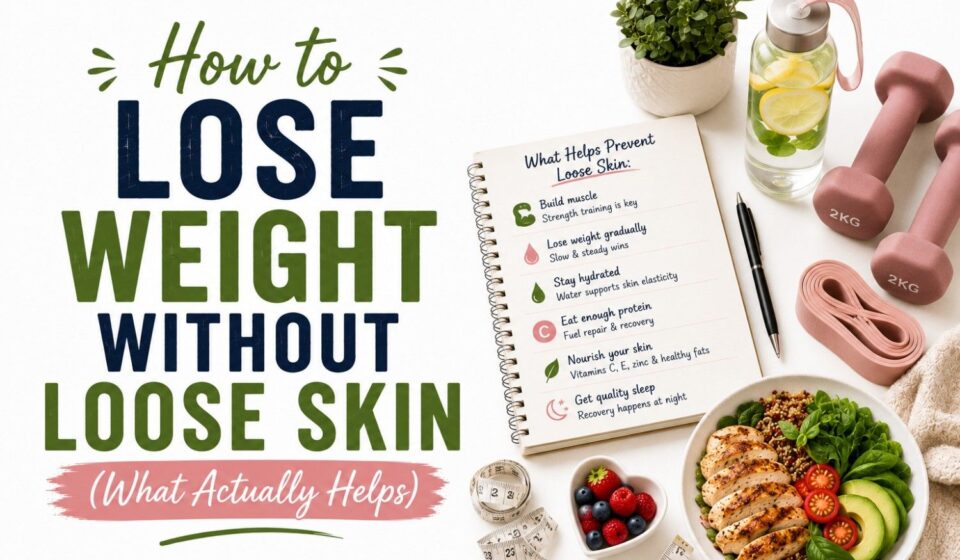

One of the most feared weight loss side effects — here’s what causes it, what prevents it, and the honest truth about what you can and can’t control

Loose skin after weight loss is one of the most emotionally difficult aspects of significant fat loss — and one of the least discussed. You do everything right, lose the weight, and then face a new concern: excess skin that wasn’t there before.
Here’s the honest picture: loose skin can be minimized but not always eliminated, particularly after significant weight loss. Understanding what causes it and what actually helps allows you to make meaningful decisions — without falling for the snake oil products that target this vulnerable topic.
What Causes Loose Skin After Weight Loss?
Understanding the cause helps identify what can and can’t be done about it.
Skin is elastic — to a point. Skin expands to accommodate weight gain through stretching of collagen and elastin fibers. When weight is lost, the skin is supposed to contract back. Whether it does — and how much — depends on several factors.
Collagen and elastin damage: When skin is stretched significantly for an extended period, the collagen and elastin fibers that provide elasticity become damaged and lose their ability to snap back. Think of a rubber band that’s been stretched for too long — it doesn’t fully contract when released.
The rate of weight gain: Rapid weight gain produces more collagen/elastin damage than gradual gain. People who gained weight slowly over decades often have better skin elasticity than those who gained significant weight quickly.
Duration of excess weight: The longer skin has been stretched, the more collagen damage accumulates and the less elastic it becomes.
Age: Collagen production declines with age, and skin elasticity naturally decreases. A 25-year-old who loses 50 lbs will typically have better skin contraction than a 55-year-old losing the same amount.
Genetics: Individual variation in skin elasticity, collagen quality, and repair capacity is significant. Some people’s skin contracts remarkably well after major weight loss; others’ doesn’t — and much of this is genetic.

Amount of weight lost: Losing 20 lbs rarely produces noticeable loose skin. Losing 100+ lbs almost always does — the degree depends on the factors above.
What Actually Helps Minimize Loose Skin
1. Lose Weight Slowly — The Most Important Factor You Can Control
This is the single most impactful preventable factor for loose skin.
Rapid weight loss (more than 1–2 lbs per week sustained) gives skin less time to adapt — the underlying fat disappears faster than the skin can contract. Slower weight loss at 0.5–1 lb per week gives collagen fibers more time to gradually adjust as fat is lost.
As covered in our guide to how much weight can you lose in a month, the “slower is better” principle applies not just to sustainability but to skin outcome as well.
The exception: For people with very large amounts to lose (100+ lbs), the degree of loose skin is largely determined by how long the skin was stretched — slow loss reduces but doesn’t eliminate it.
2. Build Muscle Alongside Fat Loss
This is the most practical thing most people can do to improve body appearance during and after weight loss — and it directly addresses the “loose skin” appearance.
Why muscle matters for loose skin:
When fat is lost without building muscle, the skin has nothing to fill the space that fat occupied. The result is skin that appears loose and deflated.
When fat is lost while building muscle, the muscle partially fills the space previously occupied by fat — making the skin appear tighter and better toned even if the skin itself hasn’t fully contracted.
This is why two people can lose the same amount of weight and look completely different — the one who built muscle throughout the process has skin that appears significantly tighter.
Target: 3 sessions per week of progressive resistance training. This is the most impactful thing most people can do for their body composition beyond the number on the scale.
3. Stay Hydrated
Skin hydration directly affects elasticity. Well-hydrated skin maintains better elasticity and has more capacity to contract during weight loss.
3+ liters of water daily — as covered in our guide to how much water to drink to lose weight — supports both fat loss and skin health simultaneously.
4. Optimize Protein Intake
Protein provides the amino acids (particularly proline, glycine, and hydroxyproline) that are the building blocks of collagen — the primary structural protein in skin.
Adequate protein during weight loss supports collagen maintenance in skin while also preserving the muscle that fills the space under the skin.
Target: 0.8–1g of protein per pound of bodyweight — as covered in our guide to how much protein you actually need per day. This simultaneously supports muscle maintenance and collagen synthesis.
5. Support Collagen Production
Several specific nutrients support collagen synthesis that may help skin elasticity during weight loss:
Vitamin C: Essential cofactor for collagen synthesis — the body cannot make collagen without it. Most people get adequate vitamin C from food, but ensuring adequate intake (75–100mg daily minimum, 200–500mg optimal) supports skin collagen production. Best sources: citrus, bell peppers, strawberries, broccoli.
Collagen peptides (supplements): Hydrolyzed collagen supplements have some evidence for improving skin elasticity — several randomized controlled trials find improvements in skin hydration, elasticity, and appearance with 2.5–10g daily. The evidence is not definitive but is promising enough to be worth considering for people specifically concerned about skin elasticity during weight loss.
Zinc: Required for collagen synthesis. Found in meat, shellfish, nuts, and seeds.
Copper: Also required for collagen cross-linking. Found in shellfish, nuts, seeds, and organ meats.
6. Avoid Rapid Yo-Yo Dieting
Repeated cycles of significant weight gain and loss progressively damage skin elasticity — each cycle stretches collagen fibers that don’t fully recover. People who have gained and lost weight multiple times typically have worse skin elasticity than people experiencing their first significant weight loss.
Losing weight once and maintaining it is significantly better for skin than repeated weight cycling — another reason sustainable approaches are preferable to crash dieting.
7. Protect Skin From Sun Damage
UV radiation breaks down collagen and elastin — directly impairing skin’s elastic recoil capacity. Protecting skin from excessive sun exposure (sunscreen, covering up) during and after weight loss preserves the skin elasticity that makes contraction possible.
8. Avoid Smoking
Smoking dramatically accelerates skin aging by breaking down collagen and impairing circulation to skin tissue. If skin elasticity during weight loss is a concern, smoking is one of the most direct avoidable contributors to poor outcomes.
The Honest Truth: What You Can’t Control
Despite all of the above, some loose skin after significant weight loss is often unavoidable — particularly when:
- More than 80–100 lbs has been lost
- The excess weight was carried for many years
- Age is above 50 (reduced collagen production)
- Genetics predispose toward lower skin elasticity
This is not a failure. It is the physical reality of significant weight loss — and it deserves to be acknowledged honestly rather than dismissed with “just do these exercises and use this cream.”
What Doesn’t Work (Despite the Marketing)
Creams and Lotions
Firming creams, body butters, and “skin tightening” topicals are among the most aggressively marketed products targeting people concerned about loose skin. The honest assessment: surface application of ingredients (retinol, collagen, elastin, caffeine) cannot penetrate to the deep dermis where structural skin changes occur.
Moisturizing skin is beneficial for skin health generally. But no topical product can reverse loose skin in any meaningful way.
Specific Exercises “For Loose Skin”
There are no exercises specifically for skin tightening. Building muscle improves appearance significantly — but through filling the space under the skin, not through directly tightening the skin itself. Any “skin tightening exercise routine” is really just strength training, which does help — through the mechanism above.
Losing More Weight
Some people believe that if they just lose more weight, the loose skin will improve. Often the opposite is true — more fat loss means less filling the skin, making it appear looser, not tighter.
Medical Options for Loose Skin
For people with significant loose skin after major weight loss, medical procedures are sometimes appropriate:
Body contouring surgery (panniculectomy, tummy tuck, arm lift, thigh lift): Surgical removal of excess skin — the only reliable treatment for significant loose skin. Often covered by insurance when loose skin causes functional problems (rashes, infections, hygiene difficulties).
Non-surgical skin tightening (radiofrequency, ultrasound, laser): Stimulate collagen production in the deep dermis — produce modest improvements in mild to moderate loose skin. Not effective for significant loose skin but can help with early or mild cases.
Fillers and collagen stimulators: Injectable treatments that stimulate collagen production — limited effect for body skin, more relevant for facial skin.
The decision about medical intervention is personal — many people decide that the health benefits of weight loss significantly outweigh cosmetic concerns about skin, while others find loose skin significantly impacts quality of life and pursue surgical correction after reaching a stable weight.
How Long Does Skin Take to Tighten After Weight Loss?
Skin continues to contract gradually for up to 2 years after weight loss stabilizes. The tightening process isn’t over when weight loss ends — collagen remodeling continues long afterward.
Waiting at least 12–24 months at a stable weight before evaluating whether surgical intervention is needed allows the natural tightening process to complete.
The Bottom Line
How to minimize loose skin during weight loss:
- Lose weight slowly — 0.5–1 lb per week allows more skin adaptation
- Build muscle throughout — fills space under skin, dramatically improves appearance
- Stay well hydrated — supports skin elasticity
- Eat adequate protein — provides collagen building blocks
- Consider collagen peptide supplementation — modest evidence for skin elasticity
- Optimize vitamin C intake — essential for collagen synthesis
- Avoid yo-yo dieting — each cycle damages elasticity further
- Protect skin from sun and avoid smoking
The honest caveat: For significant weight loss (80+ lbs), some loose skin is often unavoidable regardless of these precautions. Building muscle throughout the process produces the best appearance outcome — and skin continues to tighten for up to 2 years after reaching stable weight.
For the complete weight loss framework, our guide to how to get rid of belly fat covers everything in one place.
Have you experienced loose skin during weight loss — and what approaches have helped? Share in the comments.