
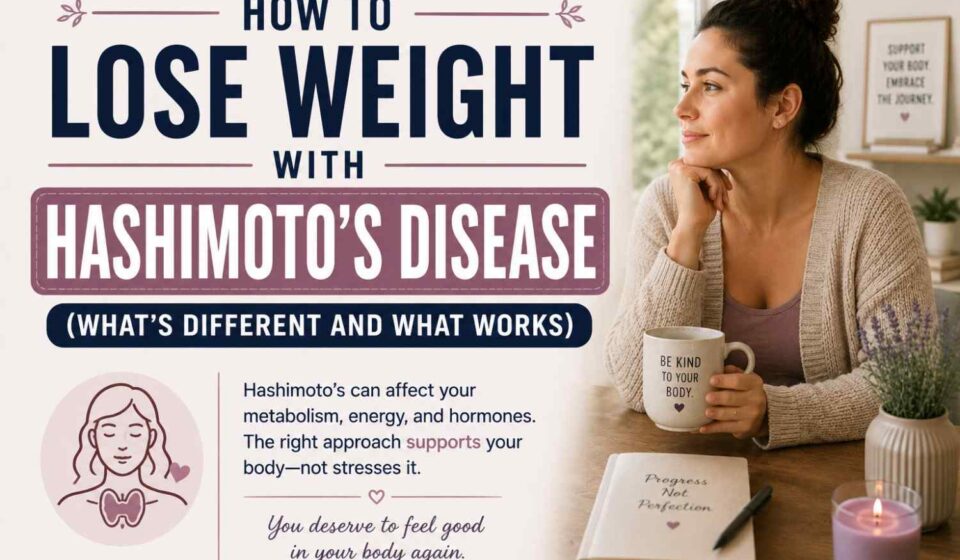
How to Lose Weight With Hashimoto’s Disease (What’s Different and What Works)

Hashimoto’s is more than just hypothyroidism — here’s the specific approach that addresses the autoimmune dimension
Hashimoto’s thyroiditis is the most common cause of hypothyroidism — but it’s more than just an underactive thyroid. It’s an autoimmune condition in which the immune system attacks thyroid tissue, gradually impairing thyroid function over time. This autoimmune dimension adds layers to weight loss that standard hypothyroidism advice doesn’t fully address.
Many people with Hashimoto’s feel dismissed when they report difficulty losing weight despite thyroid medication that keeps their TSH “within normal range.” Their experience is real — and this guide explains why, and what to do about it.

Understanding Hashimoto’s and Its Effect on Weight
How Hashimoto’s Affects Metabolism
The thyroid gland produces hormones (T4 and T3) that regulate metabolism throughout the body. In Hashimoto’s, the immune system’s attack on thyroid tissue gradually reduces the gland’s ability to produce adequate thyroid hormone.
The result:
- Reduced resting metabolic rate — every cell in the body runs more slowly
- Impaired fat metabolism — the body burns fewer calories at rest and during activity
- Fluid retention — hypothyroidism causes myxedema (fluid accumulation in tissues)
- Fatigue — reduces capacity for exercise and daily activity
- Cold intolerance — impaired thermoregulation
- Constipation — slowed gut motility
These effects can reduce resting metabolic rate by 15–40% in significant hypothyroidism — the equivalent of burning several hundred fewer calories per day.
The “Normal TSH” Problem
Many people with Hashimoto’s are told their thyroid levels are normal because their TSH (thyroid-stimulating hormone) is within the standard reference range. But standard TSH ranges are broad — and many people with Hashimoto’s feel better and lose weight more easily with TSH at the lower end of the normal range rather than the middle or upper end.
Additionally, TSH alone doesn’t capture the full picture. Free T3 — the active thyroid hormone — may be suboptimal even when TSH is normal, particularly if the conversion of T4 to T3 is impaired (which chronic inflammation can cause).
If you’re on thyroid medication and still struggling with symptoms including weight loss resistance despite “normal” TSH, discussing free T3 and free T4 testing with your doctor is appropriate.
The Autoimmune Inflammation Component
Beyond the thyroid hormone effects, Hashimoto’s involves chronic autoimmune inflammation that affects metabolism independently of thyroid function. This systemic inflammation:
- Promotes fat storage
- Worsens insulin resistance
- Increases fatigue
- Affects gut function and nutrient absorption
Addressing this inflammation through dietary and lifestyle means is a component of Hashimoto’s weight loss management that goes beyond simply optimizing thyroid medication.
First Priority: Optimize Thyroid Medication
Before implementing dietary and lifestyle changes, ensuring your thyroid medication is optimized is the most important step — because no amount of dietary effort fully compensates for significantly undertreated hypothyroidism.
What to discuss with your endocrinologist or GP:
- Is your current TSH at the optimal level for you — not just “in range”? Many practitioners target TSH of 1–2 mIU/L for symptomatic patients.
- Has free T3 been tested? Poor T4-to-T3 conversion is common in Hashimoto’s.
- Is T3 medication (liothyronine) or combination T4/T3 medication worth considering if you’re not thriving on T4 alone (levothyroxine)?
- Are your antibody levels (anti-TPO, anti-thyroglobulin) being monitored?
Medication optimization may unlock weight loss that dietary changes alone haven’t been able to achieve.
The Hashimoto’s-Specific Dietary Approach
Gluten — The Most Controversial and Most Important Topic
The relationship between Hashimoto’s and gluten is genuinely complex and debated — but the evidence is sufficient to take seriously.
The connection:
- People with Hashimoto’s have significantly higher rates of celiac disease than the general population
- Molecular mimicry — gluten proteins structurally resemble thyroid tissue proteins — may trigger immune cross-reactivity that worsens Hashimoto’s autoimmune activity
- Non-celiac gluten sensitivity may worsen Hashimoto’s symptoms and antibody levels even without full celiac disease
The evidence: Multiple studies have found that a gluten-free diet reduces thyroid antibody levels in Hashimoto’s patients — indicating reduced autoimmune activity. Some patients report significant symptom improvement including improved energy, reduced brain fog, and easier weight management on a gluten-free diet.
The practical approach: A 3-month strict gluten elimination trial is worth attempting for people with Hashimoto’s who haven’t done so. Monitor antibody levels before and after if possible. If symptoms and antibody levels improve meaningfully, the elimination is providing benefit.
Celiac testing should be done before eliminating gluten if it hasn’t been — the test requires active gluten consumption to be accurate.
The Autoimmune Protocol (AIP) Diet
The Autoimmune Protocol diet is a strict elimination diet specifically designed for autoimmune conditions — including Hashimoto’s. It eliminates gluten, grains, dairy, legumes, eggs, nightshades, nuts, seeds, alcohol, and processed food, then systematically reintroduces foods to identify individual triggers.
The evidence base is growing but not yet definitive. Many Hashimoto’s patients report meaningful symptom reduction, reduced antibody levels, and easier weight management on AIP.
The practical challenge: AIP is extremely restrictive and difficult to sustain. It’s best approached as a temporary elimination to identify triggers rather than a permanent eating pattern.
Selenium — Particularly Important for Hashimoto’s
Selenium is essential for thyroid hormone production and conversion of T4 to active T3. It also has direct antioxidant effects on thyroid tissue that reduce the immune-mediated damage of Hashimoto’s.
Multiple clinical trials specifically in Hashimoto’s patients have found that selenium supplementation (200mcg daily) reduces anti-TPO antibody levels — indicating reduced autoimmune activity.
Best food sources: Brazil nuts (1–2 per day provides 100–200mcg), tuna, sardines, eggs, chicken.
Supplementation: 200mcg selenium daily is commonly recommended for Hashimoto’s — discuss with your doctor as excess selenium is toxic.
Iodine — The Complicated Relationship
Iodine is essential for thyroid hormone production — but in Hashimoto’s, excess iodine can trigger or worsen autoimmune flares. This is counterintuitive but well-documented.
The practical approach: Avoid iodine supplements and high-dose iodine products. Maintain adequate dietary iodine from iodized salt and food sources without supplementing above recommended daily amounts.
Dairy — Worth Investigating
Some Hashimoto’s patients report symptom improvement with dairy elimination — possibly through a casein cross-reactivity mechanism similar to gluten. The evidence is weaker than for gluten, but a trial elimination (alongside or after gluten) is reasonable if symptoms persist.
Anti-Inflammatory Eating — The Foundation
Regardless of specific eliminations, an anti-inflammatory whole food dietary pattern is the foundation for Hashimoto’s management:
- Fatty fish (omega-3s reduce autoimmune inflammation)
- Colorful vegetables and fruit (polyphenols reduce inflammation)
- Olive oil (oleocanthal anti-inflammatory effects)
- Adequate protein for thyroid hormone production and metabolism
- Minimal sugar, refined carbohydrates, and ultra-processed food
The Mediterranean dietary pattern — covered in our guide to how to lose weight with Mediterranean diet — incorporates most of these principles and has the strongest evidence for both anti-inflammatory effects and weight management.
Manage Blood Sugar and Insulin Resistance
Hashimoto’s frequently co-occurs with insulin resistance — and the two conditions worsen each other. As covered in our article on how to lose weight with insulin resistance, insulin resistance makes fat loss significantly harder and requires specific dietary management.
Reducing refined carbohydrates, increasing fiber, and eating low-glycemic foods manages the insulin resistance component alongside the thyroid component.
Exercise With Hashimoto’s
Fatigue is one of the most debilitating symptoms of Hashimoto’s — and it significantly affects exercise capacity. The pacing principle applies here: find the exercise level that provides benefit without triggering excessive fatigue that lasts for days.
Strength training is particularly valuable — it improves insulin sensitivity (relevant for the co-occurring insulin resistance), builds metabolically active muscle that compensates partially for reduced thyroid-driven metabolic rate, and can be done at intensities adapted to current energy levels.
Walking is the most accessible and sustainable exercise for people with Hashimoto’s-related fatigue — providing cardiovascular and fat-burning benefits at adjustable intensity.
Avoid overtraining — excessive exercise is a physiological stressor that elevates cortisol and can trigger Hashimoto’s flares. Exercise that leaves you exhausted for days is counterproductive regardless of calorie burn. Moderate, consistent exercise within your energy envelope is more effective than intense exercise that produces crashes.
Lifestyle Factors Particularly Important for Hashimoto’s
Stress management is essential. Stress directly worsens autoimmune activity in Hashimoto’s by elevating cortisol, which impairs T4-to-T3 conversion, promotes inflammation, and triggers immune dysregulation. This isn’t optional — it’s disease management.
Sleep quality is critical. As covered in our article on why sleep is the most underrated weight loss tool, poor sleep worsens every aspect of both weight loss and Hashimoto’s management — impairing thyroid function, worsening inflammation, and disrupting metabolism.
Vitamin D optimization. Vitamin D deficiency is extremely common in autoimmune conditions including Hashimoto’s, and vitamin D plays a direct role in immune regulation. Testing and supplementing if deficient is appropriate — discuss target levels with your doctor.
When Standard Approaches Aren’t Working
For people with Hashimoto’s who have optimized medication, implemented dietary and lifestyle changes, and still struggle with weight loss, additional support options include:
Functional medicine practitioners specializing in thyroid conditions can provide more detailed investigation of T3 conversion, adrenal function, gut health, and other factors that affect Hashimoto’s weight management beyond standard endocrinology.
GLP-1 compounded medications — for people with Hashimoto’s and significant weight to lose, GLP-1 compounded medications directly address the insulin resistance that frequently co-occurs with Hashimoto’s, alongside producing significant weight loss.
Breeze Meds offers telehealth medical evaluations to assess whether prescription weight loss treatment is appropriate for your specific situation — including people with Hashimoto’s where metabolic factors make conventional weight loss approaches less effective.
Check eligibility & pricing at Breeze Meds →Affiliate disclosure: We may earn a commission if you use this link. Breeze Meds provides telehealth weight-loss services. Prescription medication is only provided following an evaluation by a licensed healthcare professional and is not guaranteed.
The Bottom Line
Hashimoto’s makes weight loss harder through reduced metabolic rate, autoimmune inflammation, frequent co-occurring insulin resistance, and the fatigue that limits exercise. But it responds to a specific, targeted approach:
- Optimize thyroid medication first — “in range” may not be optimal for you
- Trial gluten elimination — meaningful evidence for reduced autoimmune activity
- Anti-inflammatory whole food dietary pattern
- Selenium supplementation (discuss with doctor)
- Manage insulin resistance through carbohydrate quality
- Moderate, paced exercise within your energy envelope
- Sleep optimization and active stress management as disease management, not lifestyle extras
For the foundational fat loss strategies that apply alongside Hashimoto’s-specific approaches, our guide to how to get rid of belly fat covers everything in one place.
Are you managing Hashimoto’s alongside weight loss? Share what’s made the biggest difference — particularly any dietary changes that affected your antibody levels or symptoms. Real experience from this community is invaluable.
Stop Wondering What to Eat This Week
Get my free 7-Day High-Protein Weight Loss Meal Plan delivered straight to your inbox — a simple week of satisfying, protein-focused meals designed to make healthy eating easier without complicated calorie tracking.
- 7 full days of breakfast, lunch, dinner & snacks
- One complete shopping list for the whole week
- A quick high-protein food cheat sheet
- Simple daily tips to help you stay on track
Free PDF • Delivered by email • Unsubscribe anytime
Check your inbox 💜
Your free 7-day high-protein meal plan is on its way.