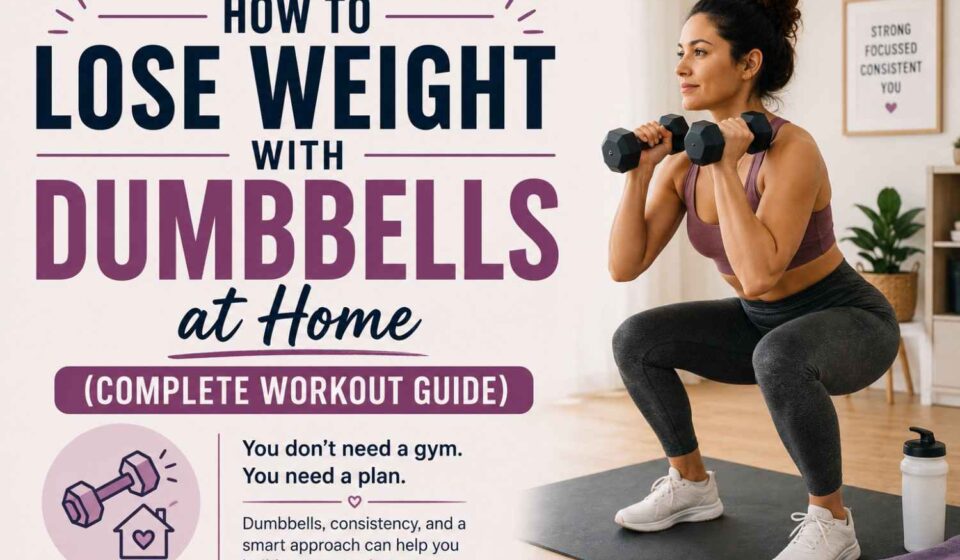

A pair of dumbbells is one of the most versatile fat loss tools available. Here’s how to use them.
Dumbbells are arguably the best single piece of home exercise equipment for fat loss — versatile enough to train every muscle group, scalable from beginner to advanced, compact enough to fit under a bed, and effective enough to replace an entire gym for most people’s fat loss goals.
But most people who buy dumbbells use them for a few weeks then put them in a corner. The difference between dumbbells that collect dust and dumbbells that produce real body composition change is structure, progression, and consistency.
This guide gives you all three.
Why Dumbbells Are Excellent for Fat Loss
Strength Training Is the Most Important Exercise for Fat Loss
As covered throughout this blog, strength training builds the lean muscle that raises resting metabolic rate, improves insulin sensitivity, and produces the toned body composition that most people actually want — not just a lower number on the scale.
Dumbbells enable genuine strength training for every major muscle group — from beginner to advanced levels — without a gym membership, barbell, or bench (though a bench adds options).
Dumbbells Allow Unilateral Training
Unlike barbells, dumbbells allow each side of the body to work independently. This identifies and corrects strength imbalances, requires greater core activation for stability, and provides more complete muscle development than bilateral-only training.
Dumbbells Are Scalable
A set of adjustable dumbbells (or several fixed pairs at different weights) can progress from beginner to advanced training as strength develops. The same equipment that challenges a beginner at 10 lbs can challenge an experienced trainer at 35 lbs simply by increasing weight over time.
Dumbbell Training Burns Significant Calories
A 45-minute dumbbell strength training session burns 250–400 calories — comparable to moderate cardio — while also producing the muscle-building stimulus that raises resting metabolic rate for 24–48 hours afterward.
What Dumbbells You Need
For beginners (women): A set of 5, 8, 10, 12, and 15 lbs covers most beginner exercises adequately.
For beginners (men): A set of 10, 15, 20, 25, and 30 lbs covers most beginner exercises.
The most cost-effective option: Adjustable dumbbells — a single pair that adjusts from light to heavy. Brands like Bowflex SelectTech and PowerBlock are expensive upfront (~$200–$400) but replace an entire rack of fixed dumbbells. Worth the investment if you’re serious about long-term home training.
Budget option: Fixed dumbbells from second-hand markets (Facebook Marketplace, Craigslist) — dumbbells hold their value and used sets are widely available at significant discounts.
The Best Dumbbell Exercises for Fat Loss
Lower Body
Dumbbell Goblet Squat — hold one dumbbell vertically at chest height, squat to depth. Excellent for beginners — the front-loaded position makes it easier to maintain an upright torso than a back squat. Primary muscles: quads, glutes.
Dumbbell Romanian Deadlift (RDL) — hold dumbbells in front of thighs, hinge at the hips while keeping a flat back, lower dumbbells toward the floor until a hamstring stretch is felt, drive hips forward to return. One of the best posterior chain exercises available. Primary muscles: hamstrings, glutes, lower back.
Dumbbell Reverse Lunge — hold dumbbells at sides, step one foot back and lower the back knee toward the floor. More knee-friendly than forward lunges. Primary muscles: quads, glutes, hamstrings.
Dumbbell Bulgarian Split Squat — rear foot elevated on a chair or couch, front foot forward, lower the back knee toward the floor. One of the most demanding and effective lower body exercises. Primary muscles: quads, glutes.
Dumbbell Sumo Squat — feet wider than shoulder width, toes turned out, dumbbell held between legs. Targets inner thighs and glutes more than standard squat.
Upper Body — Push
Dumbbell Push-Up (weighted) — standard push-up with a dumbbell in each hand for added grip challenge and greater range of motion (hands raised off floor). Or place a weight plate on your back for added resistance.
Dumbbell Floor Press — lying on your back, press dumbbells from chest height to full arm extension. Effective chest and tricep exercise without a bench.
Dumbbell Overhead Press — seated or standing, press dumbbells from shoulder height to overhead. Primary muscles: shoulders, triceps.
Dumbbell Lateral Raise — standing, raise dumbbells out to sides to shoulder height. Isolates the lateral deltoid for shoulder width development.
Upper Body — Pull
Dumbbell Bent-Over Row — hinge at hips to 45 degrees, pull dumbbells toward hips. One of the most important back exercises. Primary muscles: lats, rhomboids, biceps.
Single-Arm Dumbbell Row — one knee and hand on a bench (or chair), pull the dumbbell toward the hip with the free arm. Allows heavier loading than bilateral rowing. Primary muscles: lats, mid-back, biceps.
Dumbbell Rear Delt Fly — hinged at hips, raise dumbbells out to sides. Targets the rear deltoids that are critical for posture and shoulder health.
Core
Dumbbell Russian Twist — seated with knees bent, lean back slightly, rotate a dumbbell from side to side. Oblique-focused core exercise.
Dumbbell Pallof Press — using a resistance band or cable, press the weight away from the body to resist rotation. Best anti-rotation core exercise available.
Weighted Dead Bug — lying on your back, hold a dumbbell with both hands extended toward the ceiling, lower alternate leg while maintaining lower back contact with the floor. Core stability with load.
The Complete Dumbbell Fat Loss Program
This 3-day-per-week full-body program uses only dumbbells and can be done in approximately 45 minutes per session.
Phase 1: Foundation (Weeks 1–4)
Rest 60–90 seconds between sets.
Day A:
- Goblet Squat — 3 sets × 12 reps
- Dumbbell Floor Press — 3 sets × 10 reps
- Dumbbell Bent-Over Row — 3 sets × 10 reps
- Dumbbell RDL — 3 sets × 12 reps
- Dumbbell Overhead Press — 3 sets × 10 reps
- Weighted Dead Bug — 3 sets × 8 per side
Day B:
- Dumbbell Reverse Lunge — 3 sets × 10 per leg
- Dumbbell Single-Arm Row — 3 sets × 10 per side
- Dumbbell Sumo Squat — 3 sets × 12 reps
- Dumbbell Lateral Raise — 3 sets × 12 reps
- Dumbbell RDL — 3 sets × 10 reps
- Russian Twist — 3 sets × 12 per side
Day C:
- Bulgarian Split Squat — 3 sets × 8 per leg
- Dumbbell Floor Press — 3 sets × 12 reps
- Dumbbell Bent-Over Row — 3 sets × 12 reps
- Goblet Squat — 3 sets × 15 reps
- Dumbbell Overhead Press — 3 sets × 12 reps
- Weighted Plank Hold — 3 × 30 seconds
Phase 2: Development (Weeks 5–8)
Increase weights by 2.5–5 lbs on each exercise compared to what you finished Phase 1 with. Add one set to each exercise (3 sets → 4 sets). Reduce rest periods to 45–60 seconds.
Phase 3: Intensity (Weeks 9–12)
Switch to supersets — perform two exercises back-to-back with no rest between them, then rest 60 seconds before the next superset.
Example superset structure:
Superset 1: Goblet Squat × 12 / Dumbbell Floor Press × 10 — rest 60 sec — repeat 3 times Superset 2: Dumbbell RDL × 12 / Single-Arm Row × 10 per side — rest 60 sec — repeat 3 times Superset 3: Bulgarian Split Squat × 8 per leg / Overhead Press × 10 — rest 60 sec — repeat 3 times Superset 4: Russian Twist × 15 per side / Dead Bug × 8 per side — rest 60 sec — repeat 3 times
Superset training significantly increases the cardiovascular demand of strength training — producing greater calorie burn during the session and more EPOC (afterburn) afterward.
Adding Cardio to Your Dumbbell Program
Strength training with dumbbells is the foundation — add cardio to accelerate fat loss:
Daily walking — 8,000–10,000 steps is the most sustainable addition. As covered in our guide to how to lose weight by walking, consistent walking burns meaningful additional calories without the recovery cost of intense cardio.
Dumbbell HIIT circuits — combining dumbbell exercises into circuits with minimal rest creates significant cardiovascular demand:
Example 20-minute dumbbell HIIT:
- Dumbbell Squat Jumps × 30 seconds
- Rest 15 seconds
- Dumbbell Renegade Rows × 30 seconds
- Rest 15 seconds
- Dumbbell Thrusters (squat to overhead press) × 30 seconds
- Rest 15 seconds
- Dumbbell Reverse Lunges × 30 seconds
- Rest 15 seconds
- Repeat circuit 4 times
As covered in our complete guide to HIIT for beginners, high-intensity intervals produce the most fat loss per unit of time of any exercise format.
Progressive Overload — The Key to Continued Results
This is the most important principle for long-term results with dumbbells — and the one most home trainers ignore.
Progressive overload means consistently making your workouts harder over time. Without it, your body adapts, calorie burn per session decreases, and results plateau.
How to progressively overload with dumbbells:
- Increase weight by 2.5–5 lbs when you can complete all sets with good form
- Increase reps (8 → 10 → 12) before increasing weight
- Add sets (3 → 4)
- Slow the tempo (2 seconds down, pause, 1 second up)
- Reduce rest periods between sets
- Progress to harder exercise variations (reverse lunge → Bulgarian split squat)
Log your workouts — the weights, sets, and reps you used. Review the log before each session and make at least one thing slightly harder than last time.
Combining Dumbbells With Diet for Maximum Results
As covered throughout this blog — particularly in our guide to how much protein you actually need per day — nutrition does 70–80% of the fat loss work. The dumbbell program above does the rest.
The combination that produces the best results:
- Moderate calorie deficit (400–500 calories below maintenance)
- High protein (0.7–1g per pound of bodyweight)
- Daily walking for additional calorie burn
- The dumbbell program 3x per week
This combination produces:
- Fat loss from the calorie deficit
- Muscle preservation and building from the strength training and protein
- Additional calorie burn from walking
- The toned, defined appearance that comes from the combination of less fat and more muscle
At 12 weeks of consistent execution, most people produce genuinely visible body composition transformation with this approach.
What to Expect: A Realistic Timeline
Weeks 1–4 (Phase 1): Learning the movements, building base strength. Significant muscle soreness initially. Scale may not show dramatic movement yet but body composition is already changing.
Weeks 4–8 (Phase 2): Strength noticeably increasing. Body composition visibly changing — clothes fitting differently. Scale moving consistently with good diet.
Weeks 8–12 (Phase 3): Real transformation visible. Strength significantly improved from week 1 baselines. The combination of fat loss and muscle development producing the appearance most people are aiming for.
Beyond 12 weeks: Continued progression. By this point the habit is established and the question is where to take it next — heavier dumbbells, more advanced programs, or maintaining what’s working.
The Bottom Line
A pair of dumbbells and a well-structured program produces genuine fat loss and body composition results — without a gym membership, barbell, or complex equipment. The exercises in this guide train every major muscle group. The progressive program ensures results continue over 12+ weeks. And the combination with dietary changes and daily walking produces the full fat loss effect.
For the complete fat loss framework that dumbbell training supports — particularly protein targets and dietary strategies — our guide to how to get rid of belly fat covers everything in one place.
What’s your current dumbbell setup at home — fixed weights, adjustable, or still looking? Share in the comments, along with any exercises that have become your go-to.
Stop Wondering What to Eat This Week
Get my free 7-Day High-Protein Weight Loss Meal Plan delivered straight to your inbox — a simple week of satisfying, protein-focused meals designed to make healthy eating easier without complicated calorie tracking.
- 7 full days of breakfast, lunch, dinner & snacks
- One complete shopping list for the whole week
- A quick high-protein food cheat sheet
- Simple daily tips to help you stay on track
Free PDF • Delivered by email • Unsubscribe anytime
Check your inbox 💜
Your free 7-day high-protein meal plan is on its way.