
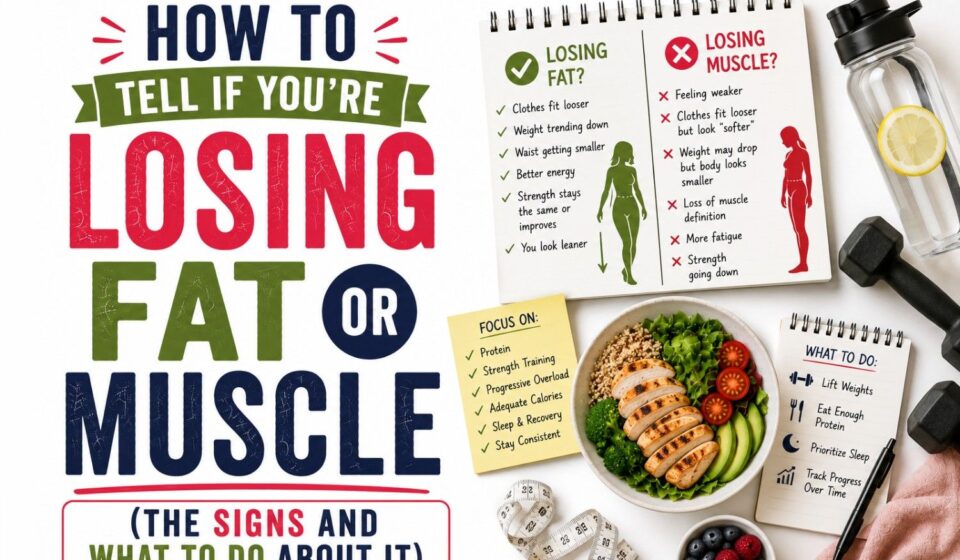

The scale doesn’t tell you what you’re actually losing — here’s how to find out

The goal of weight loss isn’t just to lose weight — it’s to lose fat while keeping the muscle that makes you look good, feel strong, and maintain your results long-term.
But the scale can’t tell the difference between a pound of fat lost and a pound of muscle lost. Both show the same number going down. The composition of what you’re losing — fat vs. muscle — determines everything about how you look at your goal weight and how easy it is to maintain results afterward.
Here’s how to tell what you’re actually losing, and what to do if the answer is the wrong thing.
Why It Matters So Much
Losing fat and losing muscle produce completely different outcomes at the same weight:
Losing primarily fat:
- Body looks leaner and more defined
- Metabolic rate remains relatively stable
- Maintaining results is more manageable
- Strength is preserved or improved
- The “toned” appearance most people are aiming for
Losing primarily muscle:
- Body looks “smaller but soft” — same shape, just smaller
- Metabolic rate decreases significantly (less muscle = fewer calories burned at rest)
- Results are harder to maintain because metabolism has slowed
- Strength decreases
- Risk of weight regain is higher and faster
Two people can both lose 20 lbs and look completely different afterward — one lean and defined, one smaller but unchanged in shape — depending entirely on whether they lost fat or muscle.
Signs You’re Losing Muscle (Not Just Fat)
1. You’re Getting Weaker in the Gym
This is the clearest signal. If the weight you can lift is decreasing week over week — if squats that were manageable last month are now a struggle — your body is losing muscle tissue.
Strength loss during dieting indicates inadequate protein, too aggressive a calorie deficit, insufficient strength training, or some combination of the three.
2. You Look “Smaller” But Not More Defined
If you’ve lost weight but the mirror shows roughly the same shape just in a smaller size — without visible muscle definition emerging — muscle loss alongside fat is likely.
Genuine fat loss while preserving muscle produces progressive definition. Weight loss with muscle loss produces a deflated version of the original shape.
3. You Feel Constantly Fatigued
Persistent, debilitating fatigue disproportionate to the restriction level suggests inadequate protein and/or calories — conditions that promote muscle breakdown.
4. You’re Losing Weight Very Quickly
As covered in our article on is losing 2 pounds a week safe, the faster you lose weight, the higher the proportion of lean mass in that loss.
At 0.5–1 lb per week: approximately 90% fat loss At 2+ lbs per week sustained: 30–50% may be lean mass
5. You’re Not Eating Much Protein
Without adequate protein, the body breaks down existing muscle tissue instead of using dietary amino acids for maintenance.
6. You’re Not Strength Training
Without resistance training stimulus, the body has no reason to prioritize preserving muscle tissue during a calorie deficit.
Signs You’re Losing Fat (The Good Signs)
1. Strength Is Maintaining or Improving
Maintained or improving strength during fat loss is one of the strongest signs that body composition is moving in the right direction.
2. You’re Looking More Defined, Not Just Smaller
Emerging muscle definition — visible shoulders, arms beginning to show shape, legs looking more toned — indicates fat is being removed from on top of existing muscle.
3. Waist Measurement Decreasing Faster Than Other Areas
A waist measurement decreasing meaningfully while scale weight changes moderately indicates genuine fat loss.
4. Energy Levels Are Reasonable
Adequate energy levels suggest the body is burning fat for fuel rather than breaking down muscle.
5. Progress Photos Show Body Composition Change
Monthly progress photos often reveal body composition changes that the scale completely obscures.
How to Actually Measure What You’re Losing
Body Fat Percentage Testing
DEXA scan: Gold standard. X-ray-based, precise measurement of fat mass and lean mass.
Bioelectrical impedance scales: Consumer products ($30–$200). Less accurate than DEXA but tracks trends over time.
Skinfold calipers: Inexpensive, reasonably accurate when done consistently.
The Simple Proxy: Strength + Measurements + Photos
The combination of:
- Weekly strength benchmarks
- Monthly tape measurements (waist, hips, arms, thighs)
- Monthly progress photos
…provides enough information to tell whether fat or muscle is being lost without expensive testing.
What to Do If You’re Losing Too Much Muscle
1. Increase Protein Immediately
As covered in our guide to how much protein you actually need per day, targeting 0.8–1.2g per pound of bodyweight is the primary dietary protection against muscle loss.
2. Reduce the Calorie Deficit
As covered in our article on what happens if you eat too few calories, aggressive restriction dramatically worsens body composition. Reduce to 400–600 calories per day.
3. Start or Maintain Strength Training
Three full-body strength sessions per week — compound movements — sends the signal to preserve muscle even in a calorie deficit. As covered in our guide to cardio vs. weights for fat loss, strength training is the most important exercise variable for body composition.
4. Prioritize Sleep
Growth hormone — the primary muscle-repair hormone — is secreted predominantly during deep sleep. As covered in our article on why sleep is the most underrated weight loss tool, 7–9 hours is a body composition requirement.
5. Consider a Diet Break
After 3+ months of significant deficit, a 1–2 week break at maintenance calories partially reverses the muscle-catabolic hormonal environment before returning to a moderate deficit.
The Body Recomposition Goal
The ideal fat loss outcome is body recomposition — simultaneously losing fat while maintaining or building muscle. This happens when:
- Protein is adequate (0.8–1.2g per pound)
- Deficit is moderate (400–600 calories)
- Strength training is consistent (3x per week)
- Sleep is adequate (7–9 hours)
The Bottom Line
The scale can’t tell you what you’re losing. Signs of muscle loss: decreasing strength, looking smaller but not more defined, constant fatigue, rapid weight loss, low protein, no strength training.
Signs of fat loss with muscle preserved: maintained strength, progressive definition, waist decreasing, reasonable energy, improving progress photos.
If muscle loss is occurring: increase protein immediately, reduce deficit, add strength training, improve sleep.
For the complete body recomposition framework, our guide to how to get rid of belly fat covers everything in one place.
Have you noticed the difference between losing weight with and without muscle preservation? Share in the comments.