
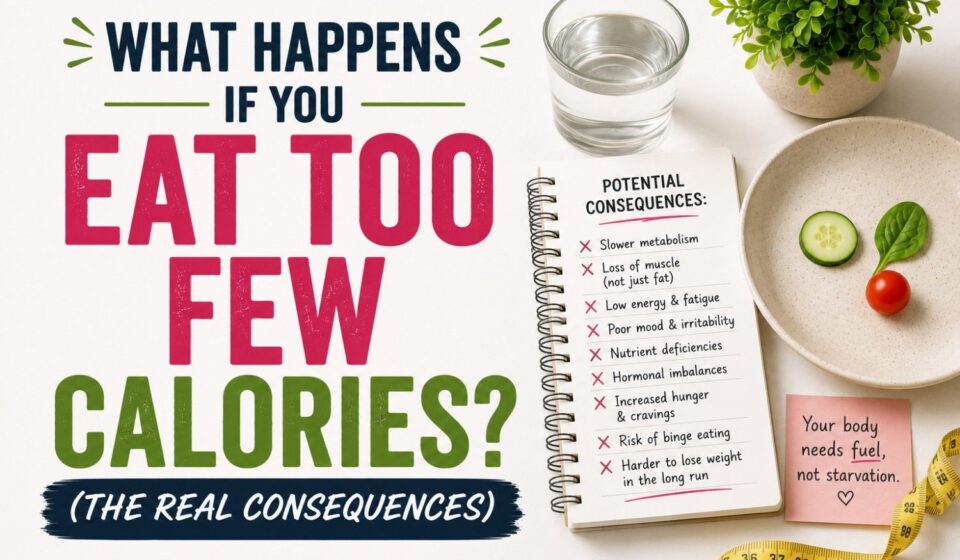
What Happens If You Eat Too Few Calories? (The Real Consequences)

Aggressive restriction feels like faster results — here’s what it actually does to your body
The logic seems sound: the bigger the calorie deficit, the faster the weight loss. If 500 fewer calories per day produces 1 lb per week, surely 1,500 fewer calories produces 3 lbs per week?
It doesn’t work that way. Below certain thresholds, eating too few calories produces a cascade of biological responses that undermine fat loss, damage metabolism, and create health consequences that take months to reverse.

This guide covers exactly what happens when calorie intake drops too low — and where the “too low” threshold actually is.
What “Too Few Calories” Actually Means
There’s no single universal threshold — it depends on body size, activity level, age, and sex. But practical minimums that shouldn’t be crossed:
Women: 1,200 calories per day Men: 1,400 calories per day
Below these floors, the consequences below become increasingly severe and rapid. Above them — even at significant deficits — the body can generally adapt without the most damaging effects.
The critical distinction: These floors apply to actual food intake, not net calories after exercise. Someone who eats 1,400 calories and burns 600 exercising has 800 net calories available — which is too low regardless of the intake number.
What Happens to Your Body Below Minimum Calories
1. Muscle Loss Dramatically Accelerates
This is the most metabolically damaging consequence of severe calorie restriction.
When calorie intake drops below minimum thresholds, the body turns increasingly to muscle protein as a fuel source — breaking down muscle tissue to provide amino acids for gluconeogenesis (glucose production for the brain).
The numbers: At a moderate deficit (500 calories), approximately 10% of weight lost is lean mass. At a severe deficit (1,500+ calories), 40–50% of weight lost can be lean mass.
Someone losing 10 lbs at a severe deficit may lose 4–5 lbs of muscle alongside 5–6 lbs of fat — compared to losing 9 lbs of fat and 1 lb of muscle at a moderate deficit.
The consequence: significantly lower resting metabolic rate, worse body composition at the goal weight, and dramatically higher risk of weight regain. The “thinner but softer” appearance of people who crash diet comes from this muscle loss.
2. Metabolic Rate Adapts Downward — Dramatically
This is what people mean by “starvation mode” — though the reality is more nuanced than the term implies.
When calorie intake drops significantly below needs, the body adapts to conserve energy through multiple mechanisms:
Reduced resting metabolic rate: The body lowers the calories burned at rest — organ function slows, body temperature decreases slightly, and cellular energy expenditure decreases.
Reduced NEAT: Non-exercise activity thermogenesis (fidgeting, unconscious movement, posture changes) decreases significantly — the body conserves energy through reduced spontaneous movement.
Reduced thyroid hormone: T3 (active thyroid hormone) decreases with severe restriction, further reducing metabolic rate.
Adaptive thermogenesis: Beyond what weight loss and muscle loss alone would predict, the body produces additional metabolic adaptation as a specific defense against continued restriction.
The combined effect: someone who has been severely restricting may burn 300–500 fewer calories per day than would be predicted from their body weight alone — making subsequent weight loss progressively harder and making maintenance after the restriction ends nearly impossible without continued severe restriction.
As covered in our article on why you lose weight then gain it all back, this metabolic adaptation is the primary biological driver of weight regain after aggressive dieting.
3. Hunger Hormones Shift Dramatically
Ghrelin rises: The hunger hormone increases significantly with severe restriction — producing constant, intense hunger that becomes increasingly difficult to override.
Leptin falls: The fullness hormone decreases dramatically with aggressive restriction — removing the biological satiety signal that helps regulate intake.
The combined hormonal shift produces hunger of a different quality than moderate dieting — the kind of hunger that eventually overrides even strong willpower and produces the compensatory binge eating that follows most crash diets.
4. Nutritional Deficiencies Develop
Below minimum calorie thresholds, it becomes extremely difficult to meet basic nutritional requirements — even with carefully selected food choices.

The deficiencies most commonly developing with severe restriction:
Iron: Fatigue, impaired immune function, cognitive changes.
Calcium: Bone density loss that accelerates with restriction-induced estrogen reduction.
Vitamin B12: Fatigue, neurological symptoms.
Essential fatty acids: Skin changes, hormonal disruption.
Zinc: Immune impairment, wound healing delay, hormonal effects.
Magnesium: Muscle cramps, sleep disruption, cardiovascular effects.
These aren’t theoretical concerns — they develop on timescales of weeks to months of severe restriction and can have consequences that persist long after restriction ends.
5. Hair Loss (Telogen Effluvium)
One of the most distressing physical consequences of severe calorie restriction: hair shedding that typically begins 2–3 months after the restriction starts and can continue for months afterward.
Telogen effluvium is caused by the physiological stress of severe restriction — forcing hair follicles into the resting (telogen) phase simultaneously, producing diffuse shedding when those follicles later transition.
Hair loss from crash dieting is extremely common and often not connected by sufferers to the restriction that caused it (due to the 2–3 month delay). It typically resolves once adequate nutrition is restored — but can take 6–12 months to normalize fully.
6. Hormonal Disruption
In women: Severe restriction disrupts the hormonal cascade required for menstrual function. Below certain calorie and body fat thresholds, the hypothalamus reduces gonadotropin-releasing hormone — suppressing ovulation and menstruation (hypothalamic amenorrhea). This causes infertility, accelerated bone density loss, and estrogen-related metabolic disruption.
In men: Severe restriction reduces testosterone significantly — impairing muscle maintenance, libido, energy, and mood.
In both sexes: Thyroid hormone reduction, elevated cortisol, and impaired growth hormone secretion affect metabolic function, mood, cognitive performance, and long-term health.
7. Cognitive Impairment — “Diet Brain”
Severe calorie restriction impairs cognitive function through multiple mechanisms:
- Insufficient glucose for optimal brain function
- Elevated cortisol that impairs memory and decision-making
- Preoccupation with food that consumes cognitive bandwidth
- Nutritional deficiencies affecting neurotransmitter synthesis
The Minnesota Starvation Experiment (1944–1945) — a landmark study of semi-starvation — found profound psychological effects including depression, anxiety, social withdrawal, and obsessive preoccupation with food, in addition to physical effects. These psychological consequences of severe restriction are well-documented and predictable.
8. Immune Suppression
Adequate calorie and protein intake are essential for immune function. Severe restriction impairs the production of immune cells, antibodies, and inflammatory responses — increasing susceptibility to infection and impairing recovery from illness.
9. Reduced Exercise Performance and Recovery
At severe calorie restriction:
- Muscle glycogen is depleted — reducing exercise performance dramatically
- Muscle protein synthesis is impaired — reducing recovery from training
- Fatigue impairs both exercise capacity and motivation
- The already accelerated muscle loss is compounded by impaired recovery
The result: people who severely restrict calories and try to exercise simultaneously often find their fitness deteriorating rather than improving — and lose muscle at an accelerated rate rather than gaining it.
Why People Still Do It — And Why It Seems to Work Initially
Crash dieting produces rapid initial results — primarily from:
- Glycogen and water loss (2–4 lbs in days 1–3)
- Sodium-driven fluid loss (1–2 lbs in days 1–4)
- Rapid fat loss from the large deficit (1–2 lbs in the first week)
The dramatic first-week scale movement feels like proof that aggressive restriction is working. It is producing rapid loss — but the composition of that loss becomes increasingly unfavorable as the restriction continues, and the metabolic damage accumulates silently.
The true cost of crash dieting appears later: the plateau that develops as metabolic adaptation kicks in, the hair loss at month 3, the hormonal disruption at month 2, the weight regain that follows stopping, and the subsequent difficulty losing weight again.
The Minimum Effective Approach
Rather than the minimum possible calories, the goal is the minimum restriction that produces sustainable fat loss without the consequences above:
Moderate deficit: 400–600 calories below TDEE Minimum intake: Above the floors (1,200 women, 1,400 men) Adequate protein: 0.7–1g per pound of bodyweight — the primary protection against muscle loss
As covered in our guide to what is the fastest way to lose weight safely, the fastest approach that avoids these consequences is a 750-calorie deficit with high protein and strength training — producing 1–1.5 lbs of fat loss per week without the metabolic damage of more aggressive approaches.
How to Recover From Too-Aggressive Restriction
If you’ve been severely restricting and recognize the signs above, recovery involves:
Gradual calorie increase: Not immediately jumping to maintenance, but increasing by 100–150 calories per week to allow metabolic adaptation to reverse without excessive fat gain.
Prioritizing protein: Maintaining or increasing protein while increasing calories supports muscle rebuilding alongside metabolic restoration.
Resuming or starting strength training: The primary stimulus for metabolic rate restoration through muscle rebuilding.
Patience: Metabolic recovery from significant restriction takes months — not days. Hair loss continues for weeks after restoration; hormonal recovery takes 3–6 months in some cases.
As covered in our guide to how to lose weight with a calorie deficit, the sustainable approach produces better long-term outcomes than the aggressive approach that appears faster initially.
The Bottom Line
Eating too few calories produces:
- Accelerated muscle loss (40–50% of weight lost vs. 10% at moderate restriction)
- Metabolic adaptation that makes subsequent fat loss harder
- Dramatic hunger hormone changes that eventually override restriction
- Hair loss (2–3 months post-restriction)
- Hormonal disruption (menstrual changes, testosterone reduction)
- Nutritional deficiencies
- Cognitive impairment
- Immune suppression
The floor: 1,200 calories (women), 1,400 calories (men). Below this, the biological costs outweigh the fat loss benefits.
The optimal approach: a moderate deficit of 400–750 calories daily with adequate protein — producing sustainable fat loss at a rate the body can tolerate without triggering the damaging responses above.
For the complete fat loss framework built around sustainable rather than aggressive restriction, our guide to how to get rid of belly fat covers everything in one place.
Have you experienced the consequences of eating too little — hair loss, hormonal changes, the plateau that follows initial rapid loss? Share your experience in the comments.
Stop Wondering What to Eat This Week
Get my free 7-Day High-Protein Weight Loss Meal Plan delivered straight to your inbox — a simple week of satisfying, protein-focused meals designed to make healthy eating easier without complicated calorie tracking.
- 7 full days of breakfast, lunch, dinner & snacks
- One complete shopping list for the whole week
- A quick high-protein food cheat sheet
- Simple daily tips to help you stay on track
Free PDF • Delivered by email • Unsubscribe anytime
Check your inbox 💜
Your free 7-day high-protein meal plan is on its way.