
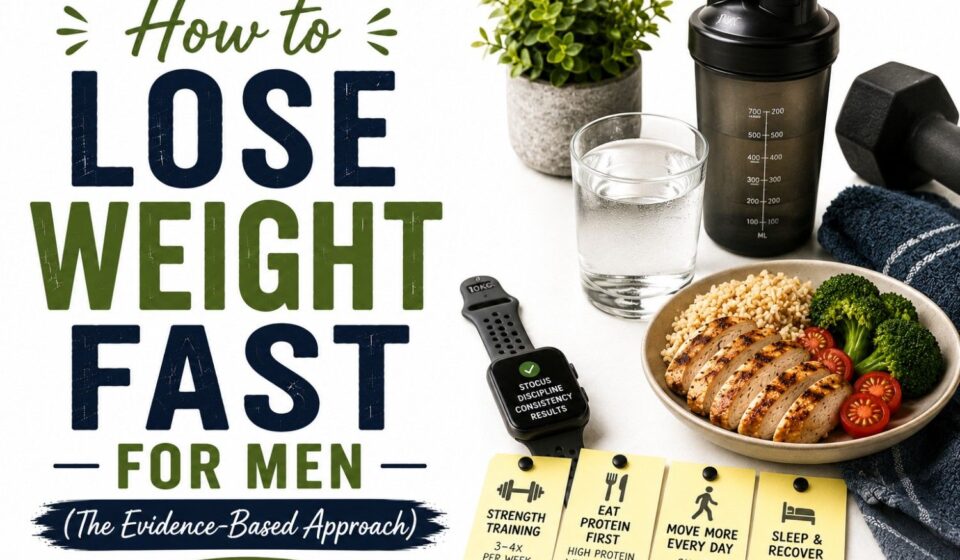

Men lose weight differently than women — here’s the specific approach that works fastest for the male physiology

Men and women lose weight through the same fundamental mechanism — a calorie deficit — but the physiological differences between male and female metabolism mean the specific approach that produces the fastest results differs meaningfully. Men have specific advantages in fat loss that, when leveraged correctly, produce faster results than most men realize.
Here’s the honest, evidence-based guide to fast weight loss for men — what the science shows, what the male-specific advantages are, and the specific approach that produces maximum results.
Why Men Lose Weight Faster Than Women (The Physiology)
This isn’t perception — men genuinely lose weight faster than women on average, and there are specific physiological reasons:
Higher muscle mass: Men naturally carry more muscle mass than women — and muscle is metabolically active tissue that burns calories at rest. More muscle = higher resting metabolic rate = larger calorie deficit at equivalent food intake.
Higher testosterone: Testosterone directly supports fat mobilization and muscle maintenance during calorie restriction. Men preserve more muscle during fat loss than women at equivalent deficits — meaning more of the weight lost is fat rather than muscle.
Less fat-storing hormonal complexity: Women’s hormonal cycles (estrogen, progesterone fluctuations) directly affect fat storage patterns, water retention, and fat mobilization in ways men don’t experience. Male hormonal environment is more consistent and generally more conducive to steady fat loss.
Higher TDEE: Simply due to larger body size and more muscle mass, men burn more calories at equivalent activity levels — creating a larger natural calorie deficit from the same dietary reduction.
Less subcutaneous fat, more visceral fat: This sounds like bad news — visceral fat (around organs) is more metabolically dangerous. But it’s actually good news for fast fat loss: visceral fat is significantly more metabolically active and responds faster to lifestyle intervention than subcutaneous fat (the fat under the skin). Men’s fat loss is often visible faster than women’s.
The Male-Specific Weight Loss Advantages to Leverage
1. Muscle Mass — Your Biggest Asset
The most important thing a man can do for fast weight loss is protect and build muscle throughout the process. More muscle means:

- Higher resting metabolic rate (more calories burned at rest)
- More glucose disposal capacity (better insulin sensitivity)
- Better body composition at every weight on the scale
Men who lose weight through diet alone without strength training lose significant muscle alongside fat — sacrificing the very metabolic advantage that makes male fat loss faster. Men who strength train throughout fat loss maintain their metabolic rate and lose a higher proportion of fat.
Target: 3–4 sessions per week of compound strength training. This is non-negotiable for fast, quality fat loss in men.
2. Higher Natural Deficit
Because men have higher TDEE, the same dietary changes produce a larger calorie deficit than they would in a woman of equivalent weight. A man eating 500 fewer calories per day may be achieving a 25% deficit; the same reduction for a smaller woman might be a 35% deficit — more aggressive and harder to sustain.
Men can often eat relatively generous amounts of food while maintaining a meaningful deficit — which supports dietary adherence.
3. Visceral Fat Responds Quickly
Men’s characteristic pattern of fat storage — central, abdominal, visceral — is the fat that responds fastest to lifestyle intervention. Men typically see visible waist reduction relatively early in a fat loss program — which provides the motivational feedback that supports continued adherence.
The Fastest Evidence-Based Approach for Men
Step 1: Calculate Your Actual Deficit
The fastest sustainable fat loss comes from a 500–750 calorie daily deficit — producing 1–1.5 lbs of fat loss per week.
For most men:
- Sedentary (desk job, minimal exercise): TDEE = bodyweight in lbs × 14
- Moderately active: TDEE = bodyweight in lbs × 16
- Very active: TDEE = bodyweight in lbs × 18
Example: 200 lb moderately active man → TDEE ≈ 3,200 calories → fat loss target ≈ 2,450–2,700 calories
This is a meaningful deficit that produces fast results — without the metabolic damage of severe restriction. As covered in our guide to how many calories should I eat to lose weight, aggressive restriction below this level accelerates muscle loss and metabolic adaptation.
Step 2: Hit Protein Targets — The Most Important Dietary Variable
Protein is the single most important dietary variable for male fat loss — for three reasons:
Muscle preservation: Adequate protein during a deficit ensures weight lost is fat, not muscle. As covered in our guide to how much protein you actually need per day, 0.8–1g per pound of bodyweight is the target during fat loss.
Satiety: Protein suppresses hunger more powerfully than carbohydrates or fat — making the calorie deficit significantly more manageable.
Thermic effect: Protein burns 25–30% of its own calories through digestion — eating 200g of protein daily burns an extra 150–200 calories through thermic effect alone.
For a 200 lb man: 160–200g of protein daily. This sounds like a lot — it requires intentional protein focus at every meal. Chicken breast, eggs, Greek yogurt, cottage cheese, tuna, and protein shakes are the most practical high-protein foods for men trying to hit these targets efficiently.
Step 3: Strength Train 3–4 Times Per Week
As discussed above, strength training is the male fat loss multiplier. The specific approach for maximum fat loss while building/maintaining muscle:
Compound movements: Squats, deadlifts, bench press, rows, overhead press. These recruit the most muscle mass, produce the highest post-exercise calorie burn, and stimulate the most testosterone response.
Progressive overload: Consistently increasing weight or volume over time — this is what produces continued adaptation and muscle growth that maintains metabolic rate.
3–4 sessions per week: Sufficient stimulus for muscle maintenance and growth with adequate recovery. More is not better — recovery is where adaptation happens.
Step 4: Walk 8,000–10,000 Steps Daily
Daily walking is the highest-return, lowest-cost addition to a male fat loss program:
- Burns 300–500 calories daily at 10,000 steps
- Doesn’t trigger compensatory hunger the way intense exercise can
- Reduces cortisol — supporting the testosterone environment that drives male fat loss
- Completely compatible with strength training recovery
As covered in our guide to how many steps a day to lose weight, daily walking compounds significantly over weeks and months — adding meaningful calorie expenditure without the recovery cost of additional training sessions.
Step 5: Eliminate Liquid Calories
Beer, sodas, sports drinks, sweetened coffee — liquid calories are the single biggest hidden calorie source for most men, and the easiest to eliminate without feeling deprived.
Beer specifically: A typical man drinking 3–4 beers on a Friday and Saturday night is consuming 600–800 extra calories twice per week — 1,200–1,600 weekly calories that directly undermine a carefully maintained deficit. As covered in our article on is alcohol bad for weight loss, alcohol also specifically pauses fat burning while being metabolized.
Switching to water, black coffee, and sparkling water eliminates 300–700 calories per day for the average man without any feeling of food deprivation.
Step 6: Prioritize Sleep
Testosterone — the hormone that most directly supports male fat loss and muscle maintenance — is primarily produced during sleep. Sleep deprivation reduces testosterone production measurably even after a single night.
Additionally, poor sleep elevates cortisol — which promotes muscle breakdown and fat storage — directly working against the male physiological advantages in fat loss.
7–9 hours of quality sleep is a testosterone-supporting, fat-loss-accelerating intervention for men. As covered in our article on why sleep is the most underrated weight loss tool, the metabolic effects of sleep deprivation are immediate and significant.
The Fastest Results: What’s Actually Achievable
Week 1–2: 3–6 lbs on scale (mostly glycogen and water from reduced carbohydrates and processed food — not fat)
Weeks 3–8: 1–2 lbs per week of actual fat loss with the approach above
Month 3–6: Visible body composition changes — reduced waist, improved muscle definition, clothes fitting significantly differently
Realistic 3-month result for a committed man: 15–20 lbs of fat loss with maintained or improved muscle mass
Men who see faster results than this are typically losing significant muscle alongside fat — which feels like a win on the scale but produces the “skinny fat” outcome that leaves body composition worse than it looks.
Male-Specific Weight Loss Mistakes
Doing Too Much Cardio, Not Enough Weights
The classic male mistake: running on a treadmill for an hour daily while avoiding the weights section. Cardio burns calories in the session but doesn’t build the metabolically active muscle that raises resting metabolic rate. Strength training produces better long-term fat loss results than cardio for men — because it builds the muscle that makes the male metabolic advantage work.
The optimal combination: 3–4 strength sessions + daily walking. Cardio is supplementary, not primary.
Eating Too Little Protein While Eating Enough Calories
Maintaining a calorie deficit while under-eating protein is the most common dietary mistake in male fat loss. The result: weight loss on the scale that includes significant muscle loss — reducing the metabolic rate advantage and producing poor body composition.
Most men eat 80–120g of protein daily. The fat loss target is 160–200g. The gap is significant and intentional protein focus is required to close it.
Weekend Drinking Eliminating Weekday Progress
A man who maintains a 500-calorie daily deficit Monday through Friday accumulates a 2,500-calorie weekly deficit — equivalent to approximately 0.7 lbs of fat loss per week. Two nights of moderate drinking (4 beers each night) adds 1,200–1,600 calories — eliminating 50–65% of the week’s deficit. This man will lose weight very slowly and never understand why despite “eating well all week.”
Ignoring Sleep
Men who prioritize training and diet but sleep 5–6 hours are undermining both through testosterone suppression and cortisol elevation. Sleep is not a recovery tool — it’s an active physiological requirement for the hormonal environment that supports male fat loss.
Not Tracking Food Intake Initially
Men frequently overestimate their calorie burn (exercise burns less than most people think) and underestimate their calorie intake (portions are larger than perceived). As covered in our article on is counting calories worth it, even 4–6 weeks of accurate tracking provides the nutritional awareness that makes long-term eating decisions significantly more accurate.
A Sample Week for Fast Male Fat Loss
Monday: Upper body strength (bench, rows, overhead press, arms) + 10,000 steps Tuesday: Lower body strength (squats, deadlifts, lunges) + 10,000 steps Wednesday: Active recovery — walking, mobility + 10,000 steps Thursday: Upper body strength + 10,000 steps Friday: Lower body strength + 10,000 steps Saturday: Optional HIIT or recreational sport + 10,000 steps Sunday: Rest + 8,000 steps
Daily nutrition:
- Calories: TDEE minus 500–750
- Protein: 160–200g
- Carbohydrates: moderate, focused around training
- Fat: fill remaining calories
- Water: 3+ liters
- Alcohol: minimal or eliminated
The Bottom Line
How to lose weight fast for men:
- Calculate your deficit — 500–750 calories below TDEE
- Hit protein targets — 0.8–1g per pound of bodyweight
- Strength train 3–4x per week — the male fat loss multiplier
- Walk 8,000–10,000 steps daily — high-return, low-cost calorie burn
- Eliminate liquid calories — particularly alcohol and sugary drinks
- Prioritize sleep — testosterone production and cortisol management
- Track food intake — close the gap between perceived and actual intake
Men have real physiological advantages in fat loss — higher muscle mass, testosterone, and visceral fat responsiveness. The approach above leverages all of them for the fastest sustainable results.
For the complete fat loss framework, our guide to how to get rid of belly fat covers everything in one place — including the belly fat that men typically carry first and lose first.
What’s worked best for your fat loss as a man — and what mistakes did you make early on that slowed you down? Share in the comments.