
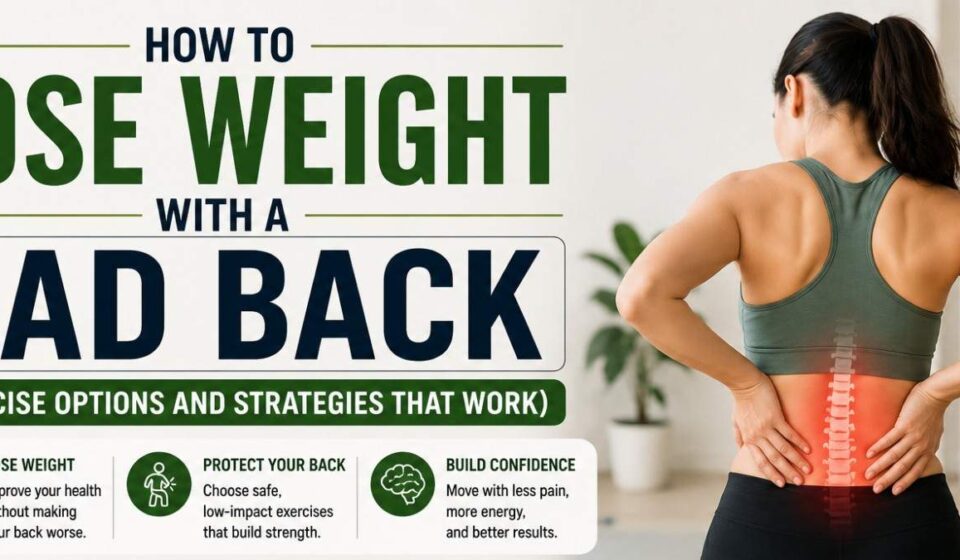
How to Lose Weight With a Bad Back (Exercise Options and Strategies That Work)

Back pain doesn’t have to stop your weight loss — it just requires a smarter approach

Back pain is one of the most common reasons people struggle to exercise — and one of the most frustrating obstacles to weight loss. The exercises most commonly recommended for fat loss (running, HIIT, heavy lifting) are often exactly the movements that aggravate back pain most.
But back pain doesn’t prevent weight loss. It requires adapting the approach — finding the exercise options that don’t load the spine problematically, letting diet do more of the work, and addressing the back pain itself through approaches that may also support fat loss.
The Back Pain and Weight Connection
The relationship between body weight and back pain runs in both directions:
Excess weight worsens back pain — carrying extra weight shifts the center of gravity forward, increasing the load and stress on lumbar spinal structures. Abdominal fat specifically pulls the lower spine into excessive lordosis (inward curve), increasing compression on the posterior elements of the spine.
Back pain makes weight loss harder — it limits exercise, increases sedentary time, disrupts sleep (which worsens metabolism), and elevates stress and cortisol (which promotes fat storage).
Weight loss improves back pain — reducing body weight decreases the mechanical load on spinal structures. Even 10–15 lbs of weight loss produces meaningful back pain reduction for many people.
The positive cycle: weight loss reduces mechanical load → back pain improves → more exercise becomes possible → more weight loss → further back pain improvement.
Get a Proper Diagnosis First
“Bad back” encompasses dozens of different conditions — each with different exercise implications:
- Muscle strain or spasm — typically improves with gentle movement, responds well to most low-impact exercise
- Herniated disc — specific movement directions may worsen or improve symptoms; extension may help some, flexion others
- Spinal stenosis — typically better with flexion (bending forward), worse with extension (standing upright for long periods)
- Spondylolisthesis — specific exercise restrictions apply
- Osteoporosis-related fracture — significant exercise modifications required
- Sciatica — nerve pain that may have specific triggers and positions to avoid
Before starting any exercise program with back pain, a proper diagnosis from a physician, physiotherapist, or sports medicine doctor is valuable — not to restrict your activity, but to understand what’s specifically happening and which exercises are safe and beneficial for your situation.
Part 1: Diet Does Most of the Work
This is the most important message for anyone with back pain limiting exercise: you don’t need to exercise heavily to lose weight. Diet drives 70–80% of fat loss results.
For someone with significant back pain who can’t run, do HIIT, or lift weights, focusing primarily on dietary approaches produces real, meaningful weight loss — which itself reduces back pain, enabling more activity over time.
As covered in our guide to how to lose weight with a calorie deficit, a moderate dietary deficit of 400–500 calories per day produces 0.5–1 lb of fat loss per week regardless of exercise capacity.
Protein is particularly important when exercise is limited — without strength training stimulus, muscle is more vulnerable to loss during a calorie deficit. As covered in our guide to how much protein you actually need per day, targeting 0.7–1g per pound of bodyweight preserves muscle even with minimal exercise.
Anti-inflammatory eating — reducing sugar, refined carbohydrates, and processed food while increasing omega-3 fatty acids (fatty fish), olive oil, and colorful vegetables — reduces systemic inflammation that worsens chronic back pain independently of weight loss.
Part 2: Exercise Options With Back Pain
The key principle: choose movements that provide cardiovascular and muscular benefit without loading the spine in ways that aggravate your specific condition.
Swimming and Water Exercise
Water exercise is one of the best options for back pain — the buoyancy of water dramatically reduces spinal loading while enabling genuine cardiovascular exercise and full-body movement.
Backstroke is particularly well-suited for many back pain sufferers — it keeps the spine in a neutral to slightly extended position, avoids the forward flexion of freestyle, and provides excellent upper body and cardiovascular exercise.
Water walking — walking in chest-deep water — provides cardiovascular benefit without the impact forces that aggravate many back conditions.
Water aerobics — designed for people with physical limitations, these classes provide cardiovascular and muscular exercise with minimal spinal loading.
As covered in our guide to how to lose weight swimming, water exercise burns 400–600 calories per hour — comparable to running — with dramatically reduced joint and spinal stress.
Cycling
Stationary cycling — particularly recumbent cycling — is one of the best exercise options for back pain. The recumbent position supports the lower back, eliminates the forward lean of upright cycling, and provides excellent cardiovascular exercise.
Recumbent bikes are specifically designed for people with back pain and are widely available in gyms and for home use. The supported, semi-reclined position keeps the spine in a comfortable neutral position throughout.
Standard upright stationary bikes are also manageable for many people with back pain — the seat position allows adjustment that reduces lower back strain.
As covered in our guide to how to lose weight cycling, even moderate cycling produces significant calorie burn and cardiovascular benefit.
Walking — With Modifications
Walking is generally one of the best exercises for back pain — it loads the spine through normal, functional movement, strengthens the supporting musculature, and maintains the mobility that back pain patients often lose through excessive rest.
Modifications for walking with back pain:
- Supportive, well-cushioned footwear reduces impact transmission
- Trekking poles reduce spinal loading and improve stability
- Shorter, more frequent walks rather than long distances
- Avoid inclines if they worsen pain — flat walking first
- Listen to your back: mild discomfort that doesn’t worsen during or after walking is typically acceptable; sharp or escalating pain is a signal to stop
As covered in our guide to how to lose weight by walking, consistent daily walking produces meaningful fat loss over time.
Yoga and Pilates (Modified)
Both yoga and Pilates have genuine evidence for back pain management — but require careful selection of appropriate poses and exercises.
Yoga for back pain: Gentle yoga and restorative yoga specifically are appropriate. Poses that strengthen the core and hip muscles while avoiding extreme spinal flexion or extension are generally safe and beneficial. Look specifically for “yoga for back pain” classes rather than standard yoga.
Pilates for back pain: Pilates was actually originally developed in part for rehabilitation — it emphasizes deep core stabilization that directly supports the spine. Clinical Pilates (supervised by a physiotherapist) is the gold standard for back pain rehabilitation; general mat Pilates with appropriate modifications is also beneficial for many people.
Both provide the core and back strengthening that reduces back pain long-term while providing some cardiovascular and body composition benefit.
Core Strengthening — The Most Important Exercise Category
Weak core muscles are a major contributor to back pain and back pain recurrence. Strengthening the deep core — particularly the transverse abdominis and multifidus — directly reduces pain and disability for most back pain conditions.
Safe core exercises for back pain:
Dead bugs — lying on your back, extend alternate arm and leg while maintaining lower back contact with the floor. One of the most effective and back-safe core exercises available.
Bird dogs — on hands and knees, extend alternate arm and leg while maintaining spinal neutrality. Builds core stability without spinal loading.
Glute bridges — lying on your back, press through heels to lift hips. Builds glutes and hamstrings (both important for back support) with minimal spinal load.
Pelvic tilts — lying on your back, gently flatten the lower back against the floor by engaging the abdominals. Builds awareness of spinal position and gentle core activation.
Planks (if tolerated) — with careful attention to maintaining neutral spine. Modified versions (knees down) if needed.
Avoid initially: Sit-ups and traditional crunches — these produce high spinal flexion loads that aggravate many back conditions. Dead bugs and bird dogs achieve core development more safely.
Upper Body Training
For people whose back pain specifically limits lower body and spinal-loading exercises, upper body strength training remains possible and valuable:
- Seated dumbbell exercises (shoulder press, bicep curls, tricep extensions)
- Resistance band exercises performed seated or standing with back support
- Machine-based upper body exercises at a gym (allow controlled, supported movement)
Building upper body muscle raises resting metabolic rate and maintains body composition even when lower body and core training is limited.
What to Avoid
High-impact activities: Running, jumping, HIIT with jumping — these produce significant spinal impact forces that aggravate most back conditions.
Heavy deadlifts and squats: These are excellent exercises for healthy backs but can be significantly problematic with existing back conditions — particularly if form is compromised. Discuss with a physiotherapist before including.
Prolonged sitting: Sitting is often more painful than movement for back pain sufferers — the disc pressure in lumbar spine is highest in seated positions. Frequent position changes and standing are preferable to sustained sitting.
Bed rest: Despite feeling intuitive, prolonged rest worsens back pain and delays recovery. Gentle, appropriate movement is consistently better than rest for almost all back pain conditions.
Lifestyle Factors That Affect Both Back Pain and Weight Loss
Sleep: Poor sleep worsens pain perception significantly — pain signals are amplified by sleep deprivation. As covered in our article on why sleep is the most underrated weight loss tool, 7–9 hours of quality sleep is important for both fat loss and pain management.
Stress: Chronic stress worsens back pain through muscle tension and elevated pain perception. The same cortisol reduction strategies that support fat loss directly benefit back pain management.
Posture and ergonomics: For people with desk jobs, ergonomic setup — monitor at eye level, supported lower back, feet flat on the floor — reduces the postural stress that accumulates into back pain. As covered in our article on how to lose weight with a sedentary job, workstation setup significantly affects both back health and daily movement patterns.
When Medical Support Is Appropriate
Physiotherapy
A physiotherapist specializing in back pain can provide:
- Specific diagnosis of what’s causing the pain
- A tailored exercise program that’s safe for your specific condition
- Manual therapy if appropriate
- Movement coaching that prevents re-injury
This is significantly more valuable than any generic recommendation and is worth pursuing if back pain is significantly limiting your life and activity.
Medical Weight Loss Support
For people with back pain who are significantly limited in their ability to exercise, reaching a healthy weight is both more medically important (weight loss reduces back pain) and harder to achieve (exercise is limited).
ClinicSecret offers telehealth medical evaluations to assess whether prescription weight loss treatment is appropriate — including for people whose physical limitations make traditional exercise-inclusive weight loss programs difficult to follow.
[Check if you qualify at ClinicSecret →]
This is a paid partnership. ClinicSecret is a licensed telehealth provider. Medication is only prescribed following a medical consultation and is not guaranteed.
The Bottom Line
Back pain limits exercise options — but it doesn’t prevent weight loss. Diet does most of the work regardless of exercise capacity, and specific low-impact exercise options (swimming, recumbent cycling, walking, core strengthening) provide meaningful cardiovascular and muscular benefit without the spinal loading that aggravates most back conditions.
The approach that works:
- Diet first — moderate calorie deficit, high protein, anti-inflammatory whole foods
- Water exercise and recumbent cycling for cardiovascular fat burning
- Core strengthening exercises (dead bugs, bird dogs, glute bridges) for back pain management
- Daily walking adapted to your tolerance
- Sleep and stress management for both fat loss and pain reduction
Weight loss itself reduces back pain — creating the positive cycle where improved back pain enables more exercise, enabling more weight loss, enabling further pain improvement.
For the foundational fat loss framework, our guide to how to get rid of belly fat covers all the strategies that apply alongside the back pain-specific adaptations above.
Are you managing back pain alongside weight loss? Share what exercise options you’ve found most effective in the comments.