
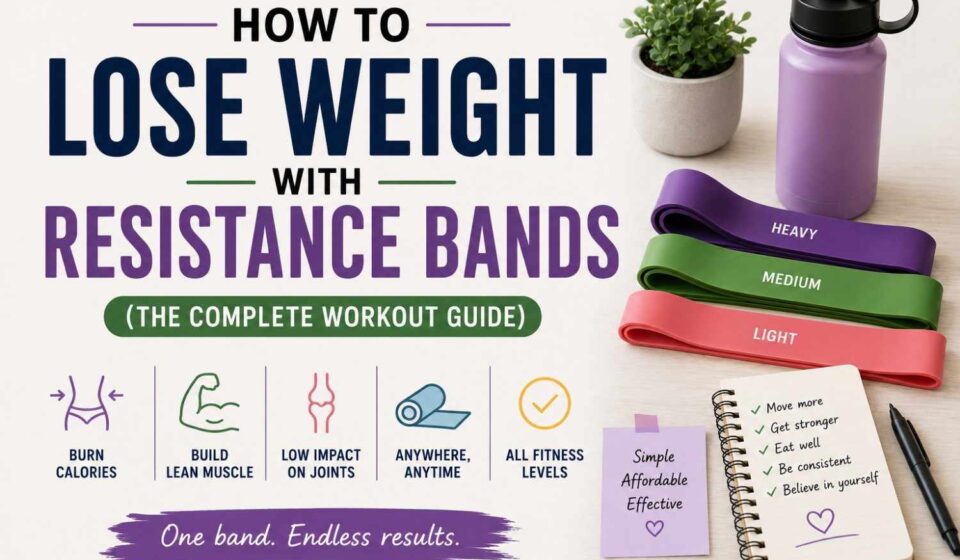

One of the most versatile, affordable, and effective fat loss tools available — here’s how to use them properly

Resistance bands are one of the most underrated pieces of exercise equipment available. They’re cheap ($15–30 for a full set), take up almost no space, can be used anywhere, and when used correctly, provide genuine muscle-building and fat loss stimulus comparable to free weights for most people.
The problem: most people use resistance bands for light “toning” exercises that don’t provide enough stimulus to produce meaningful body composition change. This guide shows you how to use them correctly — with enough intensity and structure to produce real results.
Why Resistance Bands Work for Fat Loss
Genuine Muscle-Building Stimulus
The common misconception: resistance bands are only for rehabilitation and light exercise. The reality: heavy resistance bands provide loading comparable to dumbbells for many exercises — enough to stimulate genuine muscle development that raises resting metabolic rate and improves body composition.
The key is using bands with sufficient resistance and progressing that resistance over time — the same progressive overload principle that makes any strength training effective.
Variable Resistance — A Unique Advantage
Resistance bands provide increasing resistance through the range of motion — the band is lighter at the start of a movement and heavier at the end (when the muscle is contracted). This variable resistance profile matches the natural strength curve of many muscles, producing maximal tension at the point of peak muscular contraction.
This is something that free weights don’t provide — and makes bands a genuinely different and complementary stimulus.
Total Portability and Accessibility
Resistance bands fit in a pocket. They work in a hotel room, a garden, a park, a small apartment, or anywhere else. For people whose life circumstances change frequently — travel, childcare, irregular schedules — this portability is a genuine practical advantage over weights.
Low Impact and Joint-Friendly
Resistance bands produce tension without the compressive joint forces of free weights — making them particularly appropriate for people with joint concerns, beginners, or anyone returning from injury.
The Bands You Need
Resistance bands come in several forms:
Loop bands (also called mini bands): Short flat loops of varying resistance. Best for lower body exercises — lateral walks, clamshells, squats, hip thrusts. Typically sold in sets of 3–5 different resistances ($15–25).
Long resistance bands (tube bands or flat bands): Longer bands that can be anchored, held in the hands, or attached to a door anchor for a wide variety of exercises. Best for upper body, pulling movements, and full-body exercises.
Pull-up assistance bands: Heavy, wide loop bands for assisted pull-ups and other exercises requiring substantial resistance.
For a complete home program: A set of loop bands + a set of tube bands or long flat bands covers virtually all exercises. Total cost: $25–50.
The Best Resistance Band Exercises for Fat Loss
Lower Body
Banded Squats — resistance band around thighs, just above knees. The band provides lateral resistance that activates the glute medius and hip abductors while the squat movement works the quads and glutes. Superior to bodyweight squats for glute activation.
Banded Glute Bridge — lying on back with band around thighs, press through heels to lift hips. At the top, press knees outward against band resistance. Excellent glute isolation with minimal equipment.
Banded Hip Thrust — back against a couch or box, feet flat, band across hips, drive hips upward against resistance. The most effective glute exercise available with bands.
Lateral Band Walks — band around ankles or just above knees, slight squat position, step sideways maintaining tension. Targets glute medius that is commonly weak and responsible for knee pain and poor lower body mechanics.
Banded Romanian Deadlift — stand on the band with both feet, hold the other end, hinge at hips. Targets hamstrings and glutes through a hip hinge pattern.
Banded Reverse Lunge — stand on band with one foot, hold ends at shoulder height, step back into a lunge. Lower body compound movement with shoulder stability component.
Upper Body — Push
Banded Push-Up — loop a resistance band across the upper back and hold the ends under your hands during push-ups. Adds progressive resistance to the push-up, making it significantly more challenging.
Banded Overhead Press — stand on band with feet shoulder-width, hold ends at shoulder height, press overhead. Targets shoulders and triceps.
Banded Chest Fly — anchor band at chest height, hold each end, bring hands together in front of chest. Chest isolation through adduction movement.
Banded Tricep Pushdown — anchor band overhead, press down toward hips keeping elbows tucked. Tricep isolation.
Upper Body — Pull
Banded Row — anchor band at waist height, hold ends, pull elbows back past hips. Back and bicep compound movement.
Banded Pull-Apart — hold band with arms extended in front, pull hands apart to sides keeping arms straight. Rear deltoid and upper back — excellent for posture.
Banded Face Pull — anchor band at face height, pull handles toward face with elbows high. Rear deltoid, external rotators, and upper back. One of the most important exercises for shoulder health and posture.
Banded Bicep Curl — stand on band, curl handles toward shoulders. Direct bicep work.
Core
Banded Pallof Press — anchor band at chest height to the side, hold with both hands at chest, press straight out resisting rotation. Best anti-rotation core exercise.
Banded Woodchop — anchor band high, pull diagonally down and across the body in a chopping motion. Rotational core strength.
Banded Dead Bug — anchor band overhead, hold with both arms extended to the ceiling while performing dead bug leg movements. Core stability with load.
The Complete Resistance Band Fat Loss Program
This 3-day-per-week full-body program uses only resistance bands and can be done in 40 minutes anywhere.
Phase 1: Foundation (Weeks 1–4)
Rest 60–90 seconds between sets. Choose a band resistance that makes the last 2–3 reps of each set challenging.
Day A:
- Banded Squat — 3 sets × 15 reps
- Banded Row — 3 sets × 12 reps
- Banded Glute Bridge — 3 sets × 15 reps
- Banded Overhead Press — 3 sets × 12 reps
- Lateral Band Walks — 3 sets × 15 steps per direction
- Banded Pull-Apart — 3 sets × 15 reps
Day B:
- Banded Romanian Deadlift — 3 sets × 12 reps
- Banded Push-Up — 3 sets × 10 reps
- Banded Hip Thrust — 3 sets × 15 reps
- Banded Face Pull — 3 sets × 15 reps
- Banded Bicep Curl — 3 sets × 12 reps
- Banded Pallof Press — 3 sets × 10 per side
Day C:
- Banded Reverse Lunge — 3 sets × 10 per leg
- Banded Row — 3 sets × 15 reps
- Banded Squat — 3 sets × 12 reps
- Banded Overhead Press — 3 sets × 15 reps
- Banded Tricep Pushdown — 3 sets × 12 reps
- Banded Woodchop — 3 sets × 10 per side
Phase 2: Development (Weeks 5–8)
Progress to heavier resistance bands. Add one set to each exercise (3 → 4 sets). Reduce rest to 45–60 seconds.
Introduce supersets — perform two exercises back-to-back before resting:
Example superset pairs:
- Banded Squat + Banded Row (lower body push + upper body pull)
- Banded Hip Thrust + Banded Overhead Press
- Lateral Band Walks + Banded Pull-Apart
Phase 3: Intensity (Weeks 9–12)
Full circuit training:
Perform all exercises back-to-back with minimal rest between exercises, then rest 90 seconds before repeating the circuit.
Circuit A (repeat 3 times):
- Banded Romanian Deadlift × 15
- Banded Push-Up × 12
- Banded Hip Thrust × 15
- Banded Row × 12
- Lateral Band Walks × 20 per direction
- Banded Face Pull × 15
- Rest 90 seconds, repeat
Circuit B (repeat 3 times):
- Banded Squat × 15
- Banded Overhead Press × 12
- Banded Reverse Lunge × 10 per leg
- Banded Pull-Apart × 20
- Banded Pallof Press × 10 per side
- Banded Woodchop × 10 per side
- Rest 90 seconds, repeat
The circuit format significantly increases cardiovascular demand — producing greater calorie burn and more EPOC (afterburn) than straight sets.
Progressive Overload With Resistance Bands
Without progressive overload — making workouts consistently harder over time — results plateau. With bands, progression happens differently than with weights:
Move to a heavier band — the most direct progression. When you can complete all reps with good form at the end of a set, use the next band up.
Double up bands — using two bands simultaneously increases resistance without purchasing new bands.
Increase reps — if you don’t have heavier bands, increase from 12 to 15 to 20 reps before moving to a heavier band.
Slow the tempo — 3 seconds down, pause, 1 second up. Slower tempo increases time under tension, which increases muscle stimulus without requiring heavier resistance.
Reduce rest periods — shorter rest periods increase cardiovascular demand and metabolic stimulus.
Add sets — 3 sets → 4 sets increases total volume.
Log your workouts — record which band resistance you used and how many reps you completed. Review before each session and aim to beat the previous week in at least one exercise.
Adding Cardio to Your Band Program
Resistance band training builds muscle and burns calories — adding cardio accelerates fat loss further:
Daily walking — the most sustainable addition. As covered in our guide to how to lose weight by walking, consistent daily walking burns meaningful additional calories without the recovery cost of intense cardio.
Resistance band HIIT — bands can be incorporated into interval training for a combined strength-cardio effect:
20-minute Band HIIT circuit:
- Banded Squat Jump × 30 seconds
- Rest 15 seconds
- Banded Row (fast tempo) × 30 seconds
- Rest 15 seconds
- Banded Reverse Lunge (alternating) × 30 seconds
- Rest 15 seconds
- Banded Pull-Apart × 30 seconds
- Rest 15 seconds
- Repeat 4 rounds
As covered in our guide to HIIT for beginners, high-intensity intervals produce the most fat loss per unit of time when combined with resistance training.
Combining Band Training With Diet
As with all exercise approaches: diet does 70–80% of the fat loss work. As covered in our guide to how much protein you actually need per day, adequate protein (0.7–1g per pound of bodyweight) combined with a moderate calorie deficit and the band training program above produces the best body composition results.
The combination produces:
- Fat loss from the calorie deficit
- Muscle preservation and development from the resistance training and protein
- Improved metabolic rate from muscle development
- The toned, defined appearance that comes from losing fat while maintaining muscle
At 12 weeks of consistent execution, meaningful body composition transformation is achievable with this approach — with nothing more than a $25 set of resistance bands.
Resistance Bands vs Dumbbells: Which Is Better?
For most fat loss and body composition goals, dumbbells provide somewhat greater loading potential — you can load more resistance with heavy dumbbells than with bands for many exercises.
However:
- Resistance bands are more affordable (10x cheaper)
- More portable (infinite portability vs. bulky dumbbells)
- Joint-friendlier for people with joint concerns
- Provide unique variable resistance that complements dumbbell training
- More accessible for complete beginners
For someone choosing between the two: dumbbells for maximum progression potential; resistance bands for maximum convenience and accessibility. The ideal is both — bands for travel and convenience, dumbbells for home training sessions.
As covered in our guide to how to lose weight with dumbbells at home, both produce genuine results when used consistently with progressive overload.
What to Expect: A Realistic Timeline
Weeks 1–4: Learning movements, adapting to the training stimulus. Some muscle soreness initially. Establishing the habit and routine.
Weeks 4–8: Strength noticeably increasing. Body composition beginning to shift — less fat, more muscle definition. Clothes fitting differently.
Weeks 8–12: Meaningful body composition change. The combination of fat loss and muscle development from the band training producing visible results. Significant strength improvement from week 1 baselines.
Beyond 12 weeks: Continued progression as resistance increases. By this point the habit is established and the question is where to take the program next.
The Bottom Line
Resistance bands are not just rehabilitation tools or “light toning” equipment — used correctly with sufficient resistance and progressive overload, they provide genuine muscle-building stimulus that drives the body composition changes most people want.
The three-phase program in this guide provides 12 weeks of structured, progressive training using only bands — producing real fat loss and body composition improvement from equipment that fits in a pocket and costs less than a single month’s gym membership.
For the complete fat loss framework that resistance band training supports — particularly protein targets and dietary strategy — our guide to how to get rid of belly fat covers everything in one place.
What’s your experience with resistance bands — do you use them as a primary training tool or supplement to other training? Share your favorite band exercises in the comments.