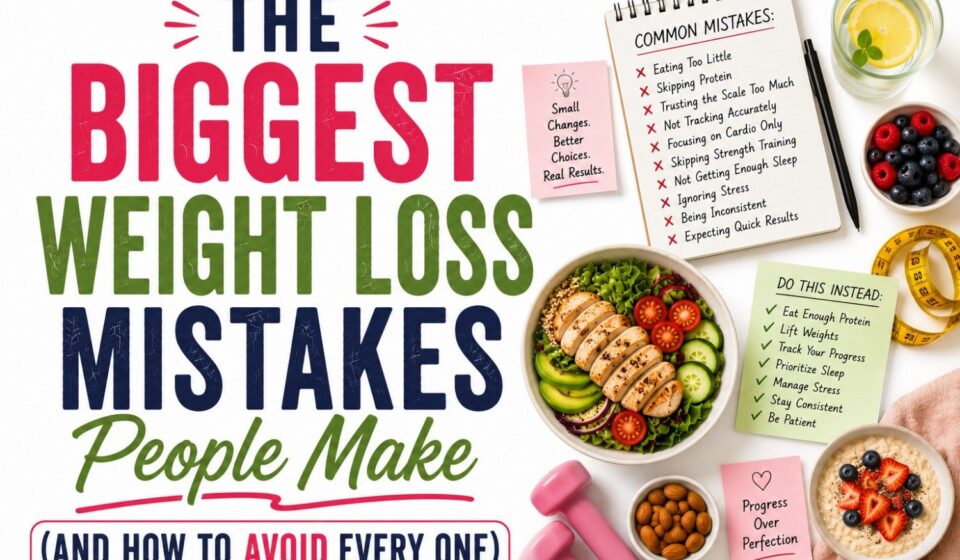

The errors that keep people stuck — and the simple fixes that actually work

Most weight loss failures aren’t caused by bad genetics, broken metabolism, or lack of willpower. They’re caused by specific, avoidable mistakes that are extremely common — and that almost nobody talks about directly.
This guide covers the biggest ones: what they are, why they’re so common, and exactly what to do instead.
Mistake 1: Treating Exercise as the Primary Fat Loss Tool
This is probably the single most common weight loss mistake — and the one that produces the most disappointment.
People start exercising vigorously, expect significant weight loss, and get frustrated when the scale barely moves after weeks of effort.
The reality: as covered in our article on does exercise actually help you lose weight, exercise alone produces an average of only 2–3 lbs of weight loss without dietary changes — because hunger compensates for calories burned.
What to do instead: Focus on diet first — it drives 70–80% of fat loss results. Add exercise for body composition, metabolic health, and the remaining 20–30% of fat loss. In that order.
Mistake 2: Eating Too Little — The Crash Diet Trap
It seems logical: eat less, lose more. But below certain calorie thresholds, aggressive restriction produces:
- Dramatic muscle loss (40–50% of weight lost is lean mass)
- Metabolic adaptation that makes future fat loss harder
- Hair loss, hormonal disruption, nutritional deficiency
- Intense hunger that eventually collapses into binge eating
- Weight regain that exceeds the original loss
As covered in our article on what happens if you eat too few calories, the minimum floors are 1,200 calories for women and 1,400 for men — below which the damage significantly outweighs the fat loss.
What to do instead: A moderate deficit of 400–600 calories below TDEE produces better long-term results than aggressive restriction — because it’s sustainable and preserves the muscle that maintains metabolic rate.
Mistake 3: Not Eating Enough Protein
This is the most impactful dietary mistake for body composition. Without adequate protein during a calorie deficit:
- 20–40% of weight lost comes from muscle rather than fat
- Hunger is significantly harder to manage
- Metabolic rate decreases as muscle is lost
- The body at goal weight looks “smaller but soft” rather than lean and defined
What to do instead: Target 0.7–1g of protein per pound of bodyweight per day, distributed across all meals. As covered in our guide to how much protein you actually need per day, this is the single most important dietary variable for fat loss quality.
Mistake 4: Relying on the Scale as the Only Progress Measure
The scale measures everything — fat, muscle, water, glycogen, bone, food weight, hormonal fluctuations. Daily weight fluctuations of 2–5 lbs are normal and tell you nothing meaningful about fat changes on any given day.
People who weigh themselves daily and react emotionally to normal fluctuations:
- Make poor decisions based on misleading data
- Quit approaches that are actually working during temporary scale stalls
- Experience unnecessary distress that undermines motivation
As covered in our article on why you weigh more at night than in the morning, the scale is one data point — not the whole story.
What to do instead: Weigh weekly (not daily), track monthly measurements and progress photos, and monitor non-scale victories (energy, fitness, how clothes fit) alongside scale weight.
Mistake 5: Being Perfect on Weekdays and Abandoning Everything on Weekends
Five days of excellent eating followed by two days of unrestricted eating frequently produces zero net weekly deficit.
At a 500-calorie weekday deficit × 5 days = −2,500 calories At a 1,000-calorie weekend surplus × 2 days = +2,000 calories Net weekly deficit: 500 calories → approximately 0.14 lbs per week of fat loss
This is why people can “diet all week” and see no results month after month.
As covered in our article on how to stop ruining your diet on weekends, weekend consistency is the most commonly overlooked fat loss variable.
What to do instead: Plan for weekend flexibility — one or two higher-calorie meals, not two full days of unrestricted eating. Maintain protein targets and daily walking even on weekends.
Mistake 6: Dramatically Underestimating Calorie Intake
This might be the most widespread mistake in weight loss — and the hardest to accept.
Research finds people underestimate their calorie intake by 20–40% on average. The handfuls of nuts, the splashes of oil, the drinks, the tastes while cooking, the slightly larger portions than estimated — these add up to several hundred hidden calories per day.
“I’m barely eating anything” often means “I’m eating significantly more than I think” rather than “I have a broken metabolism.”
What to do instead: Track food honestly for at least 2 weeks — with a food scale, logging everything including cooking oils, drinks, and condiments. Most people find the culprit within a few days.
Mistake 7: Drinking Their Calories
Liquid calories are uniquely problematic — they provide almost no satiety signal, making it easy to consume hundreds of calories without reducing hunger at all.
A large sweetened coffee drink: 400–600 calories. Two glasses of wine: 300 calories. A glass of orange juice: 110 calories. Sweetened sports drink: 150 calories.
Someone drinking two sweetened coffees and a glass of juice daily is consuming 600–900 calories before eating a single bite of food.
What to do instead: Switch to water, black coffee, and unsweetened tea as the default. This single change eliminates 300–600 calories per day for most people who currently drink sweetened beverages.
Mistake 8: Ignoring Sleep
Sleep is a fat loss strategy — not just a health recommendation. As covered in our article on why sleep is the most underrated weight loss tool:
- Sleep deprivation elevates ghrelin (hunger hormone)
- Sleep deprivation reduces leptin (fullness hormone)
- Poor sleep raises cortisol — promoting belly fat storage
- Tired brains make significantly worse food choices
People sleeping under 6 hours eat 300–500 more calories per day than people sleeping 7–9 hours — even when trying to eat less.
What to do instead: Treat 7–9 hours of quality sleep as a fat loss requirement, not optional. It’s one of the highest-leverage interventions available with zero cost.
Mistake 9: Doing Too Much Cardio and Not Enough Strength Training
Cardio-only weight loss programs produce significant weight loss — but a large proportion of that loss is muscle alongside fat. The result: a smaller but softer body with lower metabolic rate that regains weight easily.
Strength training preserves and builds muscle during fat loss — producing the lean, defined appearance most people actually want, and the metabolic rate that makes maintaining results possible.
What to do instead: Prioritize strength training 3x per week alongside (not instead of) daily walking. As covered in our article on cardio vs. weights for fat loss, this combination produces dramatically better body composition outcomes than cardio alone.
Mistake 10: Expecting Results Too Quickly and Quitting Too Soon
This is the mistake that makes all the others worse. People try an approach for 2–3 weeks, see insufficient results, and conclude it doesn’t work — before the approach has had time to produce meaningful results.
The realistic timeline:
- Week 1–2: Mostly fluid and glycogen loss, minimal fat
- Month 1: 2–4 lbs of actual fat loss, beginning changes
- Month 2–3: Visible body composition changes
- Month 3–6: Significant transformation
As covered in our article on how long does it take to see weight loss results, meaningful visible results take 2–3 months of consistent effort — and most people quit in week 3.
What to do instead: Commit to a minimum 90-day trial before evaluating whether an approach is working. Track multiple progress measures, not just scale weight.
Mistake 11: Trying to Out-Exercise a Bad Diet
“I’ll run off that pizza.” The math rarely works. A 45-minute run burns approximately 400 calories. A pizza dinner can easily contain 1,500–2,000 calories. Exercise simply can’t compensate for consistently poor dietary choices.
This doesn’t mean exercise isn’t valuable — it is. But using it as compensation for poor dietary choices produces disappointment every time.
What to do instead: Build a sustainable dietary approach that doesn’t require compensatory exercise. Exercise for health, body composition, and the 20–30% fat loss contribution it provides — not as a punishment for eating.
Mistake 12: Following a Diet That Ignores Hunger
Any dietary approach that leaves you constantly, intensely hungry will eventually fail — because hunger is a biological drive that eventually overcomes willpower.
The most sustainable fat loss approach is one where hunger is genuinely manageable — not one where you white-knuckle through constant deprivation.
As covered in our article on how to stop hunger while dieting, hunger management through protein, volume, fiber, and sleep is a skill and a strategy — not something to simply endure.
What to do instead: Build hunger management into the dietary approach from the start. High protein, high-volume low-calorie-density foods, adequate sleep, and regular meal timing all reduce hunger without reducing the deficit.
Mistake 13: Not Having a Plan for Setbacks
Setbacks happen in every weight loss journey. The people who succeed long-term aren’t those who never slip — they’re those who recover from slips quickly.
Without a pre-planned recovery strategy, a single bad day becomes a bad week, then a bad month, then complete abandonment of the effort.
What to do instead: Decide in advance what recovery looks like. “When I have a bad day, I return to normal eating at the next meal. No compensation, no drama, just the next meal.” As covered in our article on how to get back on track after overeating, the speed of recovery from setbacks determines long-term success more than any other single factor.
The Bottom Line
The biggest weight loss mistakes — in order of impact:
- Treating exercise as the primary fat loss tool (diet does 70–80%)
- Eating too little (muscle loss, metabolic damage)
- Not eating enough protein (muscle loss, hunger, poor body composition)
- Relying only on the scale (misleading data, unnecessary discouragement)
- Perfect weekdays + abandoned weekends (zero net deficit)
- Underestimating calorie intake (the most common hidden obstacle)
- Drinking calories (liquid calories with no satiety)
- Ignoring sleep (hunger hormones, cortisol, poor choices)
- Too much cardio, not enough strength training (poor body composition)
- Quitting too soon (before results have had time to appear)
- Trying to out-exercise poor diet (math doesn’t work)
- Following an approach that ignores hunger (inevitably collapses)
- No plan for setbacks (one slip becomes total abandonment)
Avoiding these mistakes doesn’t require extraordinary effort — it requires understanding what actually drives fat loss and building an approach around that reality.
For the complete framework that avoids all of these pitfalls from the start, our guide to how to get rid of belly fat covers everything in one place.
Which of these mistakes have you made — and what finally clicked when you stopped making it? Share in the comments.