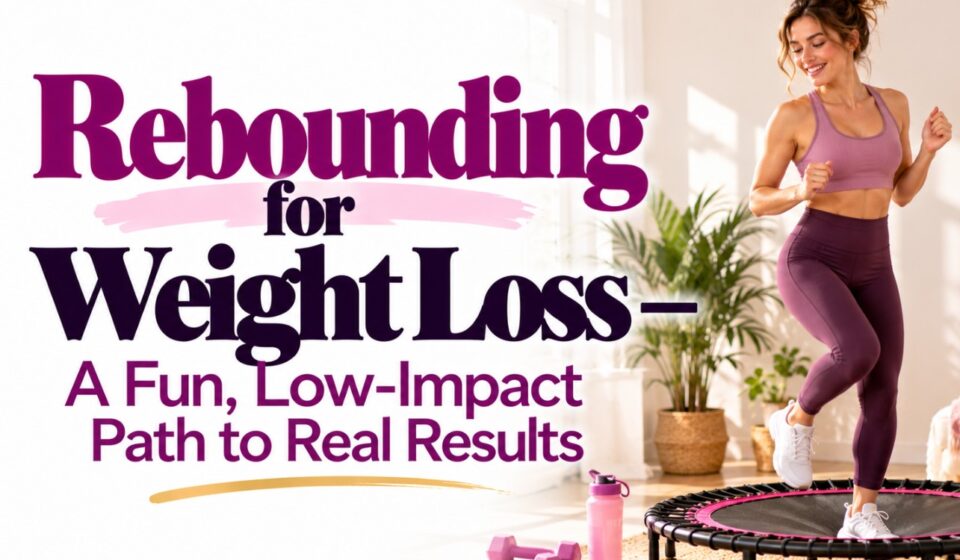

Jumping on a mini trampoline for fat loss — here’s the honest evidence on what it does and doesn’t do
Rebounding — bouncing on a mini trampoline — has attracted significant attention as a weight loss and fitness tool. It’s been promoted for everything from lymphatic drainage to calorie burning to bone density. Some claims are legitimate. Others are significantly overstated.
Here’s the complete honest guide to rebounding for weight loss.

What Rebounding Actually Is
Rebounding is aerobic exercise performed on a mini trampoline (rebounder) — typically 36-48 inches in diameter, designed for home use rather than gymnastics.
Different from:
- Full-size trampolines — larger, higher bounce, different physics
- Gymnastics/competitive trampolining — completely different activity
Types of rebounders:
- Basic spring rebounders: Traditional springs, lower cost, more bounce noise, lower durability
- Bungee cord rebounders: Softer, quieter, lower impact, typically higher cost — preferred for joint-sensitive users
- Folding rebounders: Portable, storable — slightly less stable
A typical rebounding session:
Bouncing at varying intensities — from a gentle health bounce (feet barely leaving the mat) to jogging in place, jumping jacks, and higher-intensity movements — for 20-45 minutes.
How Many Calories Does Rebounding Burn?
The research-based estimates:
A 2016 ACE (American Council on Exercise) study — one of the most cited rebounding research papers — found that a vigorous rebounding session burned:
- Average: 9.4-12.4 calories per minute for men
- Average: 7.2-9.4 calories per minute for women
Per 30-minute session (150 lb person):
- Moderate intensity rebounding: approximately 200-250 calories
- Vigorous rebounding: approximately 280-350 calories
How this compares:
| Exercise | Calories/30 min (150 lb) |
|---|---|
| Rebounding (moderate) | 200-250 |
| Brisk walking | 150-180 |
| Jogging (5mph) | 280-320 |
| Cycling (moderate) | 240-280 |
| Swimming | 250-300 |
| Zumba | 200-260 |
As covered in our guide to zumba for weight loss — rebounding produces comparable calorie burn to Zumba and brisk jogging, at lower joint impact than running.
The important caveat:
Calorie burn varies significantly with intensity. Gentle bouncing (the “health bounce” where feet barely leave the mat) burns far fewer calories than vigorous jumping. The ACE study used vigorous effort — casual bouncing produces significantly lower results.
Why Rebounding Is Genuinely Useful for Weight Loss
Low Impact — High Intensity Potential
The defining characteristic of rebounding — the trampoline mat absorbs approximately 87% of the impact shock that running on hard surfaces produces. This means:
- Joints experience significantly less stress than running
- Higher intensity is sustainable for longer before discomfort
- People with knee, hip, and back issues can exercise at intensities that would be painful on land
As covered in our guide to how to lose weight with knee pain — low-impact aerobic exercise is one of the most important alternatives for people who cannot tolerate running or high-impact activity. Rebounding provides the cardiovascular intensity of jogging at a fraction of the joint stress.
Cardiovascular Fitness Improvement
The ACE study found rebounding produced heart rates of 68-82% of maximum — solidly in Zone 3-4 as covered in our guide to ideal heart rate for weight loss. This intensity produces genuine cardiovascular fitness improvement and meaningful EPOC (afterburn effect).
Enjoyment and Adherence
Like Zumba — rebounding has an enjoyment advantage over conventional cardio. The bouncing sensation is inherently playful and novel — many people find it significantly more enjoyable than treadmill running or cycling.
As covered in our guide to how to stay consistent with weight loss — exercise enjoyment is one of the strongest predictors of long-term adherence. An exercise you enjoy doing 4 times per week produces better results than a superior exercise you do twice before quitting.
Accessibility — Home Exercise With No Commute
A quality rebounder ($100-300) eliminates gym commute, gym fees, and weather dependence. The ability to bounce for 20 minutes at home — even during bad weather, late evenings, or busy schedules — removes the logistical barriers that cause gym-based exercise to lapse.
As covered in our guide to how to lose weight with a busy schedule — home exercise accessibility is one of the most significant factors in real-world exercise adherence.
Lymphatic System Benefits — The Most Unique Claim
This is where rebounding’s marketing gets most excited — and where honest assessment is most needed.
What the lymphatic system is:
The lymphatic system is a network of vessels and nodes that drains fluid from tissues, carries immune cells, and returns proteins and waste products to the bloodstream. Unlike the cardiovascular system — the lymphatic system has no pump. It relies on muscle contractions and body movement to circulate lymph fluid.
The rebounding-lymphatic claim:
The vertical G-force changes during bouncing — alternating between acceleration (going up) and deceleration (coming down) — create rhythmic pumping action that moves lymph fluid more effectively than most other exercises.
What the evidence actually shows:
- Exercise generally improves lymphatic circulation — this is well-established
- Whether rebounding specifically is superior to other exercise for lymphatic drainage is not well-established in clinical research
- The claims about rebounding “detoxifying” through lymphatic drainage are significantly overstated — the lymphatic system’s primary function isn’t detoxification in the way wellness marketing implies
The honest conclusion:
Rebounding probably is beneficial for lymphatic circulation — all exercise is. Whether it’s uniquely superior to walking, swimming, or other movement for lymphatic health is not supported by comparative clinical evidence.

Balance and Coordination Benefits
Rebounding requires and develops balance and proprioception — the body’s sense of its position in space. This benefit is particularly relevant for:
- Older adults — as covered in our guide to how to lose weight after 70 — fall prevention through improved balance is a major health priority in older age
- People rehabilitating from injury
- Anyone with poor balance who wants to develop it alongside cardiovascular fitness
What Rebounding Doesn’t Do
Specifically Target Belly Fat or “Detox”
As with all exercise — rebounding reduces total body fat through calorie burning and cardiovascular improvement. It doesn’t spot-reduce fat from specific areas and doesn’t “detox” the body in any meaningful sense beyond what general circulation improvement achieves.
Replace Strength Training
Rebounding is cardiovascular exercise — it doesn’t provide the resistance training stimulus needed for significant muscle building. As covered in our guide to cardio vs weights for fat loss — the best body composition outcomes combine cardiovascular exercise with resistance training.
Rebounding as the sole exercise leaves muscle building unaddressed — missing the body composition improvement and metabolic rate support that strength training provides.
Produce Weight Loss Without Dietary Attention
As covered in our guide to why am I not losing weight in a calorie deficit — exercise contributes approximately 20-30% of weight loss results when diet is also addressed. Rebounding burns real calories — but post-exercise compensation (eating more) can eliminate the deficit if dietary awareness is absent.
Rebounding Protocols for Weight Loss
Beginner Protocol (Weeks 1-4)
Start conservatively — even gentle bouncing activates muscles that aren’t used to this movement pattern.
Session structure:
- 5 minutes gentle health bounce (feet barely leave mat)
- 5 minutes light jogging in place
- 5 minutes health bounce recovery
- 5 minutes light jogging
- Total: 20 minutes, 3 sessions per week
Calorie burn: Approximately 100-150 calories per session
Intermediate Protocol (Weeks 4-8)
Session structure:
- 3 minutes health bounce warm-up
- 8 minutes moderate jogging in place
- 2 minutes jumping jacks
- 8 minutes moderate jogging
- 2 minutes jumping jacks
- 2 minutes cool-down bounce
- Total: 25 minutes, 4 sessions per week
Calorie burn: Approximately 175-225 calories per session
Advanced Protocol (Ongoing)
HIIT rebounding:
- 2 minutes moderate bounce (warm-up)
- 30 seconds maximum effort jumping
- 30 seconds gentle health bounce (recovery)
- Repeat 10-15 times
- 2 minutes cool-down
- Total: 25-30 minutes, 4-5 sessions per week
Calorie burn: Approximately 250-350 calories per session with significant EPOC
As covered in our guide to aerobic exercise for weight loss — HIIT protocols produce higher total calorie burn through afterburn effects than equivalent-duration steady-state exercise.
Adding Rebounding to an Existing Routine
Rebounding works excellently as:
- Morning cardio before strength training
- Active recovery between strength sessions
- Evening movement session for people with sedentary jobs
As covered in our guide to how many steps to lose weight — rebounding sessions count toward daily activity targets while providing structured cardiovascular work beyond step counting.
Choosing a Rebounder
For weight loss and general fitness:
Budget option ($50-100):
Basic spring rebounders — functional but noisier and higher impact. Adequate for getting started.
Mid-range ($100-200):
Better spring quality or entry-level bungee rebounders. Quieter, more durable, lower impact. The best value range for most people.
Premium ($200-400):
Quality bungee rebounders (Bellicon, JumpSport) — very low impact, quiet, durable, better bounce quality. Worth the investment for people with joint issues or serious use.
Key features to look for:
- Weight capacity above your body weight
- Stability bar option (useful for beginners and older adults)
- Bungee vs spring (bungee is lower impact)
- Size (40-48 inches is typical for adults)
- Foldability if storage matters
Safety Considerations
General safety:
- Start slowly — the unstable surface challenges balance in ways flat ground doesn’t
- Use a stability bar initially if balance is a concern
- Check weight capacity before purchasing
- Clear surrounding space of furniture
Who should be cautious:
- Pregnancy — consult doctor before rebounding
- Recent joint surgery or injury — consult doctor
- Severe balance disorders — use stability bar or choose alternative exercise
- Osteoporosis — rebounding’s impact may be contraindicated; consult doctor
Who should NOT rebound without medical clearance:
- Recent hip or knee replacement
- Significant balance impairment
- Prolapse or pelvic floor weakness — the bouncing motion can worsen pelvic floor issues; low-impact pelvic-floor-safe alternatives may be more appropriate
Rebounding vs. Other Low-Impact Cardio Options
| Exercise | Calorie burn | Joint impact | Cost | Enjoyment | Accessibility |
|---|---|---|---|---|---|
| Rebounding | High | Very low | Medium (equipment) | High | Very high (home) |
| Swimming | High | Very low | Low-medium | High | Lower (pool needed) |
| Cycling | High | Low | Medium-high | Medium | Medium |
| Walking | Moderate | Low | None | Moderate | Very high |
| Elliptical | High | Low | High | Low-medium | Lower (gym) |
| Incline walking | High | Low | Medium (treadmill) | Medium | Medium |
As covered in our guide to incline walking for weight loss — incline walking produces comparable calorie burn with even lower joint impact than rebounding. Both are excellent choices for people avoiding running.
Realistic Results From Rebounding
Month 1 (3 sessions/week, 20-25 minutes):
- Cardiovascular fitness improving noticeably
- Balance and coordination improving
- Modest calorie contribution (600-750 calories/week from sessions)
- Scale changes minimal if diet unchanged
Month 2-3 (4 sessions/week, 30 minutes):
- Sessions feel easier — intensity can increase
- Calorie contribution meaningful (1,000-1,200 cal/week)
- With dietary attention: visible fat loss beginning
Month 3-6 (consistent 4-5 sessions/week):
- Significant cardiovascular improvement
- 1,200-1,750 weekly calories from rebounding
- Combined with dietary deficit: meaningful and visible fat loss
- Balance and proprioception substantially improved
The Bottom Line
Is rebounding good for weight loss?
Yes — genuinely:
- ✅ Burns 200-350 calories per 30-minute vigorous session
- ✅ Reaches Zone 3-4 heart rate — effective cardiovascular exercise
- ✅ Very low joint impact — accessible for people who can’t run
- ✅ High enjoyment factor — better adherence than conventional cardio
- ✅ Home accessibility removes logistical barriers
- ✅ Improves balance and coordination — particularly valuable for older adults
- ✅ Lymphatic circulation benefits — real if less dramatic than claimed
The honest limitations:
- ❌ Doesn’t replace strength training for body composition
- ❌ Lymphatic “detox” claims significantly overstated
- ❌ Gentle bouncing burns far fewer calories than vigorous sessions
- ❌ Doesn’t produce results without dietary attention
The practical recommendation:
Rebounding is a genuinely effective, enjoyable, low-impact cardiovascular exercise particularly suited to home use, people with joint sensitivities, and anyone who finds conventional cardio boring. 4 sessions per week of 25-30 minutes vigorous rebounding produces meaningful calorie contribution to a weight loss approach.
For the complete exercise framework, our guides to aerobic exercise for weight loss and how to stay consistent with weight loss cover where rebounding fits in the broader picture.
Do you rebound regularly — and have you found it more sustainable than other cardio options? Share your experience in the comments.
Stop Wondering What to Eat This Week
Get my free 7-Day High-Protein Weight Loss Meal Plan delivered straight to your inbox — a simple week of satisfying, protein-focused meals designed to make healthy eating easier without complicated calorie tracking.
- 7 full days of breakfast, lunch, dinner & snacks
- One complete shopping list for the whole week
- A quick high-protein food cheat sheet
- Simple daily tips to help you stay on track
Free PDF • Delivered by email • Unsubscribe anytime
Check your inbox 💜
Your free 7-day high-protein meal plan is on its way.