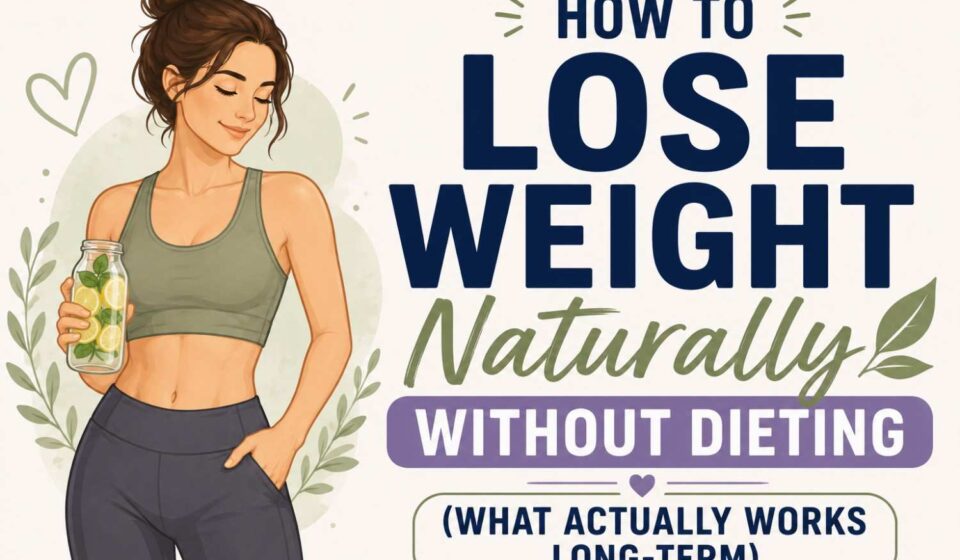
How to Lose Weight Naturally Without Dieting (What Actually Works Long-Term)

Tired of diets that don’t last? Here’s how to lose weight through habits rather than rules

“Dieting” — in the conventional sense of following a set of food rules until you reach a goal — has a failure rate approaching 95% at five years. Most people who diet lose weight and regain it within months of stopping. The diet ends; the weight returns.
This isn’t weakness. It’s the predictable consequence of a fundamentally flawed approach: trying to override the body’s hunger and preference signals through willpower and restriction, rather than changing the underlying behaviors and environment that determine what you eat.
Losing weight without dieting means something different: creating conditions where healthy eating and appropriate calorie intake happen naturally and automatically — not because you’re following rules, but because your environment, habits, and lifestyle support them.
This is harder to explain than “eat this, not that” — but it produces the lasting results that dieting almost never does.
The Problem With Conventional Dieting
Standard dieting works on a simple premise: restrict calories by following rules about what you can and can’t eat, lose weight, then stop when you reach your goal.
The problems with this approach are structural, not motivational:
It’s temporary by design. A diet ends. When it ends, the behaviors that produced the weight return — and so does the weight.
It creates deprivation that increases food’s psychological power. Forbidden foods become more appealing, not less. Restriction amplifies the desire for restricted foods through basic psychology.
It relies on willpower — a finite and depleting resource. Willpower is not stable, unlimited, or sufficient for indefinitely overriding strong biological drives. It fails under stress, fatigue, social pressure, and the accumulated weight of restriction over time.

It doesn’t address the underlying habits and environment that produced the weight in the first place. Remove the diet and you remove the only thing standing between the person and the original behaviors.
Non-diet weight loss addresses the causes rather than overriding them.
Strategy 1: Change Your Food Environment Instead of Your Willpower
The most powerful determinant of what you eat is not what you decide to eat — it’s what’s visible, accessible, and convenient. This is environmental design, and it’s more reliable than any dietary rule.
Make healthy food visible and easy:
- Keep fruit in a bowl on the counter where you’ll see it constantly
- Store cut vegetables at eye level in the fridge (not hidden in the crisper)
- Keep healthy snacks — Greek yogurt, cottage cheese, nuts, protein bars — in prominent positions
- Prepare protein sources in advance so they’re as easy to grab as processed food
Make less nutritious food invisible or inconvenient:
- Don’t keep calorie-dense processed snacks in the house
- If you do buy them, store them at the back of high cupboards — out of sight, behind other items
- Don’t walk down the chip and candy aisles in the grocery store
- Use smaller serving bowls and plates for calorie-dense foods
Research consistently shows that people eat what they see and what’s easy to access. Environmental design changes what’s easy and visible without requiring ongoing decision-making or willpower.
As covered in our guide to how to build healthy eating habits for life, environmental design is the difference between behaviors that require willpower and behaviors that happen almost automatically.
Strategy 2: Eat Protein First at Every Meal
This single habit change produces more consistent calorie reduction than most deliberate dietary rules — without any restriction or counting.
Protein is the most satiating macronutrient. A meal built around adequate protein (eggs, chicken, fish, Greek yogurt, legumes) produces more fullness, for longer, than an equivalent calorie meal built around carbohydrates or fat.
Starting each meal with the protein component — eating it before or alongside the other foods — ensures that protein’s satiety effects are engaged before the more calorie-dense parts of the meal are consumed. Multiple studies have found that eating protein first reduces total meal calorie intake compared to eating it later.
In practice: Eat the eggs before the toast. Eat the chicken before the rice. Have the Greek yogurt before the fruit. This doesn’t require counting anything — just a simple order change.
As covered in our guide to how much protein you actually need per day, adequate protein is the most important dietary variable for body composition — and prioritizing it at meals achieves this without any restriction.
Strategy 3: Eat Slowly and Without Screens
This is among the simplest and most evidence-backed behavioral interventions for reducing calorie intake — without reducing enjoyment or imposing any food restrictions.
Satiety hormones (leptin, peptide YY, GLP-1) take 15–20 minutes to register in the brain after eating begins. People who eat quickly consume significantly more food before satiety signals arrive than people who eat slowly. The mechanism is biological, not motivational.
Eating without screens removes the distraction that delays satiety signal registration — people eat 20–40% more when distracted by television or phones because the sensory experience of eating doesn’t register fully, delaying fullness.
Implementation:
- Put utensils down between bites
- Chew each bite thoroughly (20–30 times for dense food)
- Take a 2-minute pause halfway through any meal
- No screens during meals — this one change alone reduces meal calorie intake by 20% for many people
This requires no willpower to decide what to eat — just how to eat it.
Strategy 4: Drink Water Before and During Meals
Drinking a large glass of water 15–20 minutes before a meal reduces meal calorie intake through two mechanisms: physical stomach volume filling, and a mild satiety signal from gastric stretch receptors.
Research has found that people who drink water before meals consistently eat fewer total calories at those meals. Over the course of a day, this produces a meaningful caloric reduction without any dietary restriction.
Additionally, thirst is frequently misinterpreted as hunger — many instances of between-meal hunger are actually mild dehydration. Drinking water first before eating anything in response to hunger sensations resolves a proportion of apparent hunger without food.
Strategy 5: Increase Daily Movement Without “Exercising”
One of the most effective calorie-burning strategies doesn’t look like exercise at all — it looks like the background movement of an active daily life.
NEAT (non-exercise activity thermogenesis) — the calories burned through all movement that isn’t formal exercise — varies by up to 2,000 calories per day between individuals. This is where most of the real difference between “fast” and “slow” metabolism lies — not in biological metabolic rate, but in background daily movement.
NEAT-increasing habits that don’t feel like exercise:
- Take stairs rather than elevators and escalators
- Walk to any destination within 15 minutes instead of driving
- Stand up and move briefly every hour (a 2-minute walk around the office/house)
- Walk during phone calls instead of sitting
- Park further from entrances
- Walk to a colleague’s desk instead of emailing
- Do household tasks with more movement — carry one grocery bag at a time, take multiple trips
As covered in our guide to how to lose weight by walking, consistent daily walking is one of the most effective fat loss activities available — and it doesn’t feel like dieting or exercise for most people.
Strategy 6: Sleep 7–9 Hours
This is perhaps the most counterintuitive “non-diet” weight loss strategy — doing something passive produces one of the most significant fat loss effects available.
Sleep deprivation dramatically increases the hunger hormone ghrelin, decreases the fullness hormone leptin, and depletes the prefrontal cortex function needed for food impulse control — the triple threat that produces overeating the day after poor sleep.
People who consistently sleep under 6 hours eat significantly more total calories and make demonstrably worse food choices than those sleeping 7–9 hours — without any conscious decision to overeat. The biological drive simply overpowers normal restraint.
Improving sleep from 5–6 hours to 7–8 hours reduces daily calorie intake by 200–300 calories in many people — without any dietary change. As covered in our article on why sleep is the most underrated weight loss tool, sleep is the highest-leverage passive fat loss intervention available.
Strategy 7: Manage Stress Daily
Chronic stress drives overeating through multiple mechanisms — cortisol increases appetite for calorie-dense food, emotional eating provides genuine neurochemical relief from stress, and depleted willpower from stress makes resisting food impulses harder.
Daily stress management — not as a wellness luxury but as a behavioral necessity — reduces the cortisol-driven eating that accounts for a significant proportion of excess calorie intake for many people.
Daily stress management that works passively:
- A consistent walking habit (reduces cortisol reliably)
- Adequate sleep (prevents cortisol buildup from deprivation)
- Social connection maintained intentionally
- Reducing unnecessary obligations and learning to say no
- Brief breathing exercises (2–3 minutes of slow breathing genuinely reduces cortisol within minutes)
Strategy 8: Make Cooking and Meal Prep Automatic
The biggest barrier to healthy eating is usually not knowing what to eat — it’s the friction of deciding what to eat and then preparing it when tired, hungry, and without a plan.
Reducing this friction through simple systems makes healthy eating the default rather than the effortful choice:
A small set of go-to meals. Having 5–7 meals that you know well, enjoy, and can prepare without thinking removes the daily decision-making that leads to defaulting to whatever is easiest (usually processed food or takeout).
One batch cooking session per week. Preparing protein (chicken, hard-boiled eggs, lentil soup) and other components once per week means healthy food is as easy to grab during the week as processed food. As covered in our meal prep article, even one or two batch-cooked items transforms weekday eating.
A simple shopping list that stays consistent. Buying the same core items each week removes grocery decision fatigue and ensures the healthy food environment is maintained automatically.
Strategy 9: Build One Habit at a Time
Trying to change everything at once — the all-or-nothing restart that most people attempt — reliably fails for the same reason: it’s not sustainable. Too much change at once overwhelms the behavioral system.
Building one small habit at a time, allowing it to become automatic before adding the next, produces the cumulative behavioral change that actually lasts:
Month 1: Eat protein first at every meal. Month 2: Drink water before meals and stop eating in front of screens. Month 3: Sleep 7–9 hours consistently. Month 4: Walk 8,000 steps daily. Month 5: Batch cook protein once per week. Month 6: Add daily stress management practice.
At 6 months, six habits are established and largely automatic — producing a fundamentally different dietary and lifestyle pattern without any of them having required sustained willpower.
As covered in our article on how to stay consistent with weight loss, systems and habits produce more durable results than motivation or willpower.
What “Natural” Weight Loss Actually Looks Like
Without formal dieting, weight loss is slower than aggressive restriction — typically 0.5–1 lb per week rather than 2+ lbs with a strict diet. This feels frustratingly slow compared to the quick results that diets promise.
But the comparison point is wrong. The question isn’t “is this faster than a crash diet?” — it’s “what approach produces lasting results at 12 months, 2 years, 5 years?”
The answer, consistently, is habit-based lifestyle change rather than rule-based dietary restriction. The slower pace of non-diet weight loss produces results that stay — because the habits that produced the loss continue after the “goal” is reached.
There is no finish line with habit-based weight loss. There’s just gradually improved eating, movement, sleep, and stress management — and the body composition that follows as a natural result.
The Bottom Line
Losing weight without dieting means replacing restriction-based approaches with environment, habits, and systems that make healthy eating natural and automatic.
The strategies that work:
- Design your food environment so healthy choices are easiest
- Eat protein first at every meal
- Eat slowly, without screens
- Drink water before meals
- Increase daily movement through lifestyle rather than formal exercise
- Sleep 7–9 hours — passive but powerful
- Manage stress daily to reduce cortisol-driven eating
- Build automated cooking systems that reduce friction
- Add one habit at a time, never all at once
None of these require counting calories, eliminating food groups, or following rules. They work by changing the conditions under which food decisions are made — making good outcomes the natural result of a well-designed life rather than the effortful product of ongoing willpower.
For the complete dietary framework that underpins these habits — including what to eat for best results — our guide to how to get rid of belly fat covers everything in one place.
What non-diet habit has made the biggest difference to your weight — something that just became part of your life without feeling like a diet? Share in the comments.