
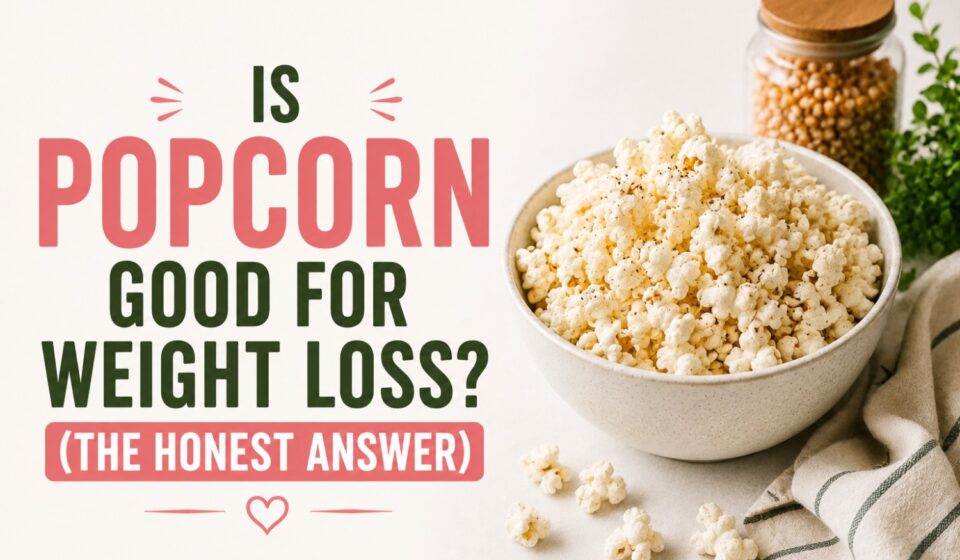

The snack that could be your best friend or worst enemy for fat loss — here’s exactly what determines which one it is
Popcorn occupies a unique position in the weight loss world. Plain air-popped popcorn is genuinely one of the best snacks available for fat loss — high volume, high fiber, low calorie. Movie theater popcorn is one of the worst — an entire day’s calorie budget in a large bucket. The difference between these two extremes is almost entirely preparation and toppings, not the popcorn itself.
Here’s the complete honest guide.

The Nutritional Case for Popcorn
Plain air-popped popcorn (3 cups / approximately 24g):
- Calories: 93
- Protein: 3g
- Fat: 1g
- Carbohydrates: 19g
- Fiber: 3.6g
Three cups of popcorn — a genuinely substantial amount — at 93 calories with 3.6g fiber is an exceptional snack-to-calorie ratio. For comparison:
| Snack | Volume | Calories | Fiber |
|---|---|---|---|
| Air-popped popcorn | 3 cups | 93 | 3.6g |
| Potato chips | 1 oz (about 15 chips) | 152 | 1g |
| Pretzels | 1 oz | 108 | 0.7g |
| Rice crackers | 1 oz | 110 | 0.4g |
| Almonds | 1 oz | 164 | 3.5g |
Popcorn provides more volume, comparable fiber, and fewer calories than virtually every common snack food.
Popcorn Is a Whole Grain
This surprises many people — popcorn is a whole grain, providing the same types of nutrients (B vitamins, magnesium, phosphorus, antioxidants) as other whole grains like oats and brown rice.
The hull of popcorn specifically contains polyphenols — antioxidants that reduce inflammation. Per serving, popcorn actually contains more polyphenols than many fruits and vegetables, making it nutritionally more impressive than its snack food reputation suggests.
The Volume Eating Advantage
As covered in our guide to the best weight loss snacks under 100 calories, volume matters for satiety — filling the stomach activates stretch receptors that signal fullness regardless of calorie count.
3 cups of popcorn provides significantly more physical volume than any chip or cracker at equivalent or higher calories. The volume-to-calorie ratio of air-popped popcorn is exceptional — making it genuinely satisfying in a way that dense, calorie-concentrated snacks aren’t.
Fiber and Satiety
3.6g fiber per 3-cup serving — meaningful fiber content that slows digestion and extends satiety. As covered in our guide to the best high fiber foods for weight loss, fiber is one of the most powerful satiety tools available. Popcorn provides more fiber per calorie than most snack foods.
Why Popcorn Often Sabotages Weight Loss
Despite plain popcorn’s excellent nutritional profile — most popcorn consumed in practice is far from plain.
Movie Theater Popcorn — A Calorie Catastrophe
Movie theater popcorn is one of the most calorie-dense foods available:
| Size | Calories | Fat |
|---|---|---|
| Small (7 cups) | 400-500 | 20-27g |
| Medium (14 cups) | 700-900 | 34-60g |
| Large (20 cups) | 1,000-1,200 | 50-80g |
A large movie theater popcorn with butter topping contains more calories than most people’s entire daily calorie target — from a single snack. The oil used for popping (typically coconut oil or butter-flavored topping) transforms the 31-calorie-per-cup air-popped into 60-90 calories per cup.
Microwave Popcorn — Hidden Calories
Microwave popcorn ranges from acceptable to problematic:
Butter or “movie style” microwave popcorn:
- 160-200 calories per serving
- Often 2.5 servings per bag — so a full bag is 400-500 calories
- High sodium
- Often contains artificial butter flavoring
“Light” or “natural” microwave popcorn:
- 100-130 calories per serving
- Lower fat, lower calorie — more appropriate for weight loss
- Still higher calorie than air-popped
The microwave bag problem: Serving sizes on microwave popcorn bags are often listed as 2.5 servings when most people eat the entire bag — tripling the stated calorie count.
Commercial Flavored Popcorn
Pre-packaged flavored popcorns — cheddar, caramel, white cheddar, kettle corn — are where popcorn most significantly enters weight gain territory:
- Caramel popcorn: 130-150 calories per cup — more than 4x air-popped
- Cheddar popcorn: 140-160 calories per cup — cheese coating adds significant fat
- Kettle corn: 120-140 calories per cup — sugar coating adds calories
- White cheddar: 130-150 calories per cup
These products use popcorn’s “healthy whole grain” marketing while delivering calorie density approaching chips or cookies.
The “Healthy Snack” Permission Effect
Popcorn’s healthy reputation creates a permission effect — people eat significantly more of it than they would of chips, reasoning that “it’s just popcorn.” The volume that looks reasonable (a large bowl) can easily contain 400-600 calories of microwave or flavored popcorn.
The Best Types of Popcorn for Weight Loss
Air-Popped (Best)
Air-popped popcorn — made with a dedicated air popper or in the microwave without oil — is the gold standard:
- 31 calories per cup
- 1.2g fiber per cup
- No added fat
- Maximum volume per calorie
Toppings that keep it weight loss friendly:
- Nutritional yeast (cheesy flavor, adds B vitamins, minimal calories)
- Cinnamon and a tiny amount of stevia (sweet option)
- Smoked paprika, garlic powder, onion powder (savory option)
- Salt and black pepper
- 1 teaspoon of olive oil tossed through + salt (adds 40 calories but significantly improves palatability)
Stovetop Popped With Minimal Oil
Popping in a pot with 1 teaspoon of olive oil adds approximately 40 calories per batch — still very reasonable for the volume produced.
Method: 1 teaspoon olive oil in a lidded pot, medium-high heat, 2-3 popcorn kernels to test, add 1/3 cup kernels when test kernels pop, shake constantly until popping slows.

“Light” Microwave Popcorn
When air-popping isn’t practical — light or natural microwave popcorn at 100-130 calories per serving is acceptable. Read labels carefully and stick to one serving rather than the whole bag.
Pre-Packaged “Simply” Style Popcorn
Some brands (SkinnyPop, Boom Chicka Pop “Simply”) make minimally processed lightly salted popcorn at 130-140 calories per 2-cup serving — higher than air-popped but significantly better than flavored alternatives.
Popcorn vs. Common Snacks — The Weight Loss Comparison
For the same 150 calories:
| Snack | Volume at 150 calories | Fiber | Protein |
|---|---|---|---|
| Air-popped popcorn | ~5 cups | 6g | 5g |
| Potato chips | ~1 oz (15 chips) | 1g | 2g |
| Pretzels | ~1 oz | 0.7g | 3g |
| Crackers | ~10 crackers | 1g | 2g |
| Almonds | ~0.9 oz | 3g | 5g |
At equivalent calories, air-popped popcorn provides dramatically more volume, more fiber, and comparable protein to most snack alternatives. For the specific goal of managing hunger while watching calories — air-popped popcorn is difficult to beat.
Practical Tips for Using Popcorn for Weight Loss
Invest in an air popper: A countertop air popper costs $20-30 and pays for itself quickly — producing the most weight loss friendly popcorn at approximately $0.10 per batch.
Pre-portion servings: Popcorn’s volume makes it easy to overeat without noticing. Pre-portion 3-4 cups into a bowl before eating rather than eating from the bag.
Add protein alongside: Popcorn’s 3g protein per 3-cup serving is too low to anchor a snack on its own. Pair with a protein source (string cheese, Greek yogurt, hard-boiled egg) for more sustained satiety.
Replace evening chip habits: For people who habitually eat chips or crackers in the evening — replacing with air-popped popcorn saves 200-400 calories per snacking session while providing more volume and fiber.
Read microwave labels before buying: The difference between “butter” and “light” microwave popcorn is 60-80 calories per serving — significant over time.
When Popcorn Doesn’t Support Weight Loss
Eating movie theater popcorn: A large bucket with butter is a dietary disaster regardless of what else you eat that day.
Eating flavored commercial popcorn freely: Caramel, cheddar, and kettle corn deliver chip-level calories in popcorn form.
Eating entire microwave bags: The 2.5-serving bag assumption is marketing — most people eat the whole bag.
Using popcorn as a meal replacement: At 93 calories per 3 cups, popcorn lacks the protein and fat to function as a meal — it’s a snack, not a meal.
The Bottom Line
Is popcorn good for weight loss?
Air-popped or lightly oiled popcorn: yes — genuinely excellent.
- Exceptional volume-to-calorie ratio (31 calories per cup)
- Meaningful fiber (3.6g per 3 cups)
- Whole grain with genuine nutritional value
- Highly satisfying per calorie
Movie theater, heavily buttered, or flavored popcorn: no.
- Calorie density approaches or exceeds chips and cookies
- The healthy whole grain status is buried under fat and sugar
The verdict: Popcorn’s weight loss value is almost entirely determined by preparation. The same food that makes an excellent 93-calorie snack becomes a 1,200-calorie disaster depending on how it’s made.
Buy an air popper. Season with nutritional yeast and smoked paprika. Eat 3-4 cups. Stay full for 2 hours on under 100 calories. That’s popcorn at its weight loss best.
For the complete snack guide, our article on the best weight loss snacks under 100 calories covers all the best options in one place.
Do you eat popcorn as a weight loss snack — and what’s your go-to seasoning that makes plain popcorn actually enjoyable? Share in the comments.
Stop Wondering What to Eat This Week
Get my free 7-Day High-Protein Weight Loss Meal Plan delivered straight to your inbox — a simple week of satisfying, protein-focused meals designed to make healthy eating easier without complicated calorie tracking.
- 7 full days of breakfast, lunch, dinner & snacks
- One complete shopping list for the whole week
- A quick high-protein food cheat sheet
- Simple daily tips to help you stay on track
Free PDF • Delivered by email • Unsubscribe anytime
Check your inbox 💜
Your free 7-day high-protein meal plan is on its way.


