
High calorie but surprisingly beneficial — here’s which nuts support fat loss and why the calorie math isn’t what you think
Nuts are one of the most counterintuitive weight loss foods. They’re calorie-dense — often 160-200 calories per ounce — yet people who regularly eat nuts consistently weigh less than people who don’t. This paradox has been studied extensively, and the explanation reveals something important about how satiety and fat loss actually work.
Here’s the complete ranked guide to nuts for weight loss — with the honest explanation of why they help despite their calorie density, and exactly how to incorporate them without sabotaging your calorie target.

Why Nuts Support Weight Loss Despite Being Calorie-Dense
The Calorie Absorption Gap
Not all calories in nuts are absorbed. The cellular structure of nuts — intact cell walls that resist digestion — means a significant percentage of their fat passes through unabsorbed. Studies using fecal fat analysis find that:
- Almonds: approximately 20% of calories not absorbed
- Pistachios: approximately 5% not absorbed
- Walnuts: approximately 21% not absorbed
This means the effective calorie count of nuts is meaningfully lower than what labels suggest — the 160 calories per ounce of almonds is closer to 130 effective calories when absorption is accounted for.
Exceptional Satiety
Nuts combine protein, fiber, and fat — the three most satiating macronutrients — in a single food. Studies consistently find that people who add nuts to their diet don’t compensate by eating more at subsequent meals — instead they naturally reduce intake elsewhere.
The satiety effect means the calorie addition from nuts is partially offset by calorie reduction from other foods — making their net calorie impact significantly lower than their label suggests.
Metabolic Benefits
Regular nut consumption is associated with improved insulin sensitivity, reduced inflammation, and better metabolic function — all of which support the hormonal environment that enables fat loss. As covered in our guide to how to improve insulin sensitivity naturally, insulin sensitivity is one of the most important metabolic factors in fat loss.
The Replacement Effect
When nuts replace processed snacks (chips, crackers, cookies) — as they typically do for health-conscious people — the calorie difference is often in favor of nuts despite their density. An ounce of chips contains similar calories to an ounce of almonds but with dramatically less protein, fiber, and satiety.
The Important Caveat: Portion Control Is Non-Negotiable
Despite all the above — nuts are still calorie-dense, and eating them freely without portion awareness will produce calorie surplus and weight gain.
The research showing nuts support weight loss involves controlled portions — typically 1 ounce (28g) daily. A “handful” that’s actually 3 handfuls has tripled the calorie intake without anyone noticing.
The practical rule: Measure nut portions with a food scale or measuring cup until you have an accurate sense of what 1 ounce looks like. It’s smaller than most people think.
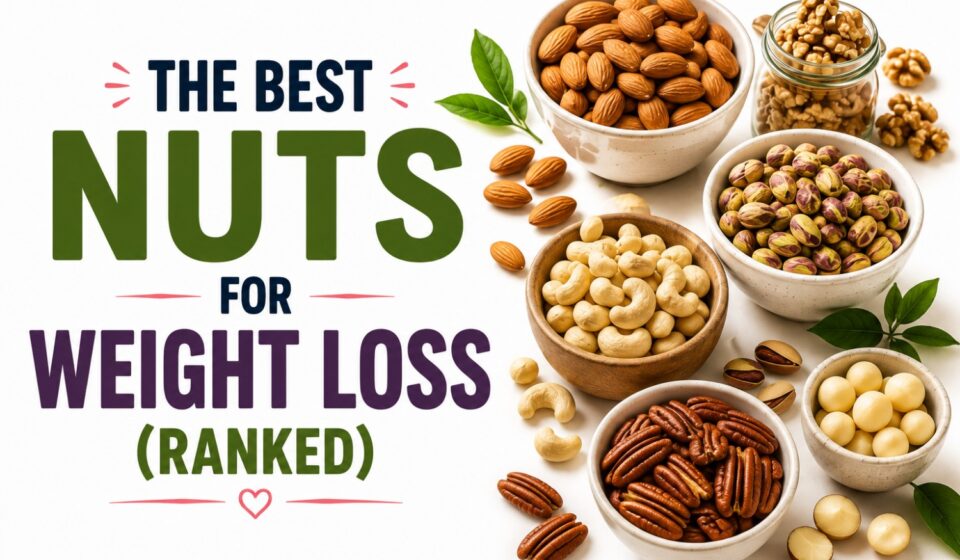
The Best Nuts for Weight Loss — Ranked
1. Almonds — The Best Overall Weight Loss Nut
Per ounce (28g): 164 calories, 6g protein, 3.5g fiber, 14g fat
Almonds have the strongest and most consistent evidence for weight loss support of any nut:
- Multiple randomized controlled trials specifically find almond consumption reduces body weight, waist circumference, and body fat percentage
- The cell wall structure is particularly resistant to digestion — producing one of the highest calorie absorption gaps of any nut (~20% unabsorbed)
- High in vitamin E, magnesium, and calcium
- The highest fiber content of common nuts — contributing to satiety
Magnesium specifically: Almonds are one of the richest dietary sources of magnesium — a mineral that improves insulin sensitivity and is deficient in most people eating Western diets.
Practical: Raw or dry-roasted almonds are best for weight loss. Flavored almonds (honey roasted, BBQ) add sugar and calories that reduce the weight loss benefit.
2. Pistachios — Best for Mindful Eating
Per ounce (28g, in shell): 49 calories (in shell weight) / 159 calories (shelled) Shelled per ounce: 159 calories, 6g protein, 3g fiber, 13g fat
Pistachios have a unique advantage for weight loss: the shells.
Studies specifically on pistachio consumption find that eating in-shell pistachios produces significantly lower calorie intake than eating pre-shelled pistachios — because the physical act of shelling slows eating speed and the empty shells provide a visual cue of how much has been consumed.
This “pistachio principle” — using physical cues to moderate consumption — is one of the more practically useful behavioral findings in weight loss research.
Nutritional highlights:
- Highest protein content of common nuts (6g per ounce)
- High in lutein and zeaxanthin (eye health)
- Rich in B vitamins
- Lower calorie than most nuts per gram
3. Walnuts — Best for Metabolic Health
Per ounce (28g): 185 calories, 4.3g protein, 1.9g fiber, 18g fat
Walnuts are nutritionally unique among nuts for one reason: omega-3 fatty acids. They’re the only common nut with significant ALA (alpha-linolenic acid) omega-3 content — providing 2.5g per ounce.
While ALA is less bioavailable than the EPA and DHA found in fish, it still provides meaningful anti-inflammatory benefit that directly supports the metabolic environment for fat loss. As covered in our guide to the best anti-inflammatory foods for weight loss, reducing inflammation is one of the most impactful dietary interventions for fat loss.
Additional walnut benefits:

- Highest antioxidant activity of any nut
- Rich in ellagic acid — compounds with specific metabolic benefits
- Multiple studies find walnut consumption reduces visceral fat specifically
- Supports gut microbiome diversity
The calorie note: Walnuts are the highest calorie common nut at 185 calories per ounce — portion control is most important here.
4. Cashews — Best for Satiety Per Calorie
Per ounce (28g): 157 calories, 5.2g protein, 0.9g fiber, 12g fat
Cashews are lower in fat than most nuts — making them slightly lower calorie per ounce. They’re also higher in carbohydrates than other nuts (9g per ounce), giving them a slightly different nutritional profile.
The lower fat content means cashews are less satiating per calorie than almonds or walnuts — but they’re also more palatable to people who find other nuts too rich, which improves adherence.
Nutritional highlights:
- Highest zinc content of common nuts (immune function, insulin sensitivity)
- Rich in magnesium and copper
- Creamy texture makes them versatile in cooking
The moderation note: The higher carbohydrate and lower fiber content means cashews have a higher glycemic impact than most nuts — relevant for people with insulin resistance or diabetes.
5. Brazil Nuts — Best Single-Nutrient Density
Per ounce (28g, ~6 nuts): 187 calories, 4.1g protein, 2.1g fiber, 19g fat
Brazil nuts are nutritionally famous for one thing: selenium. A single Brazil nut provides approximately 100% of the daily selenium requirement. Six Brazil nuts provide 6x the daily requirement.
Selenium is essential for thyroid hormone conversion (T4 to T3) — and thyroid function directly affects metabolic rate. Selenium deficiency impairs thyroid function and reduces metabolic rate — addressing deficiency through Brazil nuts can meaningfully improve metabolism.
The important caveat: More is not better with selenium. Selenium toxicity (selenosis) occurs with regular consumption of large amounts — causing hair loss, nail changes, and neurological symptoms. 2-3 Brazil nuts daily provides adequate selenium without toxicity risk. Never eat large handfuls of Brazil nuts regularly.
6. Pecans — Best Flavor-to-Calorie Ratio
Per ounce (28g): 196 calories, 2.6g protein, 2.7g fiber, 20g fat
Pecans are the highest calorie nut — but also one of the most flavorful, meaning a small amount provides significant satisfaction. They’re rich in oleic acid (the same monounsaturated fat as olive oil) and antioxidants.
The high fat content means satiety is excellent — a small portion satisfies. But the low protein and high calorie density make portion control the most important factor with pecans specifically.
Best use for weight loss: Small amounts as a flavor addition to oatmeal, salads, or yogurt — where a tablespoon provides flavor and fat satiety without the calorie impact of eating pecans as a standalone snack.
7. Macadamia Nuts — Lowest Protein, Highest Fat
Per ounce (28g): 204 calories, 2.2g protein, 2.4g fiber, 21.5g fat
Macadamia nuts are the most calorie-dense and lowest protein of common nuts — making them the least optimal for weight loss of those listed here. However they’re rich in palmitoleic acid — a monounsaturated fat with some evidence for metabolic benefit.
Their rich, buttery flavor means they’re highly satisfying in small amounts — but the calorie density requires careful portion management.
Best for: Keto approaches where fat content is prioritized and calories are managed through carbohydrate restriction.
8. Peanuts — Technically a Legume, Practically a Nut
Per ounce (28g): 161 calories, 7.3g protein, 2.4g fiber, 14g fat
Peanuts are technically legumes (they grow underground) but are nutritionally and practically similar to tree nuts. They have the highest protein content of any “nut” — making them the most satiating per calorie.
As covered in our article on is peanut butter good for weight loss, peanuts and peanut butter are genuinely beneficial for weight loss when portions are controlled — the protein-fat combination produces exceptional satiety.
Peanut butter note: Natural peanut butter (ingredients: peanuts, salt) is significantly better for weight loss than conventional peanut butter with added sugar and hydrogenated oils. Check labels.
Nut Butters for Weight Loss
Nut butters provide the same nutritional benefits as whole nuts but with some important differences:
More calorie-dense per serving: Easier to overconsume — 2 tablespoons of almond butter is 190 calories and easy to eat in seconds, while 1 ounce of almonds takes longer.
Check ingredients: Natural nut butters (nuts only, maybe salt) vs. commercial versions with added sugar, palm oil, and hydrogenated fat — dramatically different nutritional profiles.
Best nut butters for weight loss: Almond butter (highest fiber), natural peanut butter (highest protein), walnut butter (omega-3s).
How to Incorporate Nuts for Weight Loss
The Portion Protocol
Standard serving: 1 ounce (28g) — measure with a food scale until you know what it looks like
Pre-portioned bags: Portion weekly nuts into small bags or containers — removes the “just a few more” trap of eating from the bag
Where to eat nuts:
- As a planned snack (replaces processed snacks)
- Added to oatmeal or yogurt (adds fat and protein that extends satiety)
- In salads (adds crunch and nutritional density)
- NOT mindlessly while working, watching TV, or doing anything that removes attention from eating
The Replacement Principle
The research on nuts and weight loss involves nuts replacing other snacks — not being added on top. If you add an ounce of almonds to your existing diet without removing anything else, you add 164 calories net. If you replace a processed snack with an ounce of almonds, the satiety effect and absorption gap mean the net calorie impact is minimal or negative.
The Bottom Line
Best nuts for weight loss — ranked:
- Almonds — strongest evidence, best fiber, highest magnesium
- Pistachios — highest protein, shell-eating slows consumption
- Walnuts — best for inflammation and metabolic health (omega-3s)
- Cashews — good satiety, lower fat, higher zinc
- Brazil nuts — selenium for thyroid function (2-3 daily only)
- Pecans — best flavor for small portions
- Macadamia — high fat, best for keto
- Peanuts — highest protein, excellent value
The practical rules:
- Measure portions — 1 ounce daily
- Replace other snacks — don’t add on top
- Raw or dry-roasted — avoid sugar-coated or heavily salted
- Natural nut butters only — check ingredients
For the complete dietary framework, our guide to how to get rid of belly fat covers everything in one place.
Which nuts do you find most satisfying for weight loss — and do you struggle with portion control? Share in the comments.
Stop Wondering What to Eat This Week
Get my free 7-Day High-Protein Weight Loss Meal Plan delivered straight to your inbox — a simple week of satisfying, protein-focused meals designed to make healthy eating easier without complicated calorie tracking.
- 7 full days of breakfast, lunch, dinner & snacks
- One complete shopping list for the whole week
- A quick high-protein food cheat sheet
- Simple daily tips to help you stay on track
Free PDF • Delivered by email • Unsubscribe anytime
Check your inbox 💜
Your free 7-day high-protein meal plan is on its way.