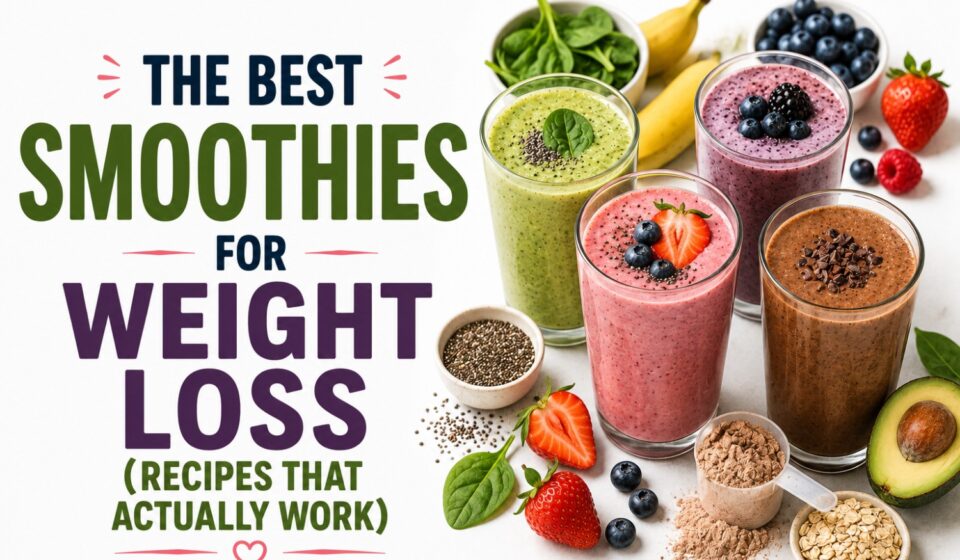

Most smoothies are liquid sugar in disguise — here’s how to build one that supports fat loss instead
Smoothies have a split personality in the weight loss world. A well-built smoothie is one of the most convenient, nutritious, and genuinely filling meals available. A poorly built smoothie — the kind sold at juice bars and made at home with good intentions — is essentially a milkshake with a health halo, delivering 500-800 calories of sugar with minimal protein and no lasting satiety.
The difference between a weight loss smoothie and a weight gain smoothie is not which fruits you use — it’s whether you build the smoothie around protein and fiber first, or around fruit and sweetness first.

Here’s the complete guide.
Why Most Smoothies Fail for Weight Loss
The Liquid Calorie Problem
As covered in our guide to the best and worst drinks for weight loss, liquid calories don’t produce the same satiety as equivalent solid calories. The chewing, digestive, and hormonal signals that tell your brain you’ve eaten are significantly weaker for liquids than solids — meaning you can consume 500 liquid calories without feeling meaningfully full.
This is why smoothies can sabotage weight loss despite containing “healthy” ingredients — the calorie density of multiple fruits blended together isn’t offset by satiety in the way equivalent whole fruit would be.
The Hidden Sugar Problem
A typical “healthy” smoothie from a juice bar might contain:
- 1 banana: 105 calories, 27g sugar
- 1 cup mango: 99 calories, 23g sugar
- 1 cup pineapple: 83 calories, 16g sugar
- 1 cup orange juice: 112 calories, 21g sugar
- Honey (1 tablespoon): 64 calories, 17g sugar
Total: 463 calories, 104g sugar — before any other ingredients
This amount of sugar — even from natural sources — floods the bloodstream rapidly (no fiber to slow absorption when blended), producing insulin spikes that promote fat storage and hunger rebounds within 1-2 hours.
The Missing Protein Problem
Most homemade and commercial smoothies are built around fruit — providing carbohydrates with minimal protein. Without protein, the satiety effect is minimal and hunger returns quickly despite significant calorie intake.
How to Build a Weight Loss Smoothie
The framework that transforms a sugary drink into a genuine weight loss meal:
Step 1: Start With Protein (Non-Negotiable)
Target 25-35g protein per smoothie to make it a meal rather than a snack.
Best protein sources:
- Protein powder (whey isolate, casein, or plant-based): 20-25g per scoop, 100-120 calories — the most efficient protein addition
- Greek yogurt (plain, non-fat, 200g): 17-20g protein, 116 calories — adds creaminess and probiotic benefit
- Cottage cheese (100g): 11g protein, 98 calories — surprisingly effective in smoothies, virtually tasteless when blended
- Silken tofu (100g): 8g protein, 55 calories — plant-based, neutral flavor
Step 2: Add Fiber
Fiber slows the absorption of fruit sugars, extends satiety, and feeds beneficial gut bacteria.
Best fiber additions:
- Chia seeds (1 tablespoon): 5g fiber, 58 calories — virtually tasteless, thickens slightly
- Ground flaxseed (1 tablespoon): 2g fiber, 37 calories — mild nutty flavor
- Spinach (large handful): 1g fiber, 7 calories — completely tasteless in smoothies, invisible nutritional upgrade
- Kale (small handful): 1g fiber, 17 calories — detectable flavor, use less
- Oats (2 tablespoons): 2g fiber, 75 calories — adds thickness and slow-releasing carbohydrates
Step 3: Choose Fruit Wisely and Limit Quantity
Fruit provides natural sweetness, vitamins, and antioxidants — but also sugar. The goal is flavor and nutrition without excessive sugar load.
Best fruits for weight loss smoothies:
- Frozen berries (1/2 cup): 40-65 calories, 3-4g fiber, low sugar — the best smoothie fruit
- Banana (half): 53 calories, 13g sugar — adds creaminess and natural sweetness; half is enough
- Frozen mango (1/4 cup): 25 calories, 6g sugar — intense flavor in small amounts
What to limit:
- Multiple whole bananas
- Fruit juice as liquid base (concentrates sugar, removes fiber)
- Dates or honey as sweeteners (very high sugar)
- Tropical fruit in large amounts
Step 4: Choose the Right Liquid Base
Best liquid bases:
- Unsweetened almond milk (240ml): 30-40 calories — lowest calorie liquid base
- Unsweetened oat milk (240ml): 90 calories — creamier, slightly higher calorie
- Water: 0 calories — perfectly acceptable, slightly thinner texture
- Plain kefir (240ml): 110 calories, 11g protein, probiotics — adds protein and gut health benefit
Avoid:
- Fruit juice (concentrates sugar)
- Sweetened plant milks (hidden sugar)
- Coconut milk (very high calorie)
Step 5: Optional Power Additions
Small additions that add nutritional value without significant calories:
- Matcha powder (1 teaspoon): antioxidants, mild caffeine boost for fat oxidation
- Cinnamon (1/2 teaspoon): improves insulin sensitivity, zero calories
- Ginger (small piece or 1/4 teaspoon powder): anti-inflammatory, digestive benefit
- Turmeric (1/4 teaspoon): anti-inflammatory, pairs with black pepper
- Cocoa powder (1 tablespoon): antioxidants, chocolate flavor, 20 calories
- MCT oil (1 teaspoon): ketone production, appetite suppression — introduce gradually
The Best Weight Loss Smoothie Recipes
1. The High-Protein Green Smoothie (Most Recommended)
Ingredients:
- 1 scoop vanilla protein powder (25g protein)
- Large handful spinach
- 1/2 frozen banana
- 1/2 cup frozen blueberries
- 1 tablespoon chia seeds
- 240ml unsweetened almond milk
- Ice
Nutrition: ~320 calories, 30g protein, 8g fiber, 18g sugar
Why it works: The protein powder anchors satiety, spinach adds micronutrients invisibly, blueberries provide antioxidants at low sugar cost, chia seeds add fiber. This smoothie keeps most people full for 3-4 hours.
2. The Greek Yogurt Berry Smoothie (No Protein Powder)
Ingredients:

- 200g plain non-fat Greek yogurt
- 1 cup frozen mixed berries
- 1 tablespoon ground flaxseed
- 1/2 teaspoon cinnamon
- 180ml unsweetened almond milk
- Ice
Nutrition: ~250 calories, 20g protein, 7g fiber, 20g sugar
Why it works: Greek yogurt provides protein and probiotics without protein powder. The berry-cinnamon combination is genuinely delicious. The flaxseed adds fiber and omega-3s invisibly.
3. The Chocolate Protein Smoothie (Dessert Replacement)
Ingredients:
- 1 scoop chocolate protein powder
- 1 tablespoon unsweetened cocoa powder
- 1/2 frozen banana
- 200g plain Greek yogurt
- 1 tablespoon almond butter
- 240ml unsweetened almond milk
- Ice
Nutrition: ~380 calories, 38g protein, 5g fiber, 16g sugar
Why it works: Replaces chocolate cravings with a genuinely satisfying high-protein meal. The combination of protein powder and Greek yogurt produces extraordinary protein content. The almond butter adds healthy fat that extends satiety.
Warning: The almond butter adds 98 calories — measure carefully.
4. The Anti-Inflammatory Green Smoothie
Ingredients:
- Large handful spinach
- Small handful kale
- 1/2 cup frozen mango
- 1/2 cup frozen pineapple
- 1 scoop vanilla protein powder
- 1/4 teaspoon turmeric
- 1/4 teaspoon ginger
- Pinch of black pepper (activates turmeric)
- 240ml unsweetened almond milk
Nutrition: ~300 calories, 28g protein, 5g fiber, 22g sugar
Why it works: The turmeric-ginger-black pepper combination has specific anti-inflammatory evidence. As covered in our guide to the best anti-inflammatory foods for weight loss, reducing inflammation directly supports fat loss. The tropical fruit sweetness makes the green vegetables undetectable.
5. The Overnight Oat Smoothie (Most Filling)
Ingredients:
- 3 tablespoons rolled oats
- 1 scoop vanilla protein powder
- 1/2 cup frozen blueberries
- 200g plain Greek yogurt
- 1 tablespoon chia seeds
- 240ml unsweetened almond milk
- Cinnamon
Nutrition: ~400 calories, 35g protein, 9g fiber, 14g sugar
Why it works: The oats add beta-glucan fiber — the same viscous fiber that makes oatmeal so satiating. The fiber-protein-fat combination from oats, protein powder, yogurt, and chia seeds produces satiety lasting 4-5 hours. This is genuinely a meal replacement.
6. The Low-Calorie Detox Smoothie (Lowest Calorie Option)
Ingredients:
- Large handful spinach
- 1/2 cucumber
- 1/2 green apple
- Juice of 1/2 lemon
- 1 tablespoon chia seeds
- 1 teaspoon ginger
- 300ml water
- Ice
Nutrition: ~120 calories, 3g protein, 7g fiber, 10g sugar
Why it works: When the goal is maximum volume and minimum calories — this delivers. The cucumber and spinach add almost no calories while providing volume and micronutrients. Best used as a mid-morning snack rather than a meal, or combined with a protein source.
Note: At 3g protein this is not a meal — pair with Greek yogurt or eggs for adequate protein.
7. The Post-Workout Recovery Smoothie
Ingredients:
- 1.5 scoops vanilla protein powder (35-40g protein)
- 1 banana (full — post-workout carbohydrates are appropriate here)
- 240ml plain kefir
- 1 tablespoon honey (post-workout, fast carbohydrates are appropriate)
- 240ml water or almond milk
Nutrition: ~450 calories, 45g protein, 2g fiber, 45g sugar
Why it works: Post-workout is the one context where higher sugar and lower fiber are appropriate — muscles are primed to absorb glucose rapidly for glycogen replenishment. The very high protein supports muscle repair. This is specifically a post-workout smoothie — not appropriate as a general meal replacement.
What Makes a Smoothie Weight Loss Friendly vs. Not
| Feature | Weight Loss Smoothie | Weight Gain Smoothie |
|---|---|---|
| Protein | 25-40g | Under 10g |
| Fiber | 5-10g | Under 2g |
| Sugar | Under 25g | Over 50g |
| Calories | 250-400 | 500-800+ |
| Liquid base | Unsweetened plant milk/water | Fruit juice |
| Primary ingredient | Protein source | Fruit |
| Satiety duration | 3-4 hours | 1-2 hours |
The Smoothie vs. Whole Food Question
Smoothies are convenient and nutritious — but worth noting that equivalent whole foods are generally more satiating:
The same ingredients eaten as a meal (Greek yogurt bowl with berries and chia seeds) keeps most people fuller longer than the same ingredients blended — because chewing, gastric processing of solid food, and the time taken to eat solid food all contribute to satiety beyond just the nutritional content.
Use smoothies for convenience — when time is short, appetite is low, or you need a portable meal. When you have time to eat whole food, prioritize that.
Practical Tips
Batch prep: Portion smoothie ingredients into freezer bags weekly. Each morning, dump one bag into a blender and add liquid. Zero decision-making, zero prep time.
Don’t add juice: The most common smoothie mistake. Juice removes fiber and concentrates sugar — use water or unsweetened plant milk instead.
Measure calorie-dense ingredients: Nut butters, protein powder, oats — measure with a tablespoon or scale. “A scoop” of almond butter can easily be 4 tablespoons (400 calories).
Drink slowly: Eating speed affects satiety. Drinking a smoothie in 30 seconds produces less satiety than sipping it over 10 minutes.
The Bottom Line
Weight loss smoothies are built on:
- 25-35g protein — protein powder, Greek yogurt, or cottage cheese
- Fiber additions — chia seeds, ground flaxseed, spinach, oats
- Limited fruit — half banana maximum, prioritize berries
- Unsweetened liquid base — almond milk, water, kefir
- No fruit juice, no honey, no sweetened additions
The best weight loss smoothie recipes in order:
- High-protein green smoothie
- Greek yogurt berry smoothie
- Overnight oat smoothie
- Chocolate protein smoothie
- Anti-inflammatory green smoothie
For the complete dietary framework, our guide to how to get rid of belly fat covers everything in one place.
What’s your go-to weight loss smoothie — and what ingredient makes the biggest difference to how full you feel? Share in the comments.
Stop Wondering What to Eat This Week
Get my free 7-Day High-Protein Weight Loss Meal Plan delivered straight to your inbox — a simple week of satisfying, protein-focused meals designed to make healthy eating easier without complicated calorie tracking.
- 7 full days of breakfast, lunch, dinner & snacks
- One complete shopping list for the whole week
- A quick high-protein food cheat sheet
- Simple daily tips to help you stay on track
Free PDF • Delivered by email • Unsubscribe anytime
Check your inbox 💜
Your free 7-day high-protein meal plan is on its way.