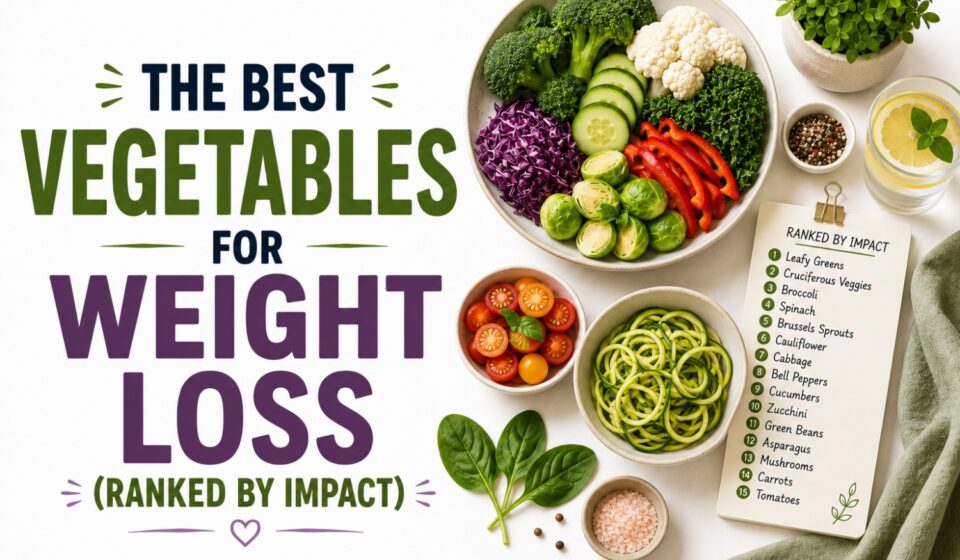

Not all vegetables are equal for fat loss — here’s which ones to prioritize and why
“Eat more vegetables” is the most universally agreed-upon dietary advice in nutrition — and for weight loss specifically, vegetables are the closest thing to a free lunch that exists. Most are extremely low in calories, high in fiber and water content, and filling enough to significantly reduce overall calorie intake when they make up a substantial portion of meals.
But not all vegetables are equal for weight loss. Some are nutritionally dense and extraordinarily low calorie. Others are higher in starch and calories. And some have specific properties — fiber types, phytonutrients, water content — that make them particularly valuable for fat loss.
Here’s the complete, ranked guide.
Why Vegetables Are So Powerful for Weight Loss
Volume Eating — The Core Mechanism
The most important reason vegetables support weight loss: they allow you to eat large volumes of food for very few calories — filling your stomach and satisfying hunger without meaningfully contributing to your calorie budget.
A large bowl of mixed salad greens with cucumber and tomato might contain 50-80 calories. The same volume of pasta contains 400+ calories. The physical satiety from stomach stretching is similar — the calorie cost is dramatically different.
Fiber Content
As covered in our guide to the best high fiber foods for weight loss, fiber is one of the most powerful weight loss tools available — and vegetables are among the primary dietary fiber sources. The fiber in vegetables slows digestion, feeds beneficial gut bacteria, stabilizes blood sugar, and extends fullness significantly.
Water Content
Most non-starchy vegetables are 85-95% water by weight. This water content contributes to physical fullness without any calorie cost — and helps maintain the hydration that supports fat metabolism.
Micronutrients and Metabolic Support
Vegetables provide vitamins, minerals, and phytonutrients that support the metabolic processes underlying fat loss — magnesium for insulin sensitivity, B vitamins for energy metabolism, antioxidants that reduce the inflammation that impairs fat loss.
Displacement Effect
Eating more vegetables naturally displaces higher-calorie foods — a meal built around vegetables leaves less room (physically and psychologically) for calorie-dense foods.
Non-Starchy vs. Starchy Vegetables — The Key Distinction
Non-starchy vegetables: Very low calorie (10-50 calories per cup), high water content, high fiber relative to calories. These are the weight loss powerhouses — eat as much as you want.
Starchy vegetables: Higher calorie (80-150+ calories per cup), higher carbohydrate content. These are nutritious and healthy but require portion awareness in a calorie deficit.
The ranking below focuses primarily on non-starchy vegetables — the ones that can be eaten in virtually unlimited quantities without affecting calorie targets.
The Best Vegetables for Weight Loss — Ranked
Tier 1: Eat As Much As You Want (Under 25 calories per cup)
1. Cucumber — 16 calories per cup
Cucumber is 96% water — among the most hydrating foods available. At 16 calories per cup it is essentially calorie-free in any practical amount. The crunch and water content contribute meaningfully to satiety despite the negligible calorie cost.
Cucumber is also one of the most versatile vegetables for weight loss — works raw as a snack, in salads, with hummus, or as a low-calorie base for various preparations.
2. Iceberg and Romaine Lettuce — 10-15 calories per cup
Lettuce is the ultimate volume eating food — virtually zero calories with meaningful fiber and water content. A large salad base of romaine provides genuine physical fullness at essentially zero calorie cost.
Romaine specifically provides more nutritional value than iceberg — vitamin K, folate, and beta-carotene alongside similar calorie content.
3. Celery — 16 calories per cup
Famous for the “negative calorie” myth (it doesn’t actually burn more calories to digest than it contains — that’s not real) — but celery IS extraordinarily low calorie. The crunch and fiber make it genuinely satisfying as a snack, particularly with a small amount of almond butter or hummus.
4. Radishes — 19 calories per cup
Underrated for weight loss — radishes add crunch, color, and peppery flavor to salads with negligible calorie contribution. Also high in vitamin C and contain compounds that support liver function relevant to fat metabolism.
5. Spinach — 7 calories per cup raw
Spinach is one of the most nutritionally dense foods per calorie available anywhere — iron, magnesium, folate, vitamin K, vitamin A, and antioxidants at essentially zero caloric cost. Raw spinach wilts dramatically when cooked — a large bag of raw spinach becomes a small portion cooked, making it easy to consume very large nutritional quantities.
The magnesium in spinach directly supports insulin sensitivity — as covered in our guide to how to improve insulin sensitivity naturally.
6. Zucchini — 20 calories per cup
Zucchini’s mild flavor and versatility make it one of the most useful weight loss vegetables — it can substitute for pasta (spiralized), add bulk to sauces, or be grilled, roasted, or eaten raw. At 20 calories per cup it adds significant volume and fiber to meals for negligible calorie cost.
7. Mushrooms — 15 calories per cup
Mushrooms are unique among vegetables — their umami flavor and meaty texture provide genuine satisfaction in ways that most low-calorie foods don’t. Studies specifically on mushroom consumption find they reduce calorie intake at subsequent meals through their satiety-promoting properties.
Mushrooms also contain beta-glucan — the same viscous soluble fiber found in oats that has strong satiety evidence.
8. Bell Peppers — 31 calories per cup
Bell peppers are slightly higher calorie than the vegetables above — but still extremely low — while providing the highest vitamin C content of any common vegetable (red peppers have 3x more vitamin C than oranges by weight). Their crunch, sweetness, and versatility make them one of the most satisfying raw snack vegetables available.
Tier 2: Excellent for Weight Loss (25-60 calories per cup)
9. Broccoli — 55 calories per cup cooked
Broccoli is the most nutritionally complete of the cruciferous vegetables — providing fiber, protein (relatively high for a vegetable at 4g per cup), vitamin C, vitamin K, and sulforaphane (a compound with specific anti-inflammatory and potentially anti-cancer properties).
The protein content is unusual for a vegetable and contributes meaningfully to satiety. As covered in our guide to the best anti-inflammatory foods for weight loss, cruciferous vegetables’ sulforaphane reduces the inflammation that impairs fat loss.
Practical tip: Roasting broccoli at 425°F with olive oil and salt until slightly charred transforms it completely — it becomes genuinely delicious rather than something to endure.
10. Cauliflower — 28 calories per cup
Cauliflower’s most valuable weight loss property is its versatility as a substitute for higher-calorie foods:
- Cauliflower rice: replaces white rice at 80% fewer calories
- Cauliflower mash: replaces mashed potato at significantly fewer calories
- Roasted cauliflower: genuinely satisfying as a side dish
The mild flavor absorbs seasonings well — making it one of the most useful “volume extender” vegetables available.
11. Brussels Sprouts — 56 calories per cup cooked
Similar nutritional profile to broccoli — high fiber, vitamin K, vitamin C, and sulforaphane. The reputation for being unpleasant comes entirely from boiling — roasted Brussels sprouts (425°F, olive oil, salt, until outer leaves are crispy) are completely different and genuinely satisfying.
12. Kale — 33 calories per cup raw
Kale is arguably the most nutritionally dense vegetable per calorie available — extraordinary vitamin K, vitamin A, vitamin C, calcium, iron, and antioxidant content at minimal calorie cost. The bitter flavor requires preparation (massaging raw kale with olive oil and lemon softens it dramatically) but the nutritional return is exceptional.
13. Asparagus — 40 calories per cup
Asparagus contains inulin — a prebiotic fiber that specifically feeds Bifidobacterium and Lactobacillus species in the gut microbiome. It also has mild diuretic properties that reduce water retention. High in folate and vitamins K and E.
14. Green Beans — 44 calories per cup cooked
Green beans provide a satisfying crunch with meaningful fiber content at low calorie cost. Versatile — works as a side dish, in salads, or as a snack.
15. Cabbage — 22 calories per cup raw
Cabbage is one of the most economical weight loss vegetables available — among the cheapest vegetables by weight, with meaningful fiber content and versatile preparation options. Red cabbage specifically is high in anthocyanins — the same anti-inflammatory compounds found in berries.
Tier 3: Nutritious but Portion-Aware (Starchy Vegetables)
These vegetables are highly nutritious and should absolutely be included in a weight loss diet — but their higher calorie and carbohydrate content means portion awareness matters more than with non-starchy vegetables.
16. Sweet Potato — 103 calories per medium potato
Sweet potato is among the most nutritious starchy vegetables — high in beta-carotene, vitamin C, potassium, and fiber. Despite being higher calorie than non-starchy vegetables, sweet potato is significantly lower glycemic than white potato and provides genuine satiety from its fiber content.
As covered in our article on is sweet potato good for weight loss, sweet potato is an excellent carbohydrate choice within a calorie-controlled diet.
17. Corn — 132 calories per cup
Corn is often treated as a vegetable but is nutritionally closer to a grain — providing meaningful fiber alongside higher starch content. Fine in controlled portions but easy to overconsume.
18. Peas — 118 calories per cup
Peas are nutritionally similar to legumes — high in protein (8g per cup) and fiber alongside their carbohydrate content. The protein-fiber combination makes them more satiating than their calorie content suggests.
19. Butternut Squash — 82 calories per cup cooked
High in beta-carotene and fiber — a nutritious starchy vegetable that works well as a lower-calorie substitute for potato in many applications.
Practical Strategies for Eating More Vegetables
The Half-Plate Rule
The simplest and most evidence-backed approach: fill half your plate with non-starchy vegetables at every meal. This single habit naturally reduces calorie intake, increases fiber, and improves nutritional density without any calorie counting.
Roasting Transforms Everything
Most people’s experience of vegetables comes from boiling or steaming — which produces bland, texturally unpleasant results. Roasting at high heat (400-425°F) with olive oil and salt produces caramelization that makes virtually any vegetable genuinely delicious.
The Maillard reaction that occurs during roasting produces flavor compounds that don’t exist in raw or boiled vegetables — this is why restaurant vegetables taste better than home-cooked ones.
Batch Roasting
Roast a large tray of mixed vegetables (broccoli, cauliflower, zucchini, bell peppers, mushrooms) once or twice per week — refrigerate and add to meals throughout the week. This removes the daily barrier of vegetable preparation.
Soup — The Volume Eating Hack
Vegetable soups extend the satiety of vegetables significantly beyond eating them solid — the liquid volume combined with fiber produces fullness that lasts longer than equivalent solid food. A large bowl of vegetable soup before a meal reliably reduces calorie intake at that meal in multiple studies.
Add Vegetables to Everything
Rather than treating vegetables as a side dish — add them to everything:
- Eggs: spinach, mushrooms, bell peppers
- Pasta sauces: zucchini, spinach, mushrooms
- Smoothies: spinach (tasteless, adds nutrients)
- Soups: virtually any vegetable
The Bottom Line
The best vegetables for weight loss — prioritized:
Eat freely (essentially unlimited): Cucumber, lettuce, celery, spinach, zucchini, mushrooms, radishes, bell peppers
Eat generously (1-2 cups per meal): Broccoli, cauliflower, Brussels sprouts, kale, asparagus, green beans, cabbage
Portion aware (treat like a carbohydrate serving): Sweet potato, corn, peas, butternut squash
The practical rule: Fill half your plate with non-starchy vegetables at every meal. Roast them. Add them to everything. This single habit produces more weight loss impact than most specific diets.
For the complete dietary framework that integrates vegetables with protein and calorie management, our guide to how to get rid of belly fat covers everything in one place.
Which vegetables have you found most satisfying for weight loss — and which ones do you struggle to enjoy? Share in the comments.
Stop Wondering What to Eat This Week
Get my free 7-Day High-Protein Weight Loss Meal Plan delivered straight to your inbox — a simple week of satisfying, protein-focused meals designed to make healthy eating easier without complicated calorie tracking.
- 7 full days of breakfast, lunch, dinner & snacks
- One complete shopping list for the whole week
- A quick high-protein food cheat sheet
- Simple daily tips to help you stay on track
Free PDF • Delivered by email • Unsubscribe anytime
Check your inbox 💜
Your free 7-day high-protein meal plan is on its way.