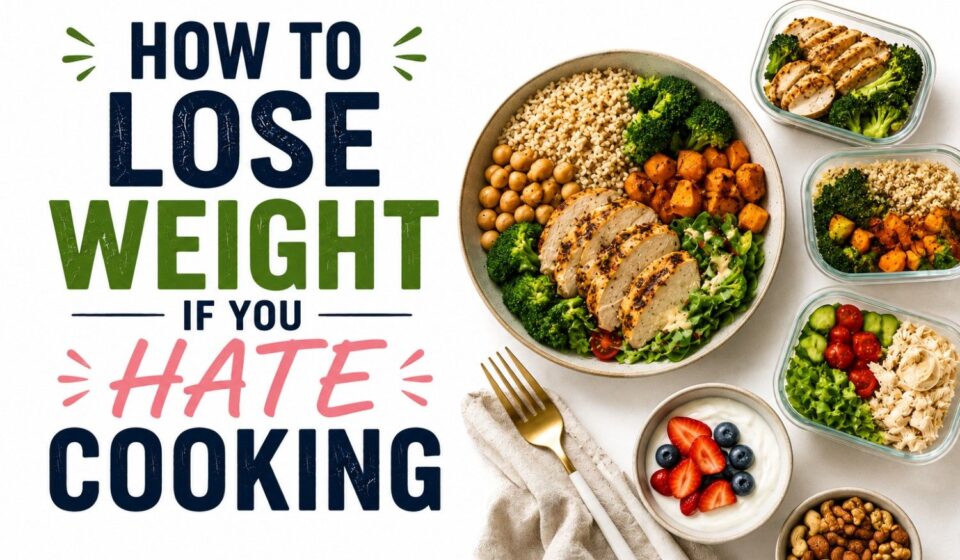
How to Lose Weight if You Hate Cooking (Practical Strategies That Actually Work)

You don’t have to love cooking to lose weight — here’s how to eat well without spending time in the kitchen
Most weight loss advice assumes you enjoy cooking, have time to meal prep, and find satisfaction in preparing food from scratch. For a significant portion of people, none of these are true — and advice that starts from “just batch cook on Sundays” is immediately useless.
If you genuinely hate cooking, find it tedious, stressful, or simply don’t have the time or energy for it — this guide is for you. Here’s how to lose weight without spending meaningful time in the kitchen.
Why You Don’t Have to Cook to Lose Weight
First, the reassurance: cooking is not a requirement for fat loss. What matters for weight loss is a calorie deficit with adequate protein. How those calories are sourced — whether prepared at home or purchased ready-made — is secondary.
The real challenges of not cooking for weight loss are:
- Calorie control: Restaurant and convenience food portions tend to be larger and higher in calories than home-cooked equivalents
- Protein adequacy: Convenient foods often skew toward carbohydrates rather than protein
- Cost: Ready-made healthy food is typically more expensive than home cooking
- Hidden ingredients: Sauces, oils, and additives in prepared food add calories that are invisible without knowing how the food was made
These challenges are all solvable — without cooking.
The No-Cook High-Protein Foods That Make This Possible
The foundation of losing weight without cooking is building meals around foods that require zero preparation:
Protein sources (zero prep):
- Canned tuna or salmon (pull-tab, fork, done) — 26g protein per can
- Rotisserie chicken from the grocery store — pull apart and eat
- Deli turkey or chicken slices — open packet, eat
- Hard-boiled eggs (pre-made from grocery store deli section)
- String cheese and Babybel
- Cottage cheese (open and eat)
- Plain Greek yogurt or skyr (open and eat)
- Canned sardines or mackerel
- Pre-cooked shrimp (available refrigerated at most grocery stores)
As covered in our article on is tuna good for weight loss, canned tuna is one of the best protein-per-calorie foods available — and requires literally zero preparation.
Carbohydrates (zero or minimal prep):
- Pre-washed bagged salad greens
- Baby carrots, cherry tomatoes, cucumber (wash and eat)
- Fruit (apples, bananas, berries — wash and eat)
- Microwaveable rice pouches (90 seconds)
- Pre-cooked lentil pouches (Merchant Gourmet and similar brands)
- Overnight oats (5 minutes the night before, zero morning effort)
Fats:
- Avocado (cut and eat)
- Nuts and nut butter
- Olive oil (drizzle)
- Cheese
The No-Cook Meal Formula
Protein + vegetable or fruit + healthy fat = complete, satisfying meal
Examples that take under 5 minutes with zero cooking:
Breakfast:
- Greek yogurt + berries + handful of nuts
- Overnight oats (prepared the night before in 3 minutes)
- Cottage cheese + fruit + a drizzle of honey
- Hard-boiled eggs + fruit
Lunch:
- Canned tuna + pre-washed salad greens + avocado + olive oil drizzle
- Rotisserie chicken pulled over bagged salad with dressing
- Deli turkey + cheese + cucumber slices + apple
- Pre-cooked lentil pouch + baby spinach + cherry tomatoes + feta
Dinner:
- Rotisserie chicken (buy whole, eat across 2 days) + microwaveable rice pouch + pre-washed salad
- Canned salmon + avocado mashed together + cucumber and crackers
- Pre-cooked shrimp + bagged coleslaw mix + olive oil and lemon
- Greek yogurt-based dip + crudités + deli meat roll-ups
Snacks:
- String cheese + apple
- Cottage cheese + berries
- Tuna from a pull-tab can
- Hard-boiled egg + cherry tomatoes
- Greek yogurt
Strategic Use of Convenience Options
Rotisserie Chicken — The No-Cook Hero
A rotisserie chicken from the grocery store is one of the most useful foods for people who hate cooking:
- Already cooked — pull apart and eat
- Provides 3–4 meals of protein
- Costs $7–12
- Pairs with anything (salad, rice pouch, vegetables)
- Skin on or off depending on calorie budget
Buy one on Sunday (or any day), refrigerate, and have protein available for 2–3 days without any cooking.
Grocery Store Prepared Foods — Used Strategically
Most grocery stores now have extensive prepared food sections — roasted vegetables, grain bowls, protein options, soups, and salads. These are more expensive than cooking but cheaper than restaurants and often more nutritious than takeout.
What to look for:
- Protein-centered options (grilled chicken, salmon, turkey)
- Simple preparations without heavy sauces
- Vegetable sides
What to avoid:
- Creamy or heavily sauced dishes (hidden calories)
- Fried options
- Dishes where you can’t estimate the protein and calorie content
Meal Kit Services
Meal kit services (HelloFresh, Green Chef, Factor, and similar) fall between cooking and not cooking:
Standard meal kits (HelloFresh, Blue Apron): Provide pre-portioned ingredients with simple instructions — typically 15–30 minutes of actual cooking. If the objection is “I don’t know what to cook” rather than “I refuse to cook,” meal kits solve this elegantly.
Ready-to-eat meal delivery (Factor, Trifecta, Green Chef ready meals): Fully cooked, macro-labeled meals that just need reheating. More expensive but genuinely zero cooking. Particularly useful for people who are busy rather than cooking-averse.

Protein Shakes — The Fastest Protein Option
A protein shake takes 60 seconds to make and provides 25–30g of protein. For people who hate cooking, replacing one meal (typically breakfast) with a protein shake + fruit significantly simplifies the day while maintaining protein targets.
As covered in our guide to the best protein powders for weight loss, a quality whey or plant protein with milk, Greek yogurt, and frozen berries produces a complete, filling meal in under 2 minutes.
Eating Out Without Derailing Progress
Since people who hate cooking eat out more — navigating restaurants well is a critical skill.
The protein-first restaurant strategy:
- Choose restaurants where protein-centered options are available (avoid carb-heavy cuisine as the primary option)
- Order the protein (grilled chicken, fish, steak, shrimp) as the main, with salad or vegetables as sides
- Ask for sauces and dressings on the side — most restaurant sauces add 200–400 invisible calories
- Skip the bread basket
- Choose water, sparkling water, or unsweetened beverages
Best restaurant choices for weight loss:
- Sushi (sashimi, edamame, miso soup — high protein, low calorie)
- Mediterranean (grilled meat and fish, salads, hummus)
- Mexican (protein bowls without sour cream and cheese, fajitas without the extras)
- Thai (grilled proteins, salads, soups without heavy coconut milk)
- Steakhouse (straightforward grilled protein with vegetable sides)
Worst restaurant choices:
- Italian (pasta-heavy menus with limited lean protein options)
- American casual dining (enormous portions, calorie-dense everything)
- Chinese-American (heavy sauces, fried options, white rice portions)
As covered in our guide to how to eat healthy at restaurants, the right restaurant strategy makes eating out compatible with fat loss rather than a guaranteed setback.
The Minimum Cooking Threshold
If “zero cooking” is a hard requirement, the strategies above are sufficient. But if the real issue is that cooking feels overwhelming, time-consuming, or requiring too many decisions — a “minimum cooking” approach may be more sustainable than pure no-cook:
The 5 recipes that cover everything:
- Scrambled eggs: 3 minutes. Eggs + salt + butter/olive oil. Zero skill required.
- Pan-seared chicken breast: 12 minutes. Season chicken + olive oil + hot pan + flip once. Done.
- Baked salmon: 12 minutes in oven. Season + olive oil + 400°F. Zero skill.
- Sheet pan vegetables: Chop vegetables + olive oil + salt + 400°F for 20 minutes. Minimal effort.
- Simple stir-fry: Protein + frozen vegetables + soy sauce + olive oil + hot pan, 8 minutes.
These five “recipes” — which aren’t really recipes, they’re just heating food — cover breakfast, lunch, and dinner indefinitely and require under 15 minutes each. If the cooking objection is really about complexity and decisions, these eliminate both.
Tracking Calories Without Cooking
A specific challenge for people who don’t cook: estimating calories in ready-made food without knowing exact ingredients.
Practical approaches:
- Use restaurant/chain calorie data: Most chains publish nutrition information. Apps like MyFitnessPal have extensive databases.
- Use generic estimates for simple preparations: “Grilled chicken breast” is approximately 165 calories per 100g regardless of where it was cooked. Simple preparations are easier to estimate than complex sauces.
- Prioritize consistency over precision: Eating the same meals regularly makes calorie tracking much simpler — you learn the calorie content of your 10 regular meals and stop needing to track actively.
- Default to protein-centered meals: High-protein, lower-fat preparations (grilled chicken, canned tuna, Greek yogurt) are forgiving — even slight portion variations don’t dramatically change the calorie count.
The Weekly No-Cook Shopping List
A simple grocery list that enables a full week of eating without cooking:
Proteins:
- 1 rotisserie chicken
- 4–6 cans tuna (pull-tab)
- 2 cans salmon
- 1 package deli turkey
- 500g cottage cheese
- 500g plain Greek yogurt or skyr
- String cheese (6 pack)
- 1 dozen eggs (for hard-boiling if you can manage that)
- 1 package pre-cooked shrimp
Carbohydrates:
- 2 bags pre-washed salad greens
- 1 bag baby carrots
- 1 punnet cherry tomatoes
- 1 cucumber
- 1 bag frozen berries
- 4 microwaveable rice pouches
- 2 pre-cooked lentil pouches
- Rolled oats (for overnight oats)
- Whole grain bread or crackers
Fats:
- 4 avocados
- Olive oil
- Mixed nuts
- Almond butter
Extras:
- Lemons
- Mustard
- Hot sauce
- Balsamic vinegar
This shopping list requires zero cooking and enables high-protein, nutritionally complete eating for an entire week.
The Bottom Line
You don’t have to cook to lose weight. The requirements for fat loss are a calorie deficit and adequate protein — both achievable without a single minute at the stove.
The no-cook weight loss approach:
- Build meals around zero-prep protein (canned tuna, rotisserie chicken, Greek yogurt, cottage cheese, deli meat)
- Add pre-washed vegetables, fruit, and avocado
- Use microwaveable rice pouches and pre-cooked grain pouches for carbohydrates
- Navigate restaurants with the protein-first strategy
- Use grocery store prepared foods strategically
- Consider ready-to-eat meal delivery for maximum convenience
The one genuine investment worth making even if you hate cooking: learning to hard-boil eggs and make overnight oats. Both take under 5 minutes of effort and provide days of ready-to-eat food.
For the complete weight loss framework, our guide to how to get rid of belly fat covers everything in one place.
What are your go-to no-cook or minimal-cook meals that keep you on track? Share in the comments — real solutions from real people who hate cooking are more useful than any recipe.
Stop Wondering What to Eat This Week
Get my free 7-Day High-Protein Weight Loss Meal Plan delivered straight to your inbox — a simple week of satisfying, protein-focused meals designed to make healthy eating easier without complicated calorie tracking.
- 7 full days of breakfast, lunch, dinner & snacks
- One complete shopping list for the whole week
- A quick high-protein food cheat sheet
- Simple daily tips to help you stay on track
Free PDF • Delivered by email • Unsubscribe anytime
Check your inbox 💜
Your free 7-day high-protein meal plan is on its way.