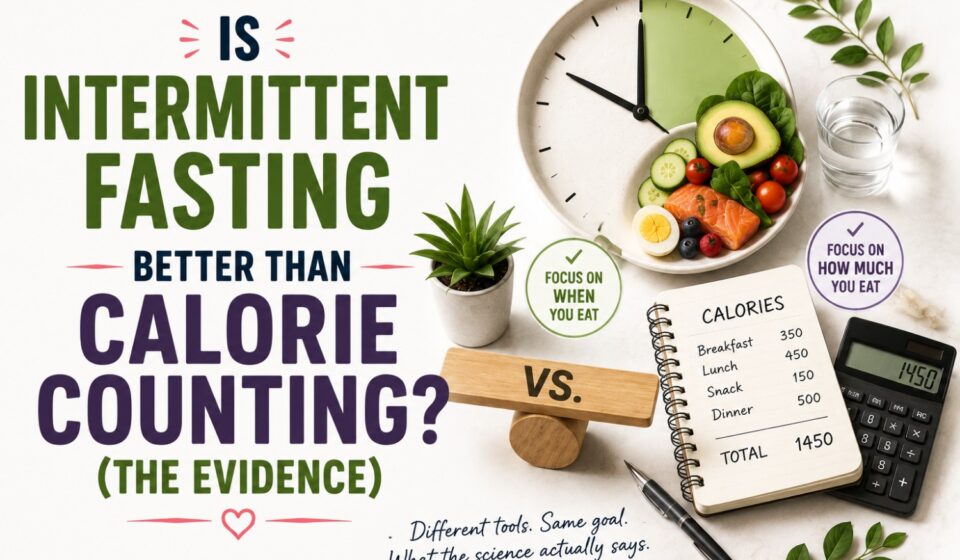

The two most popular structured weight loss approaches — here’s what the research actually shows when they go head to head

Intermittent fasting (IF) and calorie counting are the two most widely used structured approaches to weight loss — and their proponents argue for them with near-religious conviction. IF advocates claim fasting produces metabolic benefits beyond simple calorie restriction. Calorie counting advocates argue that food timing is irrelevant and only energy balance matters.
The research has now caught up enough to give a clear, evidence-based answer — and it’s more nuanced than either camp wants to admit.
What Each Approach Actually Is
Intermittent Fasting
Intermittent fasting is not a diet — it’s an eating schedule. The most common protocols:
16:8: Fast for 16 hours, eat within an 8-hour window. Most commonly: skip breakfast, eat noon to 8pm.
5:2: Eat normally 5 days per week, restrict to 500-600 calories on 2 non-consecutive days.
OMAD (One Meal A Day): Eat all daily calories in a single meal, fast for approximately 23 hours.
Alternate Day Fasting: Alternate between normal eating days and fasting/very low calorie days.
IF doesn’t specify what to eat — only when to eat.
Calorie Counting
Calorie counting involves tracking total calorie intake against a daily target — typically calculated as TDEE (Total Daily Energy Expenditure) minus a deficit. As covered in our guide to how many calories you should eat to lose weight, the standard approach produces 0.5-1 lb of fat loss per week at a 250-500 calorie daily deficit.

Calorie counting doesn’t restrict when you eat — only how much total you eat.
What the Research Shows
Head-to-Head Comparisons
The CALERIE trial and similar controlled studies consistently find:
When calories are matched — meaning both groups eat the same total calories — intermittent fasting and calorie counting produce identical weight loss results.
This is the most important finding: IF works primarily by reducing calorie intake, not through unique metabolic mechanisms.
When IF outperforms standard calorie restriction in studies, it’s almost always because IF subjects ate fewer total calories — either because the eating window naturally limited food opportunities, or because fasting suppressed appetite.
The TREAT trial (2020): One of the most rigorous IF studies — 116 participants randomized to 16:8 IF or unrestricted eating for 12 weeks. The IF group lost a modest 0.94 kg — but when calorie intake was carefully measured, they also ate approximately 200 fewer calories daily. The weight loss was explained entirely by calorie reduction.
A 2022 NEJM study comparing IF to continuous calorie restriction over 12 months found no significant difference in weight loss, body fat, or metabolic markers when both groups achieved similar calorie deficits.
Where IF Shows Advantages
Despite the “calories in, calories out” finding, IF does show genuine advantages in specific areas:
Appetite suppression: Many people find it easier to maintain a calorie deficit through IF than through conscious restriction — because skipping breakfast eliminates a meal rather than requiring willpower throughout the day. The eating window structure provides clear rules that some people find simpler than calorie tracking.
Insulin sensitivity: Extended fasting periods lower insulin levels and improve insulin sensitivity — relevant for people with insulin resistance where constant eating maintains elevated insulin. As covered in our guide to how to improve insulin sensitivity naturally, improved insulin sensitivity directly supports fat loss.
Simplified decision-making: No breakfast decisions, no morning meal prep, no morning calorie tracking. For people who prefer simplicity over flexibility, IF removes entire categories of decisions.
Autophagy: Extended fasting (typically 16+ hours) triggers autophagy — cellular cleanup processes that remove damaged proteins and organelles. This has health implications beyond weight loss, though the clinical significance for general health remains being studied.
Compliance for some people: Some people simply find IF easier to stick to than calorie counting — and the best approach is the one you actually follow consistently.
Where Calorie Counting Shows Advantages
Flexibility: Calorie counting allows eating at any time — breakfast, late dinner, social occasions — as long as the daily total is managed. This flexibility makes it more compatible with varied social schedules.
Precision: You know exactly what you ate and exactly where your deficit stands. IF provides no information about whether you’re actually in a deficit — you’re relying on the eating window to naturally limit intake.
Performance: Athletes and people with significant training loads often need pre and post-workout nutrition that doesn’t fit neatly into a restricted eating window. Calorie counting accommodates training nutrition more easily.
Evening eating preferences: People who prefer larger evening meals find IF’s typical eating window (noon-8pm) more compatible than people who prefer morning eating. But people who are hungry in the morning and not in the evening may struggle with 16:8 specifically.
No hunger during fasting window: Some people find the hunger during fasting windows genuinely difficult — leading to binge eating during the eating window that eliminates the calorie advantage.
Where IF Shows Disadvantages
Muscle loss risk: Extended fasting periods — particularly OMAD — may accelerate muscle protein breakdown. As covered in our guide to how much protein you actually need per day, protein distribution across meals matters for muscle synthesis. Eating all protein in a single meal is less efficient for muscle preservation than spreading it across multiple meals.
Binge eating risk: The restriction-feast cycle of IF can trigger binge eating during eating windows in people prone to this pattern — eliminating or reversing the calorie deficit. As covered in our article on how to lose weight with binge eating disorder, fasting approaches are contraindicated for people with eating disorder history.
Social difficulty: Declining breakfast meetings, lunch invitations during fasting windows, or early dinners creates friction that makes IF less socially compatible than calorie counting for some people.
Morning exercise: People who train in the morning before their eating window face the choice of training fasted (which affects performance for many) or eating earlier (which shortens the fasting window).
Not appropriate for everyone: IF is contraindicated during pregnancy, breastfeeding, for people with type 1 diabetes on insulin, for people with eating disorder history, and for people who are underweight.
The Metabolic Claims — What’s Actually True
“IF Boosts Metabolism”
Partially true — with important caveats. Short-term fasting (up to 48-72 hours) does increase metabolic rate modestly through norepinephrine elevation. However, extended fasting and chronic calorie restriction both eventually reduce metabolic rate as the body adapts. The metabolic boost from IF is real but modest and temporary.
“Eating at Night Causes More Fat Gain”
Largely false — total calorie intake matters far more than timing. However, there is evidence that calories eaten earlier in the day are slightly better utilized metabolically than late-night calories — related to circadian rhythms affecting insulin sensitivity. The effect is modest and secondary to total calorie management.
“IF Burns Fat Differently”
False — during the fasting window, fat oxidation increases (as stored fat is mobilized for energy). But this is offset by reduced fat oxidation during the eating window. Over 24 hours, total fat oxidation is determined by calorie balance — not fasting duration.
“Breakfast Is the Most Important Meal”
Also false — or at least not universally true. Studies on breakfast consumption and weight are mixed. Some people perform better cognitively and physically with breakfast. Others function better without it. Skipping breakfast doesn’t cause metabolic damage — but for people who are hungry in the morning, skipping it may lead to compensatory overeating.
Who IF Works Best For
Based on the evidence, IF is particularly well-suited for:
- People who genuinely aren’t hungry in the morning and prefer to delay eating naturally
- People who find simplified eating rules easier to follow than calorie tracking
- People with insulin resistance who benefit from extended low-insulin periods
- People whose social eating is concentrated in afternoons and evenings
- People who find calorie counting tedious or anxiety-inducing
Who Calorie Counting Works Best For
- People who want flexibility in when they eat
- Athletes with specific pre and post-workout nutrition needs
- People who are genuinely hungry in the mornings
- People who prefer data and precision over rules
- People who find IF hunger difficult to manage
The Hybrid Approach — The Best of Both
Many successful weight loss approaches combine elements of both:
Time-restricted eating with calorie awareness: Eating within a natural 10-12 hour window (not the extreme 8 hours of 16:8) while being generally aware of calorie intake without strict tracking. This captures the simplification benefit of IF without the rigidity.
IF on some days, flexible on others: Following an IF schedule on weekdays and eating more flexibly on weekends — capturing the calorie reduction benefit of IF during structured days while maintaining social flexibility.
Protein-prioritized IF: Following an IF eating window while specifically tracking protein intake (not total calories) — ensuring adequate protein distribution within the eating window for muscle preservation.
The Honest Verdict
Is intermittent fasting better than calorie counting?
Neither is categorically better — they produce equivalent weight loss when calorie intake is matched. The superior approach is the one you’ll actually stick to consistently for months.
IF wins if: You prefer structure over tracking, you’re not hungry in the morning, and you don’t have a history of disordered eating.
Calorie counting wins if: You want flexibility, you train in the morning, you’re hungry at breakfast, or you want precise data on your intake.
The most important finding from the research: Both approaches work through calorie deficit. IF doesn’t have magical metabolic properties — it works because eating windows naturally reduce how much most people eat. If you follow IF but still eat the same total calories, you won’t lose more weight than someone who calorie counts.
As covered in our article on is intermittent fasting worth it, the decision should be based on personal preference and sustainability — not on claims of metabolic superiority.
For the complete framework on creating a sustainable calorie deficit regardless of approach, our guide to how to get rid of belly fat covers everything in one place.
Have you tried both intermittent fasting and calorie counting — and which one did you find easier to stick to long term? Share in the comments.