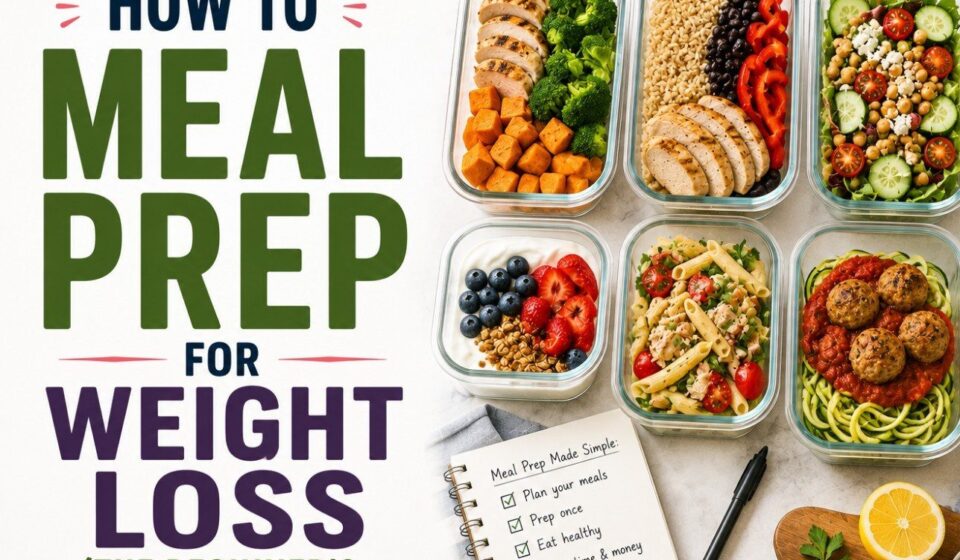

The single habit that makes every other weight loss strategy easier — here’s exactly how to start
Meal prep is one of the most consistently recommended weight loss habits — and one of the most consistently avoided. The images of perfectly portioned containers arranged in neat rows feel aspirational but intimidating. The reality is that effective meal prep doesn’t require hours in the kitchen, culinary skill, or elaborate recipes.
Done correctly, 60-90 minutes on a Sunday produces a week of meals that makes hitting your protein targets, staying within your calorie budget, and avoiding bad food decisions almost effortless.

Here’s the complete beginner’s guide.
Why Meal Prep Works for Weight Loss
Removes Decision Fatigue
Every food decision requires cognitive effort — and willpower depletes throughout the day. By the time dinner arrives after a long workday, the mental resources for making good dietary choices are largely exhausted. Meal prep eliminates the decision: the food is ready, the choice is already made.
Studies on decision fatigue consistently find that people make worse dietary choices later in the day — and that reducing the number of food decisions required significantly improves dietary adherence.
Prevents the “Nothing Healthy Is Ready” Problem
The most common reason for poor food choices isn’t lack of knowledge or motivation — it’s that healthy food isn’t immediately available when hunger strikes. A refrigerator full of prepped protein, vegetables, and ready-to-assemble components eliminates this entirely.
Controls Portions Automatically
Portioned containers remove the need for in-the-moment calorie estimation — the most common source of calorie tracking inaccuracy. If lunch is already portioned, there’s no opportunity for the “just a little more” that adds 200 calories without registering.
Saves Time During the Week
Cooking takes the same time whether you cook once for five days or five times for one day — but the cumulative time saved from cooking five separate meals vs. one batch is significant. 90 minutes on Sunday replaces 30-45 minutes of cooking Monday through Friday.
Reduces Food Waste and Grocery Cost
Planned meal prep means buying exactly what’s needed — reducing the impulse purchases and forgotten vegetables that drive food waste. Most people who start meal prepping find their grocery bill decreases alongside their waist circumference.
What Meal Prep Actually Looks Like
There are three levels of meal prep — start at the level that matches your current capacity:
Level 1: Component Prep (Easiest)
Don’t make complete meals — prepare individual components that can be mixed and matched throughout the week.
What to prep:
- Protein: cook a batch of chicken breast, hard-boil eggs, or open and drain canned fish
- Grains: cook a pot of rice or quinoa
- Vegetables: wash and chop raw vegetables, or roast a tray of mixed vegetables
- Legumes: cook a pot of lentils or drain and rinse canned chickpeas
Time required: 45-60 minutes
How it works: Each meal during the week is assembled in 2-3 minutes by combining a protein + a grain + vegetables. No recipe required. Endless variety from the same components.
Level 2: Portioned Meals (Most Popular)
Prepare complete meals and portion them into containers — open the container at mealtime.
What to prep:
- 4-5 lunches in identical containers
- 3-4 dinners in containers
- Breakfast components (overnight oats portioned into jars)
Time required: 60-90 minutes
How it works: Grab a container from the fridge. Eat. Done.
Level 3: Full Week Prep (Most Ambitious)
Every meal for the week planned, cooked, and portioned in advance.
Time required: 2-3 hours
Honest assessment: This level works for some people and produces the most consistent results — but the time investment and food monotony (eating the same meals repeatedly) causes many people to abandon it. Start with Level 1 or 2.
The Beginner’s Meal Prep System — Step by Step
Step 1: Plan Before You Shop
The most important step — and the one most beginners skip.
What to decide before shopping:
- Which protein sources will you prep? (chicken, eggs, canned fish, tofu, lentils)
- Which vegetables? (what’s in season, what you actually enjoy)
- Which grains or starches? (rice, quinoa, sweet potato, oats)
- How many meals do you need? (lunches only? lunches and dinners? breakfasts too?)
The beginner’s recommended starting plan:

- Protein: roasted chicken breast + hard-boiled eggs
- Vegetables: roasted mixed vegetables + pre-washed salad greens
- Grain: cooked quinoa or rice
- Breakfast: overnight oats (portioned into 5 jars)
This covers breakfast and lunch for the week with minimal cooking skill and maximum flexibility.
Step 2: Shop With a List
Buy exactly what the plan requires — nothing more. For the beginner plan above:
- Chicken breast (500-600g)
- 10 eggs
- Mixed vegetables for roasting (broccoli, cauliflower, bell peppers, zucchini)
- Bag of pre-washed salad greens
- Quinoa or rice
- Rolled oats
- Greek yogurt (for overnight oats)
- Frozen berries
- Chia seeds
- Olive oil, salt, pepper, garlic powder
Total cost: significantly less than five days of bought lunches.
Step 3: Set Up Your Kitchen
Before cooking, organize:
- Containers ready (5 lunch containers, 5 overnight oat jars)
- Baking trays lined with parchment
- Pots on the stove
- Timer ready
Working efficiently in a prepared kitchen saves 20-30 minutes vs. figuring things out as you go.
Step 4: Cook in Parallel — The Time-Saving Key
The biggest beginner mistake: cooking one thing at a time. Effective meal prep runs multiple things simultaneously.
The parallel cooking sequence:
Minute 0: Preheat oven to 200°C (400°F). Put rice or quinoa on to cook.
Minute 5: Season and place chicken breast in oven. Chop vegetables for roasting.
Minute 15: Add vegetables to oven (second tray). Put eggs on to boil.
Minute 25: Assemble overnight oats in jars (oats + Greek yogurt + chia + berries + almond milk).
Minute 35: Check chicken (should be nearly done). Drain eggs, run under cold water.
Minute 40: Remove chicken, let rest. Vegetables may need 10 more minutes.
Minute 50: Slice chicken, portion rice/quinoa, portion roasted vegetables into lunch containers.
Minute 60: Clean up. Done.
Everything cooked simultaneously — 60 minutes total.
Step 5: Portion and Store
Portioning guidelines:
- Protein per meal: 150-200g cooked chicken, 2-3 eggs, or equivalent
- Grain: 1/2 cup cooked quinoa or rice
- Vegetables: as much as fits — they’re essentially calorie-free
- Salad greens: keep separate from dressing (add dressing at eating time to prevent sogginess)
Storage:
- Cooked protein: 4-5 days refrigerated
- Cooked grains: 5 days refrigerated
- Roasted vegetables: 4-5 days refrigerated
- Hard-boiled eggs (in shell): 7 days refrigerated
- Overnight oats: 5 days refrigerated
- Raw washed vegetables: 5-7 days refrigerated
The Best Foods to Meal Prep (and Why)
Proteins That Meal Prep Well
Chicken breast: The most versatile meal prep protein — stays good for 5 days, works in salads, bowls, wraps, and eaten alone. Season simply (olive oil, salt, pepper, garlic powder) and roast at 200°C for 20-25 minutes.
Hard-boiled eggs: 5-7 day fridge life in shell, portable, zero reheating required. As covered in our guide to the best weight loss breakfast foods, eggs are one of the highest-satiety proteins available.
Lentils: Cook once, use all week — in soups, salads, grain bowls. As covered in our guide to the best high fiber foods for weight loss, lentils provide exceptional protein and fiber per calorie.
Canned fish (tuna, salmon, sardines): No prep required — open and use. The ultimate no-cook protein source.
Tofu (pressed and baked): Press excess water out, cube, toss with soy sauce and olive oil, bake at 200°C for 25 minutes. Keeps 5 days, works in salads and bowls.
Proteins That Don’t Meal Prep Well
Fish fillets (fresh): Best eaten day of — texture degrades after 1-2 days Rare steak: Reheats poorly — cook fresh when you want it Seafood: Texture and food safety concerns with extended refrigeration
Vegetables That Meal Prep Well
Roasted vegetables: Broccoli, cauliflower, sweet potato, bell peppers, zucchini, Brussels sprouts — all improve with a day or two in the fridge as flavors develop.
Raw chopped vegetables: Cucumber, carrot, celery, bell pepper, cherry tomatoes — chop and store in water-covered containers for maximum freshness.
Pre-washed greens: Buy pre-washed or wash and spin dry — store in container with paper towel to absorb moisture.
Vegetables to Avoid Meal Prepping
Avocado: Browns rapidly — cut fresh Dressed salads: Add dressing at eating time Cooked leafy greens: Spinach and kale become watery after cooking and refrigerating — add fresh to grain bowls
Grains and Carbs That Meal Prep Well
Quinoa: Cooks in 15 minutes, keeps 5 days, complete protein Brown and white rice: Both keep 5 days refrigerated Sweet potato: Roast whole, refrigerate, reheat or eat cold Oats (overnight): Prepare in jars, 5-day fridge life
Meal Prep for Different Dietary Approaches
High-Protein Meal Prep
Focus: Protein at every meal, adequate at every snack
What to prep:
- Large batch of chicken breast (600-700g)
- 10-12 hard-boiled eggs
- 5 overnight oat jars with protein powder
- Greek yogurt portioned into snack containers
- Cottage cheese portioned with fruit
As covered in our guide to how much protein you actually need per day, hitting 0.8-1g per pound of bodyweight requires deliberate planning — meal prep makes this automatic.
Low-Carb Meal Prep
Focus: Protein and fat, minimal grain portions
What to prep:
- Protein (chicken, eggs, fish)
- Roasted non-starchy vegetables (broccoli, cauliflower, zucchini)
- Egg salad with avocado
- Nuts portioned into snack bags
- Skip grains — replace with cauliflower rice
Plant-Based Meal Prep
Focus: Complementary plant proteins, maximum legume and grain variety
What to prep:
- Large batch of lentils
- Roasted chickpeas (oven 200°C, 30 minutes — crunchy, high-protein snack)
- Tofu (pressed and baked)
- Quinoa (complete protein grain)
- Edamame (frozen, microwave as needed)
Common Meal Prep Mistakes to Avoid
Prepping foods you don’t actually enjoy: The most common reason meal prep is abandoned. If you don’t like quinoa, don’t prep quinoa. Work with foods you genuinely eat.
Prepping too much variety: Beginners sometimes prep 8 different meals — creating a complex system that’s hard to maintain. Start with 2 proteins, 2 vegetables, 1 grain. Simplicity sustains.
Not accounting for meals out: If you eat out twice during the week, prep 3 lunches not 5. Prepping meals you won’t eat creates waste and discouragement.
Skipping protein: Vegetable-heavy prep without adequate protein creates beautiful containers that don’t keep you full. Protein first, always.
Using the wrong containers: Meal prep containers need to be airtight, microwave-safe, and stackable. Invest in a matching set — mismatched containers create fridge chaos that makes the system less likely to be maintained.
Prepping on Monday instead of Sunday: The prep session needs to happen before the week starts. Monday prep means Monday and possibly Tuesday eating poorly before prep is done.
The Minimal Viable Meal Prep
For people who genuinely don’t have 60-90 minutes — the minimum that still produces meaningful weight loss results:
20-minute Sunday prep:
- Hard-boil 8 eggs (passive — they cook themselves)
- Wash and chop salad vegetables
- Portion 5 overnight oat jars
This covers breakfast (overnight oats) and provides ready protein (eggs) for any meal throughout the week. Takes 20 minutes of active time with 12 minutes of passive egg-boiling.
A refrigerator with hard-boiled eggs and pre-washed vegetables makes dozens of quick meals possible without any further prep.
Sample Week Using the Beginner Prep
Sunday prep (60 minutes):
- 500g roasted chicken breast
- 10 hard-boiled eggs
- Large tray roasted vegetables (broccoli, bell pepper, zucchini)
- 2 cups cooked quinoa
- 5 overnight oat jars
Monday-Friday:
Breakfast: Grab overnight oat jar from fridge. 0 minutes.
Lunch: Portion quinoa + chicken + roasted vegetables into bowl. Add spinach from bag, drizzle olive oil, squeeze lemon. 3 minutes.
Snack: 2 hard-boiled eggs + apple. 1 minute.
Dinner: Cook fresh (or use remaining chicken and vegetables differently — different seasoning, different combination).
Total daily “cooking” time: Under 10 minutes.
The Bottom Line
Meal prep works for weight loss because it:
- Removes decision fatigue at hungry moments
- Ensures protein is always available
- Prevents the “nothing healthy is ready” problem
- Controls portions automatically
- Saves time and money
The beginner system:
- Plan before shopping
- Buy exactly what the plan requires
- Cook in parallel (oven + stovetop simultaneously)
- Protein + grain + vegetables = flexible complete meals
- Store in airtight containers, 4-5 day fridge life
Start simple: One protein, one vegetable, one grain, overnight oats. Master this before expanding.
For the complete dietary framework, our guide to how to get rid of belly fat covers everything in one place.
Do you meal prep already — and what’s the one thing that made it finally click for you? Or if you’ve tried and abandoned it, what got in the way? Share in the comments.
Stop Wondering What to Eat This Week
Get my free 7-Day High-Protein Weight Loss Meal Plan delivered straight to your inbox — a simple week of satisfying, protein-focused meals designed to make healthy eating easier without complicated calorie tracking.
- 7 full days of breakfast, lunch, dinner & snacks
- One complete shopping list for the whole week
- A quick high-protein food cheat sheet
- Simple daily tips to help you stay on track
Free PDF • Delivered by email • Unsubscribe anytime
Check your inbox 💜
Your free 7-day high-protein meal plan is on its way.