
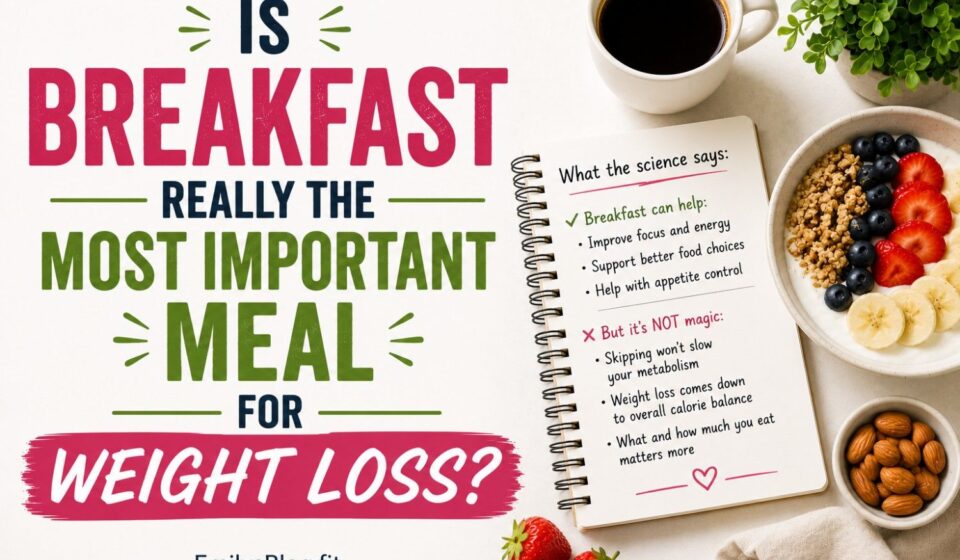

The breakfast debate — what the science actually says, and what it means for you

“Breakfast is the most important meal of the day.” You’ve heard it your entire life. It’s been repeated by nutritionists, printed on cereal boxes, and treated as settled health wisdom for decades.
But is it actually true for weight loss?
The honest answer is more nuanced than either the traditional “always eat breakfast” camp or the intermittent fasting “skip breakfast” camp would have you believe. The research is genuinely mixed — and what matters most is understanding why, so you can make the right decision for your specific situation.
Where the “Breakfast Is Important” Idea Comes From
The breakfast-weight loss connection was historically supported by observational research — studies showing that people who regularly eat breakfast tend to weigh less than those who skip it.
The famous National Weight Control Registry data — tracking thousands of people who have maintained significant weight loss long-term — found that 78% of successful maintainers eat breakfast every day.
This sounds compelling. But observational data has a major limitation: correlation isn’t causation. People who eat breakfast may weigh less for reasons unrelated to breakfast itself — they may also be more likely to exercise, sleep adequately, maintain consistent routines, and make other health-promoting choices. Breakfast-eating might be a marker of an overall healthy lifestyle, not the cause of the weight difference.
What Controlled Studies Actually Show
When researchers have conducted randomized controlled trials — where some people are randomly assigned to eat breakfast and others to skip it — the results are far less consistent than the observational data suggested.
Key findings:
The BFAST trial (2019): A large randomized trial found no significant difference in weight loss between people assigned to eat breakfast and those assigned to skip it over 16 weeks. The breakfast group didn’t lose more weight.
The CALFAN trial: Found that breakfast had different effects depending on whether participants were habitual breakfast eaters or habitual skippers. Adding breakfast helped habitual skippers somewhat; it didn’t help habitual eaters.
Multiple meta-analyses of randomized breakfast trials have concluded that the evidence doesn’t support breakfast as a weight loss intervention for most adults.
The current scientific consensus is more measured than the cultural message: breakfast is neither universally beneficial nor universally harmful for weight loss. Its effect depends significantly on the individual.
When Breakfast DOES Help With Weight Loss
Despite the mixed overall evidence, breakfast is genuinely helpful for specific groups and situations:
1. People Who Exercise in the Morning
Morning exercisers who train fasted often underperform, recover more slowly, and compensate with larger meals later in the day. A protein-rich breakfast before morning exercise:
- Supports performance and muscle preservation
- Reduces excessive hunger after training
- Provides the amino acid availability that morning strength training benefits from
2. People Who Overeat at Night
For people whose primary dietary challenge is late-night eating, a satisfying protein-rich breakfast often reduces the hunger that drives evening overeating. The satiety from breakfast extends through the day, reducing the appetite that leads to dinner-and-beyond overeating.
If your problem is overeating at night — not overeating in the morning — breakfast may be a strategic tool for addressing it.
3. People With Blood Sugar Regulation Issues
People with diabetes, insulin resistance, or reactive hypoglycemia often experience significant blood sugar swings when they skip breakfast — producing mid-morning energy crashes, cravings, and compensatory overeating. For these individuals, a low-glycemic, protein-rich breakfast stabilizes blood sugar in a way that affects the entire day’s eating.
As covered in our articles on how to lose weight with diabetes and how to lose weight with insulin resistance, blood sugar management is a specific consideration that changes the breakfast calculus.
4. Children and Adolescents
The evidence for breakfast in children and adolescents is considerably stronger than for adults. Breakfast is associated with better cognitive performance, concentration, and academic outcomes in school-aged children — though even here the weight loss evidence is mixed.
5. People Who Are Hungrier in the Morning
Individual appetite patterns vary significantly. Some people wake up genuinely hungry and find that skipping breakfast produces increasing hunger throughout the day, leading to larger meals and total calorie overshoot. For these individuals, eating a satisfying breakfast reduces total daily calorie intake — which is exactly what the research supports for habitual breakfast eaters.
When Skipping Breakfast Works for Weight Loss
1. People Who Aren’t Hungry in the Morning
Many people — particularly those who eat dinner relatively late — simply aren’t hungry in the morning. Forcing breakfast when appetite isn’t present often adds calories without reducing hunger at other meals. For these people, skipping breakfast and eating within a compressed window (often from noon or 1pm) naturally reduces total calorie intake.
This is essentially how intermittent fasting (16:8) works in practice — and as covered in our article on whether intermittent fasting is worth it, it’s an effective approach for people whose natural appetite pattern aligns with it.
2. People Who Overeat When They Start Eating Early
Some people find that eating breakfast “opens the floodgates” — triggering appetite and eating that continues throughout the day. For these individuals, delaying the first meal suppresses total daily calorie intake.
This is a real and well-documented individual variation — not an excuse. If you genuinely eat less total food when you skip breakfast, skipping breakfast is the right approach for you.
3. People Following Intermittent Fasting Successfully
For people who have found intermittent fasting — in any form — to be a sustainable approach that helps them maintain a calorie deficit, skipping breakfast is a functional component of that approach. As covered in our guide to how to lose weight with intermittent fasting, the benefits come from the compressed eating window, not from breakfast specifically.
What Actually Matters More Than Whether You Eat Breakfast
The breakfast debate somewhat misses the point. Total daily calorie intake and protein distribution matter far more than meal timing for most people.
What the research consistently supports:
Total protein across the day matters more than breakfast protein. As covered in our guide to how much protein you actually need per day, distributing 0.7–1g per pound of bodyweight across your meals — whenever those meals occur — is the most important dietary variable for body composition.
Total calorie intake over 24 hours matters more than meal timing. Whether those calories are consumed in 2 meals starting at noon or 4 meals starting at 7am has minimal effect on fat loss when total intake is equivalent.
Individual patterns matter more than universal rules. The best eating schedule is the one that helps you maintain a calorie deficit and adequate protein consistently over time — and that’s genuinely different for different people.
The Exception: Breakfast Quality
Where breakfast does consistently matter is quality — not whether you eat it, but what you eat if you do.
A breakfast that helps weight loss:
- High protein (eggs, Greek yogurt, cottage cheese, protein shake): 25–40g protein
- Moderate fiber (oats, fruit, vegetables)
- Low added sugar
A breakfast that hinders weight loss:
- High sugar cereal with low-fat milk: causes blood sugar spike and crash that drives mid-morning hunger
- Pastries, bagels, and sweet breakfast foods: calorie-dense, low-protein, high-glycemic
- Sweetened coffee drinks: 300–500 calories of liquid sugar before the day has started
The research consistently shows that high-protein breakfasts reduce total daily calorie intake compared to high-carbohydrate breakfasts — through satiety mechanisms that persist through the day. If you’re going to eat breakfast, eating it high in protein produces meaningfully better outcomes than eating it high in refined carbohydrates and sugar.
The best breakfast options:
- 3 scrambled eggs with vegetables (25g protein, ~350 calories)
- Greek yogurt with berries and a handful of nuts (20g protein, ~350 calories)
- Cottage cheese with fruit (25g protein, ~300 calories)
- Protein shake with oats (30g protein, ~400 calories)
- Smoked salmon with eggs (30g protein, ~350 calories)
The Practical Decision: Should You Eat Breakfast?
Ask yourself these questions:
Are you genuinely hungry in the morning? If yes, eat breakfast — specifically a high-protein one. If no, skipping it is entirely valid.
Do you overeat at night? If yes, a satisfying morning breakfast may reduce evening hunger enough to be worth it.
Do you exercise in the morning? If yes, some food before training (even a small protein source) typically supports performance and recovery.
Does eating breakfast make you hungrier throughout the day? If yes, skip it and don’t feel guilty about it.
Are you following intermittent fasting successfully? If yes, keep doing it — breakfast timing is already sorted.
Do you have blood sugar issues? If yes, a low-glycemic, protein-rich breakfast is likely worth eating regardless of morning hunger.
The right answer is personal — and it’s determined by your individual hunger patterns, your lifestyle, and your total daily intake, not by the conventional wisdom that applies universally to everyone.
The Bottom Line
Breakfast is not universally “the most important meal of the day” for weight loss. The controlled research doesn’t support it as a general intervention.
But breakfast can be important for specific individuals — those who are genuinely hungry in the morning, those who exercise early, those with blood sugar issues, and those whose total daily intake is better managed with morning eating.
The most important variables:
- Total daily calorie intake — more important than any single meal’s timing
- Total daily protein — distributed across however many meals you eat
- Individual hunger patterns — the best schedule is the one you can maintain
If you eat breakfast, make it high protein. If you skip it, ensure your other meals provide adequate protein and calories don’t accumulate later in the day to compensate.
For the complete dietary framework that matters more than breakfast timing, our guide to how to get rid of belly fat covers everything in one place.
Are you a breakfast eater or a skipper — and do you find it affects how you eat for the rest of the day? Share in the comments.