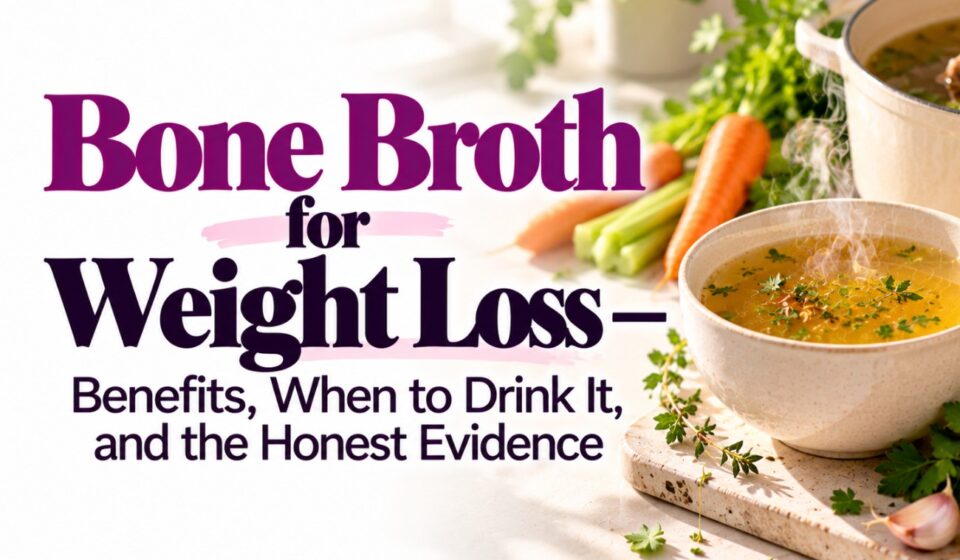
Bone Broth for Weight Loss — Benefits, When to Drink It, and the Honest Evidence

The ancient food experiencing a modern revival — here’s what bone broth actually does for fat loss
Bone broth has gone from grandmother’s kitchen staple to wellness trend to mainstream weight loss tool — appearing in everything from fasting protocols to GLP-1 medication companion guides. The claims range from reasonable to dramatically overstated.
Here’s the complete honest assessment of what bone broth actually is, what it does, and where it genuinely fits in a weight loss approach.

What Bone Broth Actually Is
Bone broth is made by simmering animal bones — typically beef, chicken, pork, or fish — in water for an extended period (4-24+ hours), often with vegetables, herbs, and a small amount of acid (apple cider vinegar) that helps extract minerals from the bones.
What distinguishes bone broth from regular stock:
The extended cooking time extracts collagen from bones and connective tissue, which breaks down into gelatin and specific amino acids — primarily glycine, proline, and hydroxyproline — that aren’t present in significant amounts in regular stock.
Nutritional profile per cup (240ml) of typical beef bone broth:
- Calories: 30-50
- Protein: 6-10g (primarily from gelatin/collagen)
- Fat: 0-3g (depends on skimming)
- Carbohydrates: 0-2g
- Collagen peptides: significant — varies by preparation
- Glycine: approximately 1.5-2g
- Proline: approximately 0.5g
- Minerals: calcium, magnesium, phosphorus, potassium (amounts vary significantly)
- Sodium: varies enormously — 300-900mg depending on seasoning
The quality variation issue:
Bone broth quality varies enormously — between homemade and commercial, and between commercial brands. A true bone broth gels when refrigerated (from collagen content). Products that don’t gel have minimal collagen and are essentially flavored water with limited nutritional value.
Why Bone Broth Has Attracted Weight Loss Attention
Low Calorie, High Satiety — The Primary Weight Loss Value
At 30-50 calories per cup — bone broth is one of the lowest calorie warm foods that provides genuine satiety through protein content.
The satiety mechanism:
- 6-10g of protein per cup stimulates ghrelin suppression
- Warm liquid fills the stomach producing volume-based satiety
- The ritual of drinking something warm reduces psychological hunger
As covered in our guide to hunger hormone ghrelin — protein is the most powerful dietary ghrelin suppressor. Even the modest 6-10g in bone broth contributes meaningfully to between-meal satiety.
A cup of bone broth 30 minutes before a meal reduces calorie intake at that meal — through both protein preloading and liquid volume. As covered in our guide to how much water to drink to lose weight — pre-meal fluid consumption reduces meal calorie intake through gastric volume effects.
Glycine — The Amino Acid With Specific Benefits
Bone broth is one of the richest dietary sources of glycine — an amino acid that’s conditionally essential (the body produces it but often not in sufficient amounts under stress or illness).
Glycine’s weight loss relevant effects:
Sleep quality improvement:
Glycine has specific evidence for improving sleep quality — reducing time to sleep onset and improving subjective sleep quality in clinical trials. As covered in our guide to sleep as the most underrated weight loss tool — sleep quality is one of the most powerful levers for weight management. Evening bone broth consumption may improve sleep quality through glycine’s neurological effects.
Blood sugar regulation:
Glycine improves insulin sensitivity and reduces post-meal blood sugar spikes — through effects on glucagon regulation and insulin receptor sensitivity. As covered in our guide to how to improve insulin sensitivity naturally — insulin sensitivity is central to fat metabolism.
Anti-inflammatory effects:
Glycine reduces inflammatory markers — particularly NF-kB activation. As covered in our guide to best anti-inflammatory foods for weight loss — reducing systemic inflammation directly supports fat metabolism.
Gut health:
Glycine supports gut barrier integrity — reducing intestinal permeability that contributes to systemic inflammation and metabolic dysfunction.
Collagen and Gut Health
The gelatin and collagen peptides in bone broth support the gut mucosal lining — the protective barrier between the digestive tract and the bloodstream.
A healthy gut barrier:
- Reduces systemic inflammation from gut bacterial products entering circulation
- Supports healthy gut microbiome
- Improves nutrient absorption
As covered in our guide to what’s wrong with ultra-processed food — gut health is increasingly linked to metabolic function. Bone broth’s gut-supporting properties contribute to the metabolic environment that supports fat loss.
Protein Preloading Effect — Similar to Gelatin Trick
As covered in our guide to gelatin trick weight loss — protein consumed before a meal reduces calorie intake at that meal through ghrelin suppression and satiety hormone stimulation.
Bone broth provides this protein preloading effect in a more palatable and nutritionally complete form than plain gelatin dissolved in water — with the additional glycine, minerals, and collagen content that plain gelatin doesn’t provide.
Fasting Compatibility
Bone broth has become a staple in fasting protocols — including intermittent fasting and extended fasting.
Why it works in fasting:
- Minimal calories (30-50 per cup) — doesn’t significantly impair ketosis or autophagy
- Sodium and electrolytes — replenishes electrolytes lost during fasting that cause weakness and headaches
- Protein (modest) — reduces the most severe hunger without fully breaking the fast’s metabolic benefits
- Psychological satisfaction of a warm food during a fasting window
As covered in our guide to is intermittent fasting worth it — bone broth during fasting windows is one of the most consistently recommended tools for making longer fasting periods manageable.

Does it break a fast?
Technically — any caloric intake breaks a strict fast. Practically — 30-50 calories from bone broth has minimal impact on the metabolic benefits of fasting (insulin reduction, fat oxidation, autophagy) and significantly improves adherence to fasting protocols.
What the Research Actually Shows
The Honest Evidence Gap
The most important thing to say about bone broth research: the specific clinical evidence for bone broth and weight loss is limited.
Most evidence for bone broth’s components — collagen, gelatin, glycine — comes from research on:
- Collagen supplements (not bone broth specifically)
- Glycine supplementation (higher doses than in bone broth)
- General protein preloading research
Direct randomized controlled trials on bone broth consumption and weight loss in humans are essentially non-existent at the time of writing.
What we can reasonably conclude:
The mechanisms through which bone broth would support weight loss are real and evidence-backed — protein preloading, glycine’s sleep and insulin effects, collagen’s gut support. Whether bone broth specifically produces these effects at the doses consumed as a beverage is extrapolated from component research rather than directly demonstrated.
The Protein Preloading Evidence
As covered in our guide to gelatin trick weight loss — protein consumed before meals reduces calorie intake at those meals. This mechanism applies to bone broth’s protein content. Studies on protein preloading — while not bone broth specific — support this mechanism strongly.
Collagen and Body Composition
Research on collagen peptide supplementation (which bone broth provides in more variable, less standardized amounts) has found:
- Improved body composition with resistance training when collagen is supplemented
- Reduced appetite in some studies
- Improved joint health that may support exercise capacity
The Best Times to Drink Bone Broth for Weight Loss
Before Meals (15-30 Minutes Before)
The protein preloading and gastric volume effect reduces calorie intake at the subsequent meal. Particularly useful before the largest meal of the day.
During Fasting Windows
As discussed — bone broth makes fasting windows more manageable without significantly impacting fasting’s metabolic benefits. For intermittent fasting practitioners, morning bone broth during the fasting window addresses the most difficult hunger period.
As an Evening Drink
Evening bone broth:
- Provides glycine that may improve sleep quality
- Satisfies evening hunger with minimal calories
- Replaces caloric evening snacks
As covered in our guide to how to stop snacking at night — having a warm, satisfying, protein-containing beverage in the evening addresses the appetite patterns that drive night snacking more effectively than willpower alone.
As covered in our guide to things to do at night to lose weight — glycine’s sleep-improving properties make evening bone broth one of the more evidence-backed bedtime habits for weight management.
As a Meal Replacement on Low-Appetite Days
For GLP-1 medication users with reduced appetite — as covered in our guide to GLP-1 friendly foods — bone broth provides protein, electrolytes, and calories in a format that’s typically well-tolerated even on nausea days when solid food is difficult.
Homemade vs. Commercial Bone Broth
Homemade bone broth:
The gold standard — extended cooking time extracts maximum collagen and minerals. Gels solidly when refrigerated (indicating high collagen content). Control over sodium and ingredients.
Basic recipe:
- 2-3 lbs bones (beef knuckles, chicken carcass, or combination)
- 2 tablespoons apple cider vinegar (helps mineral extraction)
- Vegetables (onion, carrot, celery — optional)
- Water to cover
- Simmer 8-24 hours (beef) or 4-8 hours (chicken)
- Strain and store
Commercial bone broth:
Highly variable quality. Look for:
- Gels when refrigerated — indicates real collagen content
- Short ingredient list — bones, water, minimal additives
- Protein content of 8-10g per cup — confirms meaningful collagen
- Low sodium versions available
Bone broth powder/concentrate:
Convenient but less evidence-backed than liquid broth. Protein content varies widely. Useful for travel or when liquid broth isn’t practical.
What to avoid:
Products marketed as “bone broth” that don’t gel, contain primarily water and flavoring with minimal protein, or have very high sodium (900mg+ per cup). These are essentially flavored water with little nutritional value.
Bone Broth and Specific Dietary Approaches
Keto and low-carb:
Bone broth is keto-compatible — zero carbohydrates, meaningful fat if not fully skimmed, high collagen protein. As covered in our guide to high-protein low-carb diets explained — bone broth fits naturally into ketogenic approaches and is a staple in many keto communities.
Paleo diet:
As covered in our guide to paleo diet weight loss — bone broth is one of the most traditional paleo foods — literally what our ancestors would have made by simmering bones over fire. It’s a staple in the paleo community.
Intermittent fasting:
As discussed — bone broth during fasting windows is one of the most commonly recommended fasting tools.
GLP-1 medication users:
As covered in our guide to GLP-1 friendly foods — bone broth’s easy-to-consume format and protein content make it particularly valuable for people with reduced appetite from GLP-1 medications.
Potential Considerations
Sodium content:
Commercial bone broths can contain 300-900mg sodium per cup — significant if consuming multiple cups daily. As covered in our guide to is salt bad for weight loss — sodium causes fluid retention that affects scale weight. Choose lower-sodium varieties or make your own with controlled seasoning.
Lead content concerns:
Some research has found elevated lead levels in bone broth — particularly from bones of conventionally raised animals. While likely safe in typical consumption amounts — using organic or pasture-raised bones reduces this risk. The concern is primarily relevant to very high consumption.
Histamine intolerance:
Long-cooked bone broth is high in histamine — a concern for the subset of people with histamine intolerance who experience symptoms (headaches, flushing, digestive issues) from high-histamine foods. Fresh broth cooked for shorter times is lower in histamine.
Protein completeness:
Bone broth’s protein is primarily collagen-derived — which is not a complete protein (low in tryptophan and some essential amino acids). It should complement rather than replace complete protein sources. As covered in our guide to how much protein you actually need per day — total daily protein from complete sources remains the priority.
The Bottom Line
Is bone broth good for weight loss?
Yes — as a supporting tool with specific, modest benefits:
- ✅ Protein preloading before meals reduces calorie intake — real effect
- ✅ Very low calorie satiety tool (30-50 cal/cup) — excellent calorie-to-satiety ratio
- ✅ Glycine supports sleep quality — directly relevant to weight management
- ✅ Glycine improves insulin sensitivity — supports fat metabolism
- ✅ Fasting window support — makes IF more sustainable
- ✅ Gut health support through collagen
- ✅ Electrolyte replacement during fasting
The honest limitations:
- ❌ No direct clinical trials on bone broth and weight loss
- ❌ Not a fat burner — doesn’t directly stimulate fat burning
- ❌ Incomplete protein — doesn’t replace complete protein sources
- ❌ Sodium content can be significant — choose low-sodium
The practical recommendation:
Bone broth earns its place as a daily habit — particularly as a pre-meal protein preload, during fasting windows, and as an evening drink for glycine’s sleep benefits. Quality matters enormously — choose or make broth that actually gels.
For the complete protein and satiety framework, our guides to how much protein you actually need per day and hunger hormone ghrelin cover the mechanisms bone broth contributes to.
Do you drink bone broth regularly — and have you found a specific timing or preparation that works best for you? Share in the comments.
Stop Wondering What to Eat This Week
Get my free 7-Day High-Protein Weight Loss Meal Plan delivered straight to your inbox — a simple week of satisfying, protein-focused meals designed to make healthy eating easier without complicated calorie tracking.
- 7 full days of breakfast, lunch, dinner & snacks
- One complete shopping list for the whole week
- A quick high-protein food cheat sheet
- Simple daily tips to help you stay on track
Free PDF • Delivered by email • Unsubscribe anytime
Check your inbox 💜
Your free 7-day high-protein meal plan is on its way.