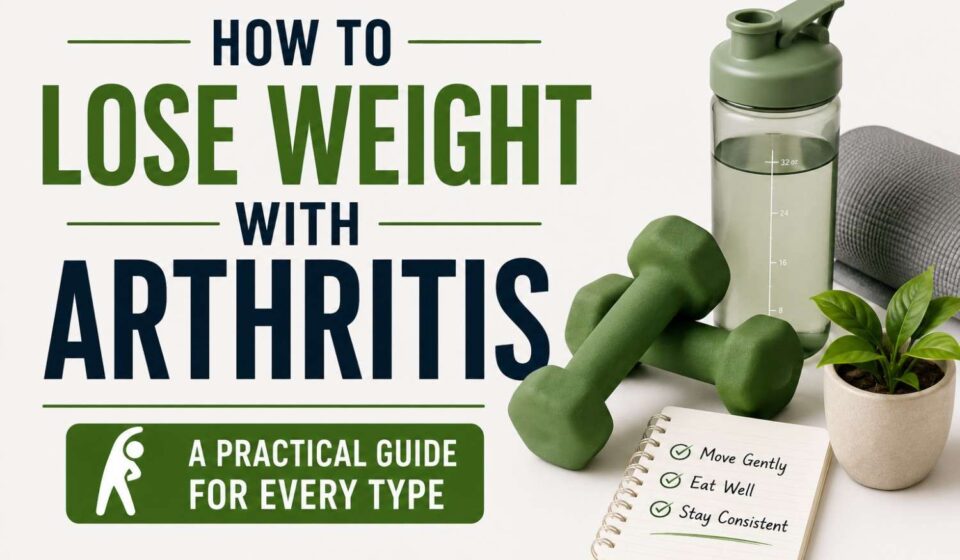
How to Lose Weight With Arthritis (A Practical Guide for Every Type)

Arthritis makes movement painful — but movement and weight loss both help arthritis. Here’s how to navigate the cycle.

Arthritis and excess weight create the same cruel cycle as knee pain: extra weight stresses inflamed joints, joint pain limits activity, limited activity makes losing weight harder, and the ongoing weight load worsens the inflammation and pain.
But there’s a powerful positive version of this cycle too: even modest weight loss dramatically reduces joint stress, which reduces pain, which enables more activity, which enables more weight loss.
This guide covers how to create that positive cycle — through diet, appropriate movement, and anti-inflammatory lifestyle choices — for people with osteoarthritis, rheumatoid arthritis, and other arthritic conditions.
How Weight Affects Arthritis
The relationship is direct:
Osteoarthritis (OA): Primarily a mechanical condition — excess body weight directly increases the compressive forces on weight-bearing joints (knees, hips, spine). Every additional pound adds 4 pounds of pressure on the knee joint. Weight loss reduces joint loading proportionally and consistently reduces OA pain.
Rheumatoid arthritis (RA): An autoimmune inflammatory condition — excess body fat contributes to systemic inflammation that worsens RA disease activity. Adipose (fat) tissue produces inflammatory cytokines that directly increase RA inflammation. Weight loss reduces this inflammatory load alongside reducing mechanical joint stress.
Both types: Research consistently shows that weight loss reduces arthritis pain, improves function, and slows disease progression — making it one of the most effective arthritis management interventions available.
Part 1: Diet Is the Foundation
For people with significant arthritis who struggle to exercise, this point is critical: diet drives 70–80% of fat loss results. Exercise matters — but it’s not required to produce meaningful weight loss. The dietary strategies below work whether or not exercise is possible.
Create a Moderate Calorie Deficit
For someone with limited mobility due to arthritis, maintenance calories are lower than for an active person. Calculate based on actual activity level:

Sedentary maintenance: bodyweight (lbs) × 13–14 Fat loss target: maintenance minus 400–500 calories
As covered in our guide to how to lose weight with a calorie deficit, a moderate deficit produces 0.5–1 lb of fat loss per week sustainably — without the metabolic downregulation that aggressive restriction produces.
Prioritize Protein
High protein intake preserves muscle during a calorie deficit — particularly important when exercise is limited. It also provides the most powerful satiety of any macronutrient, making the deficit easier to maintain.
Target 0.7–1g per pound of bodyweight, distributed across meals. As covered in our guide to how much protein you actually need per day, this is the single most important dietary variable for fat loss quality.
Eat an Anti-Inflammatory Diet
This is where arthritis-specific dietary strategy genuinely differs from standard weight loss advice — the anti-inflammatory properties of specific foods directly address the joint inflammation that drives arthritis pain, independently of weight loss.
Most anti-inflammatory foods:
Fatty fish (salmon, sardines, mackerel, herring) — omega-3 fatty acids (EPA and DHA) are among the most powerfully anti-inflammatory compounds in the food supply. Multiple clinical trials have demonstrated meaningful reductions in RA disease activity from omega-3 supplementation and dietary fatty fish. Aim for 2–3 servings per week minimum.
Olive oil — oleocanthal in extra virgin olive oil has demonstrated anti-inflammatory effects comparable to low-dose ibuprofen in laboratory studies. Use it as your primary fat source.
Berries — anthocyanins (the pigments in dark berries) reduce inflammatory cytokines. Blueberries, blackberries, and cherries are particularly high.
Tart cherries — specific evidence for gout reduction and general joint inflammation. Tart cherry juice has shown meaningful pain reduction in OA clinical trials.
Turmeric with black pepper — curcumin reduces inflammatory markers significantly when consumed consistently. Add to cooking or take as a supplement. Black pepper increases absorption by 2,000%.
Ginger — anti-inflammatory and analgesic effects. Use fresh ginger in cooking or as tea.
Leafy greens — vitamin K in leafy greens has specific evidence for OA protection. Spinach, kale, and Swiss chard are excellent.
Walnuts — the highest plant source of omega-3 fatty acids, with additional anti-inflammatory polyphenols.
Foods that worsen arthritis inflammation:
- Added sugar — perhaps the most pro-inflammatory dietary component. Directly increases inflammatory cytokines.
- Refined carbohydrates — white bread, pasta, and processed cereals spike blood sugar and promote inflammation.
- Processed and ultra-processed foods — contain pro-inflammatory additives, seed oils, and refined ingredients.
- Alcohol — promotes systemic inflammation and directly worsens gout.
- Red meat in excess — saturated fat and certain compounds in red meat promote inflammatory pathways. Limit to 2–3 times per week.
As covered in our guide to how to lose weight with Mediterranean diet, the Mediterranean eating pattern is the most anti-inflammatory dietary approach studied — and it consistently produces excellent fat loss results alongside direct arthritis benefits.
Part 2: Movement Options With Arthritis
The principle: choose movements that provide cardiovascular benefit and muscle maintenance without high-force loading of affected joints.
Swimming and Water Exercise — The Gold Standard
Water exercise is the most evidence-backed exercise intervention for arthritis. The Arthritis Foundation specifically recommends aquatic exercise as the most appropriate starting point for most people with arthritis.
Water’s buoyancy reduces joint loading by up to 90% in chest-deep water — enabling people who can’t walk comfortably on land to exercise vigorously in the pool. The warmth of heated pools (recommended for arthritis) also relaxes muscles and reduces joint stiffness.
Options:
- Swimming — gentle strokes (backstroke, gentle freestyle) provide full-body cardiovascular exercise
- Water walking — walking in shoulder or chest-deep water
- Water aerobics classes — specifically designed for joint conditions, widely available at community pools
- Hydrotherapy — specifically therapeutic pool sessions, often available through physiotherapy
As covered in our guide to how to lose weight swimming, water exercise burns significant calories with zero joint impact.
Cycling
Cycling — particularly on a stationary bike — provides excellent cardiovascular exercise and lower body muscle maintenance with minimal joint loading, particularly when compared to walking on hard surfaces.
The gentle, circular motion of cycling lubricates joints with synovial fluid and builds the surrounding muscles without the compressive forces of impact exercise.
Key considerations:
- Stationary bike is preferable initially — controllable resistance, no balance issues
- Proper seat height is critical to avoid excessive knee flexion
- Recumbent bikes are excellent for people with hip or spine arthritis — more comfortable position, excellent cardiovascular benefit
As covered in our guide to how to lose weight cycling, even moderate cycling produces meaningful calorie burn and cardiovascular improvement.
Walking — Adapted
Regular walking remains beneficial even with arthritis — joint cartilage gets its nutrition from movement rather than blood supply, so gentle regular movement actually supports joint health rather than damaging it.
Adaptations for walking with arthritis:
- Supportive, well-cushioned footwear
- Trekking poles (reduce joint loading by 15–25%)
- Softer surfaces (grass, dirt paths rather than concrete)
- Shorter, more frequent walks rather than long sessions
- Warm up joints with gentle range-of-motion movements before walking
As covered in our guide to how to lose weight by walking, consistent daily walking produces real fat loss over time — and the modifications above make it accessible for most people with arthritis.
Tai Chi
Tai chi — slow, flowing, low-impact movement — has exceptional evidence for arthritis management specifically. Multiple clinical trials have shown meaningful reductions in arthritis pain, improvements in balance, and reduced fall risk.
It provides gentle joint movement through full range of motion, builds the supporting muscles around affected joints, and has a stress-reducing effect that reduces inflammatory cortisol. Many community centers offer arthritis-specific tai chi classes.
Yoga (Chair or Gentle)
Gentle yoga and chair yoga provide range of motion, flexibility, and muscle strengthening with highly adaptable intensity. Many poses can be modified for arthritic limitations, and the breathing and mindfulness components reduce stress-related inflammation.
Look specifically for “arthritis yoga,” “gentle yoga,” or “chair yoga” classes rather than standard yoga classes.
Strength Training (Modified)
Building muscle around affected joints reduces the load those joints bear — the same principle as knee pain management. Stronger quadriceps protect arthritic knees; stronger hip muscles protect arthritic hips.
Modified strength training approaches:
- Seated exercises (leg extensions, seated rows, overhead press from a chair)
- Resistance band exercises — lower forces than free weights, easily adjustable
- Very light weights with higher repetitions
- Avoid exercises that load affected joints at extreme ranges
Work with a physiotherapist to identify which exercises are safe and beneficial for your specific joints and arthritis severity.
Part 3: Lifestyle Factors That Directly Affect Arthritis and Weight
Sleep Quality
Poor sleep worsens both arthritis pain and fat loss. It elevates inflammatory markers, impairs insulin sensitivity, and disrupts hunger hormones. As covered in our article on why sleep is the most underrated weight loss tool, 7–9 hours of quality sleep is a fat loss strategy — and for people with arthritis, it’s also a pain management strategy.
Practical sleep improvements for arthritis:
- Supportive mattress and appropriate pillow height
- Warm bath or shower before bed relaxes joints
- Anti-inflammatory evening meal reduces overnight pain
- Discuss pain management timing with your doctor — ensuring medication covers overnight hours
Stress Management
Chronic stress elevates cortisol — which promotes fat storage and directly worsens inflammatory arthritis. Stress management isn’t optional for people with RA particularly — it’s a disease management strategy.
Daily walking (as tolerated), breathing exercises, tai chi, and social connection all reduce cortisol and directly support both fat loss and arthritis management.
Heat and Cold Therapy
While not a weight loss strategy directly, managing arthritis pain enough to enable movement is essential for the exercise component of fat loss. Heat (warm pools, heating pads, warm baths) relaxes muscles and reduces joint stiffness. Cold (ice packs) reduces acute inflammation after activity.
Using these tools to manage pain enables the movement that contributes to fat loss.
Medical Considerations
Work With Your Rheumatologist or GP
Exercise and dietary recommendations may need to be adjusted based on your specific type and severity of arthritis, your current medications, and your overall health picture. Before starting a new exercise program, discussing it with your doctor or physiotherapist ensures safety.
Medications That Affect Weight
Some arthritis medications — particularly corticosteroids (prednisone) — promote significant weight gain through multiple mechanisms including fluid retention and increased appetite. If you’re on corticosteroids and struggling with weight, discussing this with your prescribing doctor is important — not to stop medication that’s managing your disease, but to understand the contribution and potentially adjust approaches accordingly.
ClinicSecret — When Diet and Exercise Aren’t Enough
For people with arthritis whose mobility is significantly limited and who struggle to lose weight despite dietary effort, medically supervised weight loss may be appropriate. GLP-1 medications — beyond their weight loss effects — have shown emerging evidence for direct anti-inflammatory benefits that may be relevant for inflammatory arthritis.
ClinicSecret connects you with licensed physicians who evaluate whether prescription weight loss treatment is appropriate for your specific situation — including people whose exercise capacity is limited by arthritis or other physical conditions.
[Check if you qualify at ClinicSecret →]
This is a paid partnership. ClinicSecret is a licensed telehealth provider. Medication is only prescribed following a medical consultation and is not guaranteed.
What Realistic Progress Looks Like
Month 1: Primarily dietary approach. Anti-inflammatory eating beginning to reduce pain alongside initial weight loss. Even small weight reductions (5 lbs) produce measurable reduction in joint loading.
Month 2–3: 10 lbs of weight loss reduces knee joint force by approximately 40 lbs per step — meaningful pain reduction for most people. More movement becoming possible as pain reduces.
Month 3–6: Positive feedback cycle establishing. More movement enabling more weight loss enabling less pain enabling more movement. Water exercise and adapted strength training building joint-supporting muscle.
Month 6+: Continued progress, potentially reaching the point where activities previously impossible become manageable.
The Bottom Line
Weight loss with arthritis requires adapting the approach — not abandoning it. Diet does most of the work and is completely accessible regardless of physical limitations. Low-impact exercise (swimming, cycling, tai chi, adapted walking) provides movement benefits without aggravating affected joints. Anti-inflammatory eating addresses joint pain directly, not just through weight loss.
The cycle that’s possible: dietary fat loss → reduced joint loading → reduced pain → more movement possible → more fat loss → further pain reduction.
For the complete foundational fat loss framework, our guide to how to get rid of belly fat covers all the strategies that apply alongside the arthritis-specific adaptations above.
Are you managing arthritis alongside weight loss — and have you found specific approaches that work particularly well? Share in the comments.