
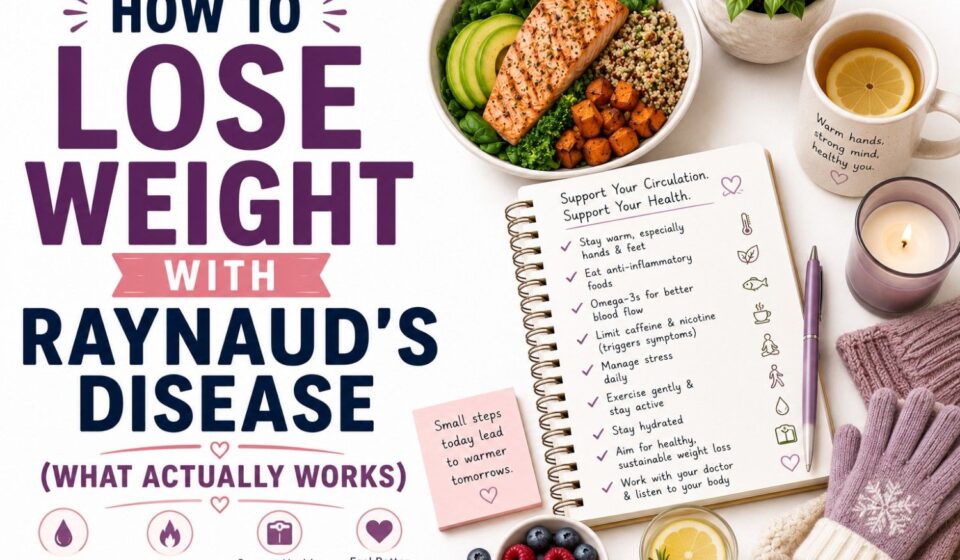

Cold sensitivity, circulation issues, and exercise limitations — here’s the approach that supports fat loss while managing Raynaud’s
Raynaud’s disease — a condition where small blood vessels in the extremities overreact to cold temperatures or stress, causing fingers, toes, ears, and nose to turn white, then blue, then red — creates specific challenges for weight management that most people don’t consider. Exercise in cold environments triggers episodes. Certain weight loss supplements affect circulation. The underlying conditions associated with secondary Raynaud’s (lupus, scleroderma, rheumatoid arthritis) add further complexity.
This guide addresses the specific realities of Raynaud’s and weight loss — and the approach that supports fat loss while minimizing episode frequency and severity.

Understanding Raynaud’s and Its Impact on Weight Loss
Primary vs. Secondary Raynaud’s
Primary Raynaud’s (Raynaud’s disease): The condition itself, without an underlying cause. Generally milder, more manageable, affects mostly young women. The weight management implications are primarily practical — exercise environment and temperature management.
Secondary Raynaud’s (Raynaud’s phenomenon): Associated with an underlying condition — most commonly scleroderma, lupus, rheumatoid arthritis, Sjögren’s syndrome, or thyroid disorders. More severe, with additional weight management implications from the underlying condition and its treatments.
How Raynaud’s Affects Weight Management
Exercise environment restrictions: Cold environments trigger Raynaud’s episodes — making outdoor exercise in cooler temperatures problematic. This eliminates or complicates some of the most accessible forms of exercise (outdoor walking, running, cycling) for a significant portion of the year in many climates.
Exercise intensity and circulation: High-intensity exercise that redirects blood flow away from extremities can trigger episodes in some Raynaud’s patients — though for most, exercise actually improves circulation and reduces episode frequency over time.
Underlying condition burden: Secondary Raynaud’s patients deal with the additional weight management challenges of their primary condition — fatigue, pain, medications, and inflammation from conditions like lupus or scleroderma.
Stress-triggered episodes: Psychological stress triggers Raynaud’s vasospasm directly — and the chronic stress of managing a visible, sometimes painful condition elevates cortisol that impairs fat loss.
Medication effects:
- Calcium channel blockers (nifedipine, amlodipine — primary Raynaud’s treatment): Generally weight-neutral, occasionally cause ankle fluid retention
- Vasodilators: Generally weight-neutral
- Corticosteroids (for secondary Raynaud’s underlying conditions): Cause significant weight gain
- Some beta-blockers: Can worsen Raynaud’s symptoms AND cause modest weight gain — discuss alternatives with your doctor
What Doesn’t Directly Affect Weight But Matters
Episode pain and discomfort: Painful episodes reduce quality of life and motivation — affecting dietary adherence and exercise consistency indirectly.
Smoking: Smoking worsens Raynaud’s dramatically through vasoconstriction — and is associated with weight changes when quitting. If smoking, quitting is the highest priority health intervention regardless of weight effects.
Why Weight Loss Helps Raynaud’s
Weight loss isn’t typically listed as a primary Raynaud’s treatment — but it helps through several mechanisms:
Improved cardiovascular function: Excess weight impairs circulation generally — weight loss improves overall vascular function and blood flow to extremities.
Reduced inflammation: For secondary Raynaud’s, reducing visceral fat reduces the inflammatory burden that worsens the underlying autoimmune condition driving vasospasm.
Better exercise tolerance: As weight decreases, exercise becomes easier and more sustained — and regular aerobic exercise consistently improves peripheral circulation and reduces Raynaud’s episode frequency in multiple studies.
Stress reduction: The psychological benefits of improved fitness and body composition reduce the stress-triggered vasospasm that causes episodes.
Dietary Approach for Weight Loss With Raynaud’s
1. Anti-Inflammatory Eating — Particularly Important for Secondary Raynaud’s
For secondary Raynaud’s associated with autoimmune conditions, the anti-inflammatory dietary pattern addresses both the underlying condition and fat loss simultaneously.
As covered in our guide to the best anti-inflammatory foods for weight loss:
Emphasize:
- Fatty fish (omega-3 fatty acids improve vascular function and reduce inflammation — directly relevant to Raynaud’s vasospasm)
- Extra virgin olive oil
- Colorful vegetables and berries
- Ginger (has mild vasodilatory properties alongside anti-inflammatory effects)
- Turmeric with black pepper
Reduce:
- Ultra-processed food
- Added sugar and refined carbohydrates
- Alcohol (causes vasodilation immediately then rebound vasoconstriction — worsens Raynaud’s)
- Caffeine in excess (vasoconstrictor — can worsen episodes, though evidence is mixed)
2. Omega-3 Fatty Acids — Specific Vascular Benefit
Beyond general anti-inflammatory benefit, omega-3 fatty acids have specific relevance for Raynaud’s — improving endothelial function, reducing platelet aggregation, and improving peripheral blood flow.
Multiple small studies show omega-3 supplementation reducing Raynaud’s episode frequency and severity. 2-3g EPA+DHA daily alongside dietary fatty fish.
3. Warming Foods — Practical Raynaud’s Dietary Strategy
Beyond the anti-inflammatory framework, certain dietary choices support peripheral circulation and body temperature maintenance — directly relevant to Raynaud’s management:
Thermogenic foods that may help:

- Ginger (improves peripheral circulation — add to tea, cooking, smoothies)
- Cayenne pepper (capsaicin improves blood flow — add to meals)
- Warm meals and beverages — simple but effective for maintaining core temperature
- Iron-rich foods — iron deficiency worsens Raynaud’s through impaired red blood cell oxygen carrying capacity
What to avoid:
- Very cold foods and beverages that lower core temperature
- Caffeine in large amounts — vasoconstrictor effect may worsen episodes for some patients
4. Adequate Protein
As covered in our guide to how much protein you actually need per day, targeting 0.8-1g per pound of bodyweight preserves muscle during fat loss and provides maximum satiety. For Raynaud’s specifically, protein from iron-rich sources (meat, fish, legumes) addresses the iron deficiency that can worsen symptoms.
5. Iron Status — Check and Address
Iron deficiency anemia significantly worsens Raynaud’s — reduced hemoglobin means less oxygen delivered to already compromised peripheral circulation. Blood testing for iron status (ferritin, hemoglobin) is worthwhile — and addressing deficiency through dietary iron and supplementation where needed directly improves Raynaud’s alongside metabolic function.
6. Moderate Calorie Deficit
A 400-500 calorie daily deficit produces meaningful fat loss without the metabolic stress that worsens circulation and stress response. Aggressive restriction elevates cortisol — which triggers vasospasm directly.
Exercise With Raynaud’s Disease — The Specific Approach
The Exercise-Raynaud’s Paradox
Exercise triggers Raynaud’s episodes acutely (through cold exposure and sometimes blood flow redistribution) — but regular exercise reduces Raynaud’s episode frequency chronically (through improved peripheral circulation and cardiovascular fitness).
The solution: manage the acute triggers while building the long-term benefits.
Managing Temperature During Exercise
This is the most important practical consideration for Raynaud’s exercise:
Indoor exercise in climate-controlled environments: The simplest solution — gym, home exercise equipment, indoor pool. Eliminates cold exposure entirely.
Layering for outdoor exercise:
- Heated gloves or mittens (battery-heated gloves are available specifically for Raynaud’s)
- Thermal base layers
- Hand warmers in pockets
- Cover ears and nose
- Never exercise outdoors in temperatures below your personal trigger threshold
Warm up indoors before going outside: Raising core temperature before cold exposure significantly reduces episode risk.
Exercise timing: In cooler climates, midday exercise when temperatures are highest reduces cold exposure.
Best Exercise Types for Raynaud’s
Indoor swimming (heated pool): Warm water maintains peripheral circulation during exercise — making heated pool swimming one of the best options for Raynaud’s patients. Avoid cold water pools.
Indoor cycling: Stationary bike in a climate-controlled environment — excellent cardiovascular benefit without cold exposure risk.
Yoga and Pilates: Indoor, temperature-controlled, stress-reducing — the stress reduction benefit is particularly valuable for Raynaud’s. As covered in our guides to how to lose weight with yoga and how to lose weight with Pilates, both provide meaningful body composition benefits alongside stress reduction.
Indoor strength training: Building muscle improves resting metabolic rate and cardiovascular function — done in a climate-controlled gym, entirely compatible with Raynaud’s.
Walking (with appropriate temperature management): As covered in our guide to how many steps to lose weight, daily walking provides meaningful metabolic benefit. In cooler weather — heated gloves, full coverage, indoor alternatives when temperatures drop below trigger threshold.
Treadmill: Removes weather variability entirely — allows consistent walking/running regardless of outdoor temperature.
Exercise Intensity and Raynaud’s
Moderate intensity exercise is generally better tolerated than maximum intensity for Raynaud’s — very high intensity can temporarily redirect blood flow away from extremities. Build intensity gradually and monitor response.
What to Do During an Episode
If a Raynaud’s episode occurs during exercise:
- Move to a warmer environment immediately
- Warm the affected area gradually — warm (not hot) water, body heat
- Don’t rub vigorously
- Resume exercise only after the episode fully resolves
Stress Management — Direct Impact on Episodes
Psychological stress triggers Raynaud’s vasospasm directly through sympathetic nervous system activation — the same mechanism that causes fight-or-flight vasoconstriction. As covered in our article on does stress cause weight gain, stress management is simultaneously a Raynaud’s management and fat loss strategy.
Daily stress reduction practices:
- Mindfulness meditation (reduces sympathetic nervous system reactivity over time)
- Regular moderate exercise (reduces baseline stress hormones)
- Adequate sleep
- Biofeedback (specifically studied for Raynaud’s — teaches voluntary warming of extremities through temperature feedback)
Biofeedback for Raynaud’s: A legitimate evidence-based intervention where patients learn to consciously warm their extremities through temperature feedback training. Some studies show meaningful reduction in episode frequency. Worth discussing with your doctor.
Supplements to Avoid With Raynaud’s
Several supplements commonly used for weight loss are vasoconstrictors that worsen Raynaud’s:
Avoid or use with caution:
- High-dose caffeine supplements: Vasoconstrictor — worsens episodes
- Ephedrine/synephrine: Strong vasoconstrictor — contraindicated
- High-dose niacin: Causes flushing and vascular effects — unpredictable in Raynaud’s
- Bitter orange extract: Vasoconstrictor
Safe and potentially beneficial:
- Omega-3 fatty acids (vasodilatory and anti-inflammatory)
- Magnesium (mild vasodilatory effect, improves vascular function)
- Vitamin D (low levels associated with worse Raynaud’s)
- Ginkgo biloba (improves peripheral circulation — some evidence for Raynaud’s)
- L-arginine (precursor to nitric oxide — vasodilatory)
Practical Daily Tips for Raynaud’s Weight Loss
Keep your whole body warm: Core temperature maintenance reduces extremity vasospasm — dress warmly even indoors during cooler months.
Avoid sudden temperature changes: Moving between very warm and cold environments triggers episodes — allow gradual temperature transitions.
Exercise with gloves: Even during indoor exercise if the gym is cool — preventing finger cooling avoids episodes mid-workout.
Stay hydrated: Dehydration reduces blood volume and worsens circulation — particularly important with Raynaud’s. As covered in our guide to how much water to drink to lose weight, 3+ liters daily supports both fat loss and vascular function.
When Additional Medical Support Is Appropriate
For Raynaud’s patients — particularly those with secondary Raynaud’s associated with autoimmune conditions — where underlying disease and medications are significantly impairing weight loss, medical support may be appropriate.
Breeze Meds offers telehealth evaluations to assess whether prescription weight loss support is appropriate alongside Raynaud’s management.
Check eligibility & pricing at Breeze Meds →Affiliate disclosure: We may earn a commission if you use this link. Breeze Meds provides telehealth weight-loss services. Prescription medication is only provided following an evaluation by a licensed healthcare professional and is not guaranteed.
The Bottom Line
Losing weight with Raynaud’s disease requires managing temperature triggers while building the cardiovascular fitness that actually reduces episode frequency long-term:
- Exercise indoors in climate-controlled environments — eliminates the primary exercise trigger
- Heated gloves and appropriate layering for any outdoor activity
- Anti-inflammatory dietary pattern — omega-3s particularly relevant for vascular function
- Warming foods — ginger, cayenne, warm meals and beverages
- Check and address iron status — deficiency worsens Raynaud’s
- Avoid vasoconstricting supplements — caffeine, ephedrine, synephrine
- Stress management daily — directly reduces vasospasm frequency
- Moderate intensity exercise — better tolerated than maximum intensity
- Moderate calorie deficit (400-500 calories) — not aggressive
- Build long-term exercise habit — chronic exercise reduces episode frequency
For the complete anti-inflammatory framework that supports both Raynaud’s management and fat loss, our guide to how to reduce inflammation to lose weight covers everything in one place.
Do you have Raynaud’s disease and have found specific approaches that work for managing weight while minimizing episodes? Share in the comments.
Stop Wondering What to Eat This Week
Get my free 7-Day High-Protein Weight Loss Meal Plan delivered straight to your inbox — a simple week of satisfying, protein-focused meals designed to make healthy eating easier without complicated calorie tracking.
- 7 full days of breakfast, lunch, dinner & snacks
- One complete shopping list for the whole week
- A quick high-protein food cheat sheet
- Simple daily tips to help you stay on track
Free PDF • Delivered by email • Unsubscribe anytime
Check your inbox 💜
Your free 7-day high-protein meal plan is on its way.


