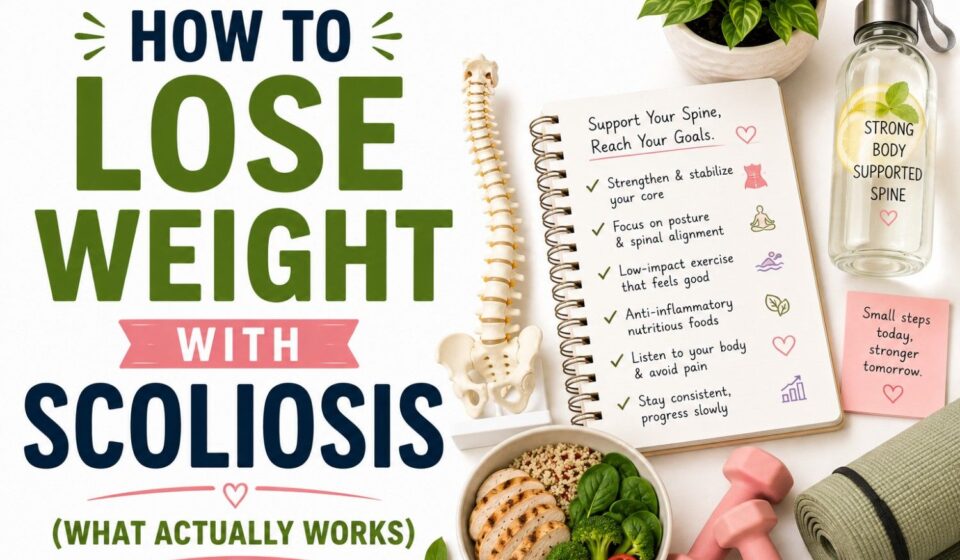

Pain, limited mobility, and exercise restrictions — here’s the specific approach that supports fat loss while protecting your spine
Scoliosis — an abnormal lateral curvature of the spine — affects approximately 3% of the population, with the majority of cases being mild and manageable. For people with moderate to severe scoliosis, weight management presents specific challenges: certain exercises are contraindicated, chronic pain reduces activity levels, and some pain medications affect metabolism and appetite.
The good news: weight loss with scoliosis is not only achievable but particularly valuable — excess weight increases the mechanical load on an already compromised spine, worsening pain and potentially accelerating curve progression in some cases.
How Scoliosis Affects Weight Management
Chronic Pain Reduces Activity
Moderate to severe scoliosis often causes chronic back, hip, and rib pain — particularly in adults with degenerative changes alongside the curvature. Chronic pain:
- Directly limits physical activity and exercise capacity
- Elevates cortisol — which promotes fat storage and impairs fat mobilization
- Disrupts sleep — worsening hunger hormones and metabolic function
- Drives emotional eating as a coping mechanism
As covered in our article on how to lose weight with chronic pain, pain management and weight loss are deeply interconnected — addressing pain creates conditions where weight loss becomes more achievable.
Exercise Restrictions
Certain exercises commonly recommended for weight loss are contraindicated or inadvisable with significant scoliosis:
- High-impact activities (running, jumping) that compress and jolt the spine
- Heavy axial loading (barbell back squats, overhead press with significant weight)
- Certain asymmetrical movements that worsen imbalances
- Exercises that increase the curve rather than addressing it
This narrows the exercise options — but doesn’t eliminate them. Many highly effective weight loss exercises are scoliosis-friendly.
Postural Imbalances Affect Exercise Mechanics
Scoliosis creates muscular imbalances — one side of the back is typically stronger and shorter, the other weaker and longer. These imbalances affect how exercises feel and perform, and can lead to compensatory movements that cause injury if not addressed.
Working with a physical therapist experienced in scoliosis before starting any exercise program is strongly recommended.
Medications and Weight
NSAIDs (ibuprofen, naproxen): Commonly used for scoliosis pain — generally weight neutral but can cause fluid retention with regular use.
Muscle relaxants: Some cause sedation that reduces activity.
Antidepressants: Used for chronic pain management — some cause weight gain.
Opioids: For severe pain — cause constipation, sedation, and reduced activity. Associated with weight gain with long-term use.
Discussing medication weight effects with your doctor — and whether alternatives exist — is worthwhile.
Why Weight Loss Matters With Scoliosis
Before the how: the motivation.
Reduced spinal load: Every pound of body weight adds significant force on spinal structures. Weight loss directly reduces the mechanical stress on an already compromised spine — often producing meaningful pain reduction.
Improved pain management: Reduced spinal load from weight loss frequently reduces chronic pain — creating a positive feedback loop where less pain enables more activity, which supports further weight loss.
Better surgical outcomes: For people considering scoliosis surgery, lower body weight is associated with better surgical outcomes, fewer complications, and faster recovery.
Reduced inflammation: Excess adipose tissue produces inflammatory cytokines that worsen pain perception and potentially accelerate degenerative changes alongside scoliosis.
Dietary Approach for Weight Loss With Scoliosis
1. Anti-Inflammatory Eating — Directly Reduces Pain
The anti-inflammatory dietary pattern addresses both weight loss and the chronic pain that limits activity — making it particularly valuable for scoliosis.
As covered in our comprehensive guide to the best anti-inflammatory foods for weight loss:
Emphasize:
- Fatty fish (omega-3s reduce inflammatory cytokines that amplify pain perception)
- Extra virgin olive oil
- Berries and colorful vegetables
- Turmeric with black pepper (curcumin has specific evidence for reducing musculoskeletal pain)
- Ginger (anti-inflammatory and analgesic properties)
- Leafy greens (magnesium — important for muscle function and pain)
Reduce:
- Ultra-processed food (primary dietary inflammation driver)
- Added sugar and refined carbohydrates
- Alcohol (worsens inflammation and pain perception)
- Industrial seed oils
2. Adequate Protein
As covered in our guide to how much protein you actually need per day, targeting 0.8–1g of protein per pound of bodyweight:
- Preserves muscle during calorie restriction
- Supports the repair of muscle tissue stressed by postural compensation
- Provides the most powerful satiety of any macronutrient
- Supports bone health (important given spinal concerns)
3. Calcium and Vitamin D — Bone Health Priority
Scoliosis is associated with reduced bone density in some patients — particularly those with adolescent idiopathic scoliosis. Weight loss itself slightly reduces bone density. Adequate calcium and vitamin D are therefore particularly important.
Calcium: 1,000–1,200mg daily from dairy, fortified plant milks, leafy greens, canned fish with bones.
Vitamin D: 1,500–2,000 IU supplementation for most adults — supports both bone health and has anti-inflammatory and analgesic effects.
4. Magnesium — For Muscle Function and Pain
Magnesium is a critical mineral for muscle function, nerve transmission, and pain modulation — and deficiency is extremely common. For scoliosis patients dealing with muscle spasm and pain, adequate magnesium is particularly relevant.
300–400mg magnesium glycinate at bedtime — also improves sleep quality, which is often disrupted by scoliosis pain.
5. Moderate Calorie Deficit
A 400–500 calorie daily deficit produces meaningful fat loss without the metabolic stress that would worsen pain and fatigue. Aggressive restriction is counterproductive with chronic pain conditions — it elevates cortisol and impairs the sleep and recovery that pain management depends on.
Exercise With Scoliosis — The Specific Approach
Work With a Physical Therapist First
This is the most important recommendation for exercise with scoliosis. A physical therapist experienced in spinal conditions can:
- Assess your specific curve pattern and severity
- Identify which exercises are safe and beneficial vs. potentially harmful
- Design a program that addresses muscular imbalances alongside fat loss
- Progress the program appropriately as strength and mobility improve
The Schroth Method — a physiotherapy approach specifically developed for scoliosis — has strong evidence for improving posture, reducing pain, and stabilizing curves. Many Schroth-trained physical therapists can design exercise programs that are both scoliosis-appropriate and metabolically beneficial.
Best Exercises for Scoliosis Weight Loss
Swimming and water exercise: The single best exercise option for most scoliosis patients — water buoyancy unloads the spine dramatically, reducing pain during exercise while providing full cardiovascular and strengthening benefits. The horizontal position of swimming also reduces spinal compression compared to upright exercise.
Many scoliosis patients who cannot tolerate land-based exercise find they can exercise comfortably in water for extended periods.
Walking: Low-impact, spinal-friendly, and accessible. As covered in our guide to how many steps to lose weight, consistent daily walking provides meaningful metabolic benefit. Good posture during walking — and appropriate footwear — reduces spinal stress.
Start with whatever is comfortable and build gradually.
Cycling (stationary): Low-impact, non-axially loading exercise that provides cardiovascular benefit without the spinal compression of running. A properly fitted bike position is important — work with a physical therapist on optimal positioning.
Pilates (modified for scoliosis): Clinical Pilates specifically modified for scoliosis has growing evidence for improving strength, posture, and pain while being appropriate for spinal conditions. Focuses on core stability and postural correction alongside general strengthening.
As covered in our guide to how to lose weight with Pilates, Pilates provides body composition benefits alongside the specific postural work valuable for scoliosis.
Yoga (modified): Gentle yoga with appropriate modifications — avoiding asymmetrical poses that worsen imbalances and deep twisting — provides flexibility, stress reduction, and body awareness beneficial for scoliosis management.
Modified strength training: Resistance training is important for maintaining the muscle mass that supports the spine and metabolic rate — but requires careful selection:
Generally appropriate:
- Seated or lying exercises that don’t load the spine axially
- Machine-based exercises with controlled movement paths
- Resistance band exercises
- Single-leg exercises with caution (address imbalances with PT guidance)
- Upper body pulling movements (rows, lat pulldowns)
Use caution or avoid:
- Heavy barbell squats and deadlifts (significant axial spinal loading)
- Heavy overhead pressing
- Asymmetrical exercises that worsen existing imbalances without correction
What to Avoid
High-impact exercise: Running, jumping, and high-impact aerobics compress and jolt the spine — contraindicated for many scoliosis patients, particularly those with pain or significant curves.
Heavy axial loading: Barbell squats and deadlifts with significant weight place high compressive force on the spine — discuss with your physical therapist before including these.
Exercises that worsen asymmetry: Without professional assessment, exercises that preferentially strengthen already dominant muscles can worsen postural imbalances.
Pain Management Strategies That Support Weight Loss
Reducing chronic pain directly enables more physical activity and better dietary adherence — making pain management a legitimate weight loss strategy for scoliosis.
Heat therapy: Applying heat to tense muscles before exercise reduces spasm and improves exercise tolerance.
Cold therapy: After exercise or during pain flares — reduces inflammation and pain.
TENS (transcutaneous electrical nerve stimulation): Some scoliosis patients find TENS units provide meaningful pain relief that enables more activity.
Massage therapy: Regular massage reduces muscle tension, improves circulation, and can significantly reduce chronic pain — enabling more activity.
Sleep positioning: A supportive mattress and appropriate sleep positioning reduces nighttime pain that disrupts sleep — and better sleep directly improves metabolism and dietary adherence.
Stress management: Psychological stress amplifies pain perception through central sensitization. As covered in our article on does stress cause weight gain, stress management is simultaneously a pain management and fat loss strategy.
Monitoring Progress
Weight and measurements: Track weekly average weight alongside waist and hip measurements — body composition changes may be visible in measurements before they show clearly on the scale.
Pain levels: Track pain intensity alongside weight loss. Many scoliosis patients experience meaningful pain reduction as weight decreases — a powerful motivator to continue.
Functional markers: What activities you can perform, how far you can walk, how long you can stand — these functional improvements often precede and predict further weight loss.
When Additional Medical Support Is Appropriate
For scoliosis patients with significant obesity where excess weight is worsening spinal pain and limiting activity, medical weight loss support may be appropriate — enabling more meaningful weight reduction more quickly.
Breeze Meds offers telehealth evaluations to assess whether prescription weight loss support is appropriate alongside scoliosis management.
Check eligibility & pricing at Breeze Meds →Affiliate disclosure: We may earn a commission if you use this link. Breeze Meds provides telehealth weight-loss services. Prescription medication is only provided following an evaluation by a licensed healthcare professional and is not guaranteed.
The Bottom Line
Losing weight with scoliosis requires a spine-friendly approach that addresses both the physical limitations and the chronic pain that makes standard weight loss advice impractical:
- Work with a physical therapist before starting any exercise program
- Anti-inflammatory dietary pattern — reduces both inflammation and pain
- Adequate protein (0.8–1g per pound) — muscle preservation and satiety
- Calcium, vitamin D, and magnesium — bone and muscle health
- Swimming — best exercise for most scoliosis patients
- Walking and cycling — accessible low-impact options
- Modified Pilates or yoga — core strength and postural benefit
- Avoid high-impact and heavy axial loading exercises
- Pain management strategies — reduce pain to enable more activity
- Moderate deficit (400–500 calories) — not aggressive
Weight loss directly reduces spinal load and often significantly reduces chronic pain — creating a positive feedback loop where less pain enables more activity and further weight loss.
For the complete anti-inflammatory framework that supports both scoliosis pain management and fat loss, our guide to how to reduce inflammation to lose weight covers everything in one place.
Do you have scoliosis and have found specific exercises or dietary approaches that work for managing weight alongside the condition? Share in the comments — real experience from people navigating this is invaluable.
Stop Wondering What to Eat This Week
Get my free 7-Day High-Protein Weight Loss Meal Plan delivered straight to your inbox — a simple week of satisfying, protein-focused meals designed to make healthy eating easier without complicated calorie tracking.
- 7 full days of breakfast, lunch, dinner & snacks
- One complete shopping list for the whole week
- A quick high-protein food cheat sheet
- Simple daily tips to help you stay on track
Free PDF • Delivered by email • Unsubscribe anytime
Check your inbox 💜
Your free 7-day high-protein meal plan is on its way.