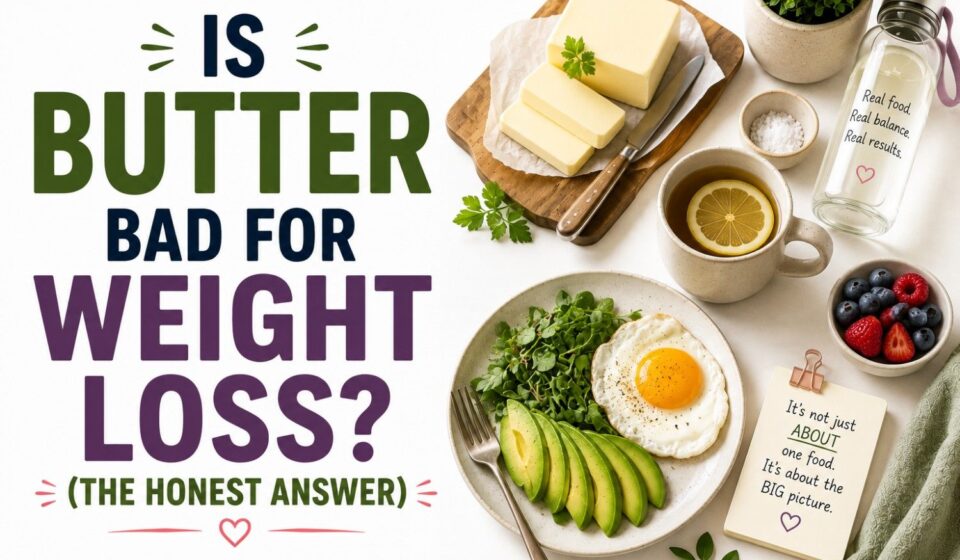

The fat that was demonized for decades — here’s what the evidence actually shows about butter and weight loss

Butter spent decades as dietary enemy number one — blamed for heart disease, obesity, and everything in between. The low-fat era of the 1980s and 1990s banished it from health-conscious kitchens and replaced it with margarine and vegetable oils that turned out to be significantly worse.
The pendulum has swung. Butter is back — but does that mean it’s good for weight loss? Here’s the honest, evidence-based answer.
What Is Butter?
Butter is made from churned cream — approximately:
- 80% fat (mostly saturated fat, with some monounsaturated and polyunsaturated)
- 16-17% water
- 2-3% milk proteins and carbohydrates
Nutritional profile per tablespoon (14g):
- Calories: 102
- Fat: 11.5g (7.3g saturated, 3g monounsaturated, 0.4g polyunsaturated)
- Protein: 0.1g
- Carbohydrates: 0g
- Vitamin A: 11% of daily value
- Vitamin K2: meaningful amounts (particularly grass-fed butter)
Is Butter Bad for Weight Loss?
The direct answer: Butter is not inherently bad for weight loss — but its high calorie density means portions matter significantly.
At 102 calories per tablespoon, butter is one of the most calorie-dense common foods. The issue isn’t butter’s fat content — dietary fat doesn’t cause fat gain independently. The issue is that small amounts add significant calories that can push you over your calorie target without you noticing.
The key distinction: Whether butter fits your weight loss approach depends entirely on how it’s used and whether it fits within your overall calorie target.
What the Evidence Shows About Butter and Weight
Saturated Fat and Weight — Reconsidered
The original case against butter was its saturated fat content — the hypothesis being that saturated fat causes heart disease and promotes obesity. This has been significantly revised:
Multiple large meta-analyses of cohort studies have found no significant association between saturated fat intake and cardiovascular disease when replacing saturated fat with refined carbohydrates — the replacement that actually happened during the low-fat era.

Butter vs. margarine: The trans fats in the margarine that replaced butter turned out to be significantly more harmful than butter’s saturated fat — one of nutrition science’s more embarrassing reversals.
Saturated fat and obesity: Dietary fat — including saturated fat — is not independently associated with weight gain in controlled studies. Calorie surplus causes weight gain regardless of macronutrient composition.
The Satiety Question
Fat is the most satiating macronutrient per gram — and butter added to meals increases satiety, potentially reducing overall calorie intake at subsequent meals. However:
The 102 calories in a tablespoon of butter represents a meaningful addition to any meal — and whether the satiety benefit offsets the calorie addition depends on individual response and the specific food context.
Grass-Fed Butter — Worth the Distinction?
Grass-fed butter (Kerrygold and similar) differs meaningfully from conventional butter:
- Higher in vitamin K2 — important for cardiovascular health and bone density
- Higher in conjugated linoleic acid (CLA) — some evidence for modest fat loss support
- Higher in omega-3 fatty acids
- Higher in beta-carotene (produces the deeper yellow color)
If choosing butter, grass-fed has a meaningfully better nutritional profile — though the calorie content is identical.
Butter vs. Common Alternatives — The Honest Comparison
Butter vs. Margarine
Margarine was the supposed healthy alternative to butter for decades. The verdict:
Modern margarine has largely eliminated trans fats — but it’s still a highly processed product made from industrial seed oils (high omega-6, pro-inflammatory). As covered in our guide to the best anti-inflammatory foods for weight loss, industrial seed oils drive inflammatory prostaglandin production.
Verdict: Butter is preferable to margarine from both a health and inflammatory standpoint — despite being equally caloric.
Butter vs. Olive Oil
Extra virgin olive oil is the gold standard cooking and finishing fat for weight loss and health — primarily through its oleic acid content and anti-inflammatory compounds (oleocanthal). However:
- Olive oil: 119 calories per tablespoon (slightly more than butter)
- Different flavor profile — better suited to some cooking contexts than others
Verdict: Olive oil is the superior choice for most cooking and dressing contexts — but the calorie difference is minimal and butter is preferable to most processed alternatives.
Butter vs. Coconut Oil
Coconut oil is higher in medium-chain triglycerides (MCTs) than butter — which are metabolized differently and have some evidence for modest metabolic benefit. However:
- Coconut oil: 121 calories per tablespoon (slightly more than butter)
- Lower in vitamins than butter
- The MCT content of standard coconut oil is lower than often claimed
Verdict: Similar calorie density, different nutritional profiles — neither is clearly superior for weight loss.
Butter vs. Ghee
Ghee is clarified butter — butter with the milk proteins and water removed, leaving nearly pure butterfat:
- Ghee: 112 calories per tablespoon (slightly more than butter)
- No lactose or casein — better tolerated by dairy-sensitive individuals
- Higher smoke point — better for high-heat cooking
- Similar nutritional profile otherwise
Verdict: Nutritionally similar to butter — the choice between them is primarily about lactose sensitivity and cooking application.
The Calorie Density Problem
This is the honest reason butter requires attention in a weight loss context — not its saturated fat, not its cholesterol content, but its calorie density.
The invisible calorie accumulation problem:
Most people significantly underestimate how much butter they use:
- A “light” spread on toast: often 1-1.5 tablespoons = 100-150 calories
- Sautéing vegetables “in a little butter”: often 1-2 tablespoons = 100-200 calories
- Finishing a sauce “with a knob of butter”: often 2-3 tablespoons = 200-300 calories
- Butter on a baked potato: often 1-2 tablespoons = 100-200 calories
Someone who adds butter to toast, uses it for cooking lunch, and finishes a dinner sauce might add 400-600 calories daily from butter alone — without registering it as a significant dietary input.
As covered in our guide to is counting calories worth it, this invisible calorie accumulation from cooking fats is one of the most common reasons people can’t identify why they’re not losing weight despite “eating healthy.”
How to Use Butter Without Sabotaging Weight Loss
1. Measure Rather Than Eyeball
A food scale or measuring spoon for butter is the single most impactful change for people who cook with butter regularly. Most people pour 2-3x what they think they’re using.
2. Use It Strategically
Reserve butter for applications where it genuinely improves the eating experience — finishing a sauce, on a special occasion, where the flavor specifically matters. Use olive oil for most everyday cooking.
3. Account for It in Your Calorie Target
If you enjoy butter and want to include it — budget for it. 1 tablespoon of butter at 102 calories is a completely reasonable dietary inclusion if it fits within your overall calorie target and you actually track it.
4. Consider Cooking Method
Butter burns at relatively low temperatures — making it less ideal for high-heat cooking where more oil is needed. This naturally limits how much butter is used in higher-heat cooking contexts.
The Bulletproof Coffee and Keto Butter Trend
The keto and biohacking communities popularized adding large amounts of butter to coffee — “bulletproof coffee” typically containing 1-2 tablespoons of butter and 1-2 tablespoons of MCT oil, adding 300-500 calories to a morning coffee.
The weight loss reality: Bulletproof coffee can work within a ketogenic framework where it replaces breakfast entirely — the fat content suppresses appetite through ketone production and delayed gastric emptying. But it adds significant calories and only makes sense within a specifically structured keto approach where total calorie intake accounts for it.
Adding butter to coffee on top of a normal diet reliably produces calorie surplus and weight gain.
As covered in our guide to how to lose weight on keto, keto’s weight loss mechanism is calorie management — not magic fat burning from dietary fat.
The Bottom Line
Is butter bad for weight loss?
No — but it’s easy to use too much of it without realizing it.
- Butter is not inherently fattening — dietary fat doesn’t cause fat gain independently of total calorie surplus
- Butter’s saturated fat content is not the health villain it was portrayed as for decades
- Butter is preferable to margarine and most processed alternatives
- Olive oil is the superior everyday cooking fat — but butter is a reasonable choice used mindfully
- The problem is calorie density — 102 calories per tablespoon accumulates quickly when cooking habits aren’t tracked
The practical recommendation: Enjoy butter in appropriate amounts where it genuinely adds value to food. Measure it rather than estimating. Account for it in your daily calorie target. Choose grass-fed where possible for better nutritional profile.
And replace the margarine in your fridge with either butter or olive oil — that was always the right call. 😄
For the complete dietary framework that puts individual foods in context, our guide to how to get rid of belly fat covers everything in one place.
Do you use butter regularly and find it affects your weight loss — or do you find it fits fine within your calorie target? Share in the comments.