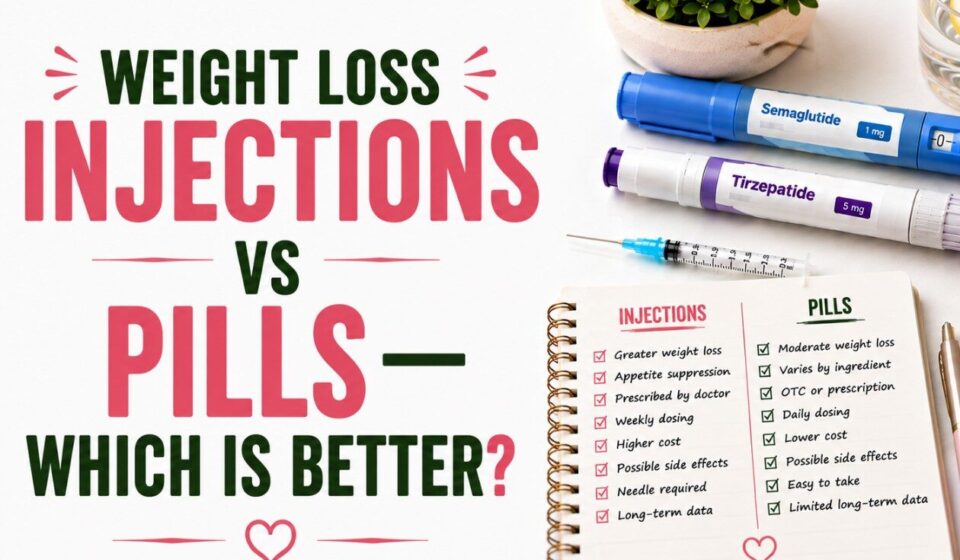

Injectable GLP-1s vs. oral medications vs. supplements — the honest comparison based on what the evidence actually shows

“Weight loss pills” means very different things depending on who’s using the term — prescription oral medications, over-the-counter supplements, or the oral versions of the same GLP-1 drugs available as injections. The comparison between injections and pills is therefore not a single comparison but several different ones, each with a different answer.
Here’s the complete breakdown.
First: Clarifying What “Pills” Means
Category 1: Oral GLP-1 Medications (Same Drug Class as Injections)
Oral semaglutide (Rybelsus): The same semaglutide used in Ozempic and Wegovy — but taken as a daily pill rather than a weekly injection. Currently FDA-approved for type 2 diabetes, not yet approved specifically for weight loss at the doses being studied.
Oral tirzepatide: In clinical trials — an oral version of Mounjaro/Zepbound. Not yet FDA-approved at time of writing but showing promising trial results.
Category 2: Prescription Weight Loss Pills (Different Drug Classes)
Orlistat (Xenical, Alli): Lipase inhibitor that reduces fat absorption. Available by prescription (Xenical) and over-the-counter at lower dose (Alli).
Phentermine-topiramate (Qsymia): Stimulant + anticonvulsant combination that reduces appetite.
Naltrexone-bupropion (Contrave): Opioid antagonist + antidepressant combination that affects appetite and reward pathways.
Phentermine alone: Short-term appetite suppressant stimulant — typically prescribed for 12 weeks maximum.
Category 3: Over-the-Counter Supplements (Not Medications)
Garcinia cambogia, green tea extract, raspberry ketones, CLA, glucomannan, and dozens of others — sold as weight loss pills without FDA approval for efficacy.

These are not medications. They have no meaningful clinical trial evidence for significant weight loss. They will not be compared seriously in this guide — not because of controversy but because the evidence for their efficacy is essentially absent.
Injections vs. Oral GLP-1 (Same Drug, Different Delivery)
This is the most direct comparison — injectable semaglutide (Ozempic/Wegovy) vs. oral semaglutide (Rybelsus).
Why the Same Drug Comes in Both Forms
GLP-1 peptides are normally broken down in the digestive system before reaching circulation — which is why these medications were originally developed as injections that bypass the gut. Oral semaglutide required significant pharmaceutical engineering (the SNAC absorption enhancer) to achieve meaningful bioavailability when taken orally.
The Efficacy Comparison
Injectable semaglutide (Wegovy 2.4mg weekly):
- STEP 1 trial: 14.9% average weight loss at 68 weeks
Oral semaglutide (Rybelsus — highest approved diabetes dose, 14mg daily):
- PIONEER trials: 4.4-5.1% weight loss at approved doses for diabetes
Oral semaglutide (higher doses being studied for weight loss):
- Phase 3 OASIS trials (50mg oral semaglutide daily): 15.1% weight loss at 68 weeks — comparable to injectable at matched doses
The conclusion: At equivalent doses, oral and injectable semaglutide produce comparable weight loss. The historical efficacy difference was primarily a dose issue — approved oral doses were lower than approved injectable doses. Higher-dose oral formulations are closing this gap.
Practical Differences Between Oral and Injectable GLP-1
Dosing requirements for oral: Oral semaglutide must be taken:
- On an empty stomach (no food or other medications for 30 minutes before and after)
- With no more than 4 ounces of plain water
- At the same time each day
These requirements significantly limit flexibility. People who don’t consistently follow the fasting window get dramatically reduced absorption and effectiveness.
Side effect profile: Oral and injectable semaglutide have similar side effect profiles — nausea, GI symptoms, etc. Some evidence suggests oral produces slightly more GI symptoms at equivalent doses because of gut exposure before absorption.
Convenience:
- Injectable: once weekly, 30 seconds, no food restrictions
- Oral: daily, strict fasting requirements, less flexible
Who might prefer oral:
- Needle phobia — though the injection is much easier than feared
- Preference for daily pill routine over weekly injection
- Situations where injection isn’t practical
Who might prefer injectable:
- Once-weekly vs. daily administration
- No food restriction requirements
- Currently more dosing options and longer track record at weight loss doses
Injections vs. Prescription Weight Loss Pills (Different Drug Classes)
Injections vs. Orlistat
Orlistat mechanism: Inhibits pancreatic lipase — reducing fat absorption from meals by approximately 30%.
Orlistat efficacy:
- Average weight loss: 3-5% of body weight over 12 months
- Significantly less than GLP-1 injections (14-21%)
Orlistat side effects: Directly related to its mechanism — unabsorbed fat must leave the body, causing:
- Oily/fatty stools
- Fecal urgency (sometimes severe)
- Oily spotting on underwear
- Fecal incontinence in some users
- These symptoms worsen significantly with high-fat meals — creating a behavioral deterrent to eating fat
Comparison verdict: GLP-1 injections significantly outperform orlistat on efficacy. Orlistat’s side effects are generally considered worse in quality-of-life impact than GLP-1 GI symptoms, despite different mechanisms. Orlistat’s advantage: lower cost and no injection.
Injections vs. Phentermine-Topiramate (Qsymia)
Mechanism: Phentermine stimulates norepinephrine release (reducing appetite). Topiramate’s weight loss mechanism isn’t fully understood but includes reduced appetite and increased satiety.
Efficacy:
- Average weight loss: 8-10% of body weight over 12 months
- Better than orlistat, less than GLP-1 injections
Side effects:
- Increased heart rate (from phentermine’s stimulant effect)
- Cognitive effects (“brain fog,” memory issues — from topiramate)
- Paresthesia (tingling, numbness — topiramate)
- Dry mouth, insomnia
- Significant birth defect risk — topiramate causes oral clefts. Requires monthly pregnancy testing for women of childbearing age.
- Contraindicated with cardiovascular disease (phentermine’s stimulant effects)
Comparison verdict: Less effective than GLP-1 injections. Significant contraindications and side effects. The cardiovascular contraindication and teratogenicity make it inappropriate for many patients who would qualify for GLP-1 medications.
Injections vs. Naltrexone-Bupropion (Contrave)
Mechanism: Naltrexone (opioid antagonist) + bupropion (antidepressant/dopamine agent) reduce food reward and appetite through complementary brain pathways.
Efficacy:
- Average weight loss: 5-8% of body weight over 12 months
- Less than GLP-1 injections
Side effects:
- Nausea (very common — similar to GLP-1s)
- Headache, dizziness
- Insomnia
- Dry mouth
- Increased blood pressure and heart rate
- Black box warning for suicidality — as with most antidepressants
- Contraindicated with opioid use, seizure disorders, eating disorders, uncontrolled hypertension
Comparison verdict: Less effective than GLP-1 injections. The bupropion component may be beneficial for people with depression and obesity — treating both simultaneously. The suicidality warning and opioid contraindication limit its use in some populations.
The Overall Efficacy Comparison
| Medication | Type | Average Weight Loss | Administration |
|---|---|---|---|
| Tirzepatide (Zepbound) | Injection | 20-21% | Weekly injection |
| Semaglutide (Wegovy) | Injection | 14-15% | Weekly injection |
| Oral semaglutide (high dose, trial) | Pill | 15% | Daily pill |
| Phentermine-topiramate (Qsymia) | Pill | 8-10% | Daily pill |
| Naltrexone-bupropion (Contrave) | Pill | 5-8% | Twice daily pill |
| Orlistat (Xenical) | Pill | 3-5% | 3x daily with meals |
| OTC supplements | Pill | ~1-2% (barely above placebo) | Varies |
Side Effect Comparison
| Medication | Primary Side Effects | Serious Concerns |
|---|---|---|
| GLP-1 injections | Nausea, GI symptoms, hair loss | Pancreatitis (rare), gallbladder disease |
| Oral GLP-1 (high dose) | Similar to injectable | Similar to injectable |
| Phentermine-topiramate | Heart rate, cognitive effects | Birth defects, CV contraindication |
| Naltrexone-bupropion | Nausea, insomnia, BP increase | Suicidality warning, opioid contraindication |
| Orlistat | Oily stools, fecal urgency | Fat-soluble vitamin deficiency |
| OTC supplements | Varies by product | Unknown (unregulated) |
Who Should Consider Pills Over Injections
Needle phobia that can’t be overcome: Though the injection is genuinely much easier than feared — as covered in our guide to weight loss injections — what nobody tells you, most people find the injection anticlimactic — some people’s aversion to injections is severe enough that oral options are preferable even at some cost to efficacy.
When oral GLP-1 becomes available at weight loss doses: High-dose oral semaglutide in trials shows comparable efficacy to injectable — when this becomes widely available, some people may prefer oral for convenience despite the fasting requirements.
Specific comorbidities favoring other medications: People with comorbid depression may benefit from naltrexone-bupropion’s antidepressant component. People whose primary eating issue is reward-driven rather than hunger-driven may respond differently to different mechanisms.
Cost considerations: Some oral prescription medications are currently cheaper than injectable GLP-1s — though compounded injectable options have narrowed this gap significantly.
Who Should Choose Injections Over Pills
Maximum efficacy priority: At current approved doses, injectable GLP-1 medications — particularly tirzepatide — produce the greatest weight loss of any non-surgical intervention available. If maximum weight loss is the primary goal, injectable outperforms all oral alternatives.
Simplest regimen: Once-weekly injection with no food restrictions is a simpler daily routine than daily pills with specific fasting requirements (oral GLP-1) or twice-daily pills (Contrave).
Cardiovascular risk: The SELECT trial demonstrates cardiovascular protection with injectable semaglutide — evidence specific to the injectable formulation at weight loss doses. Phentermine-topiramate is actually contraindicated in cardiovascular disease.
When you qualify and have access: For people who meet qualification criteria and can access GLP-1 injections at reasonable cost (compounded options at $150-400/month) — the efficacy advantage makes injections the preferred option for most people.
The Honest Recommendation
If you qualify for GLP-1 injections and can access them affordably: Injectable GLP-1 medications — particularly tirzepatide — produce the greatest weight loss with the most favorable safety profile of any currently available weight loss medication class. The injection is far less daunting than it sounds.
If needle phobia is a genuine barrier: Wait for high-dose oral semaglutide approval (showing comparable efficacy in trials) or consider oral GLP-1 options with prescriber guidance.
If you don’t qualify for GLP-1 medications: Phentermine-topiramate is the most effective alternative prescription option — but with significant contraindications that limit its use. Discuss with a prescriber.
If you’re considering OTC supplements: The evidence for meaningful weight loss from any over-the-counter supplement is essentially absent. This is money that could go toward more effective interventions.
How to Get Started
If you’re considering weight loss injections and want to assess whether you qualify, telehealth evaluation is the most accessible starting point.
Gala offers licensed telehealth evaluation for GLP-1 weight loss compounded medications — determining whether injections are appropriate for your health profile and goals.
[Check if you qualify at Gala →]
This is a paid partnership. Gala is a licensed telehealth provider. Medication is only prescribed following a medical consultation and is not guaranteed.
The Bottom Line
Injections vs. oral GLP-1: Comparable efficacy at matched doses — oral requires strict fasting requirements, injectable is simpler with once-weekly dosing. Oral options will likely expand.
Injections vs. other prescription pills: Injectable GLP-1s significantly outperform orlistat (3-5% vs. 15-21%), phentermine-topiramate (8-10% vs. 15-21%), and naltrexone-bupropion (5-8% vs. 15-21%) on weight loss efficacy.
Injections vs. OTC supplements: No meaningful comparison — supplements produce barely detectable weight loss in clinical trials.
The bottom line: For maximum weight loss efficacy with the most favorable overall safety profile, injectable GLP-1 medications are currently the superior option for people who qualify and can access them.
For the complete picture, see our guides to what are weight loss injections and who qualifies for weight loss injections.
Have you tried both pills and injections for weight loss — and which worked better for you? Share in the comments.