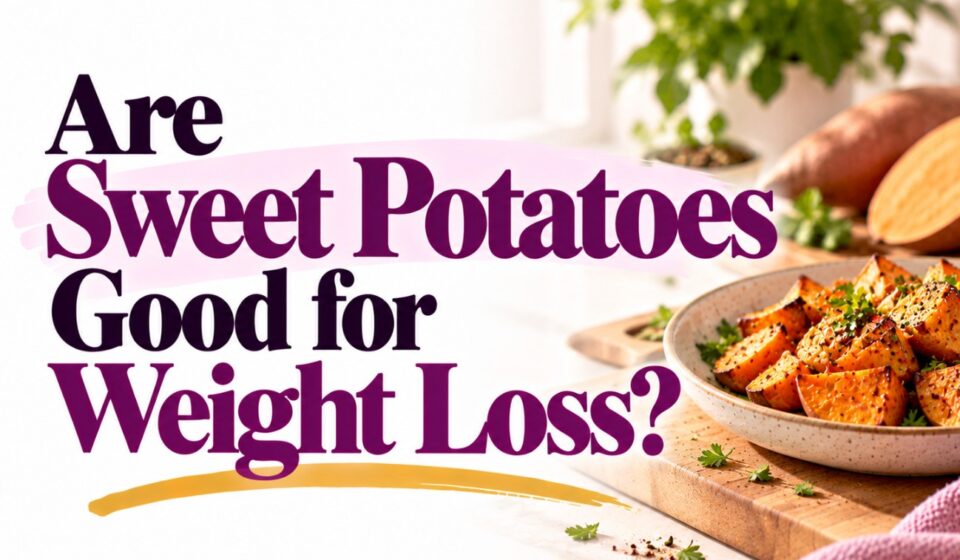

The starchy vegetable that’s both feared and celebrated in weight loss circles — here’s what the evidence actually shows
Sweet potatoes occupy a genuinely confusing place in weight loss nutrition. They’re starchy — which makes carbohydrate-fearers nervous. But they’re nutritionally exceptional — which makes whole-food advocates celebrate them. They have a moderate glycemic index — which is better than most people expect for a sweet, starchy food.
Here’s the complete honest assessment.

Sweet Potato Nutritional Profile
Per 100g of baked sweet potato (with skin):
- Calories: 90
- Fiber: 3.3g
- Protein: 2g
- Carbohydrates: 21g (net carbs: approximately 17.5g after fiber)
- Fat: 0.1g
- Vitamin A (as beta-carotene): 961mcg — 107% daily value
- Vitamin C: 19.6mg — 22% daily value
- Vitamin B6: 0.3mg — 18% daily value
- Potassium: 475mg — 10% daily value
- Manganese: 0.3mg — 15% daily value
- Magnesium: 27mg — 6% daily value
Per medium sweet potato (approximately 130g):
- Calories: 117
- Fiber: 4.3g
- Protein: 2.6g
- Carbohydrates: 27g
The standout numbers:
107% of daily vitamin A in a medium sweet potato — one of the richest beta-carotene sources available. 3.3g fiber per 100g — excellent for a starchy vegetable.
The Glycemic Index Question — The Most Important Clarification
Sweet potatoes have a reputation for being “better” than regular potatoes for blood sugar — but the reality is more nuanced:
Sweet potato GI by preparation method:
- Boiled sweet potato: GI approximately 44-46 — LOW GI
- Baked sweet potato: GI approximately 54-94 — LOW to HIGH GI
- Fried sweet potato: GI approximately 76 — HIGH GI
- Steamed sweet potato: GI approximately 44 — LOW GI
The critical finding:
Preparation method dramatically affects sweet potato’s glycemic impact. The same sweet potato can have a low GI (boiled/steamed: 44-46) or a high GI (baked at high temperature: up to 94) depending entirely on how it’s cooked.
Why this happens:
High-heat baking (particularly long baking times) gelatinizes the starch and converts much of the resistant starch to rapidly digestible starch — significantly increasing the glycemic response. Boiling keeps more starch in its less-digestible form.
Regular potato comparison:
Boiled regular white potato: GI approximately 50-56 — actually similar to boiled sweet potato.
The honest takeaway:
Sweet potatoes are NOT automatically lower GI than regular potatoes — the preparation method matters more than the variety. Boiled sweet potato is genuinely low GI. Baked sweet potato is moderate to high GI.
As covered in our guide to are potatoes good for weight loss — both sweet and regular potatoes can fit into weight loss approaches, with preparation method being the key variable.
Why Sweet Potatoes Support Weight Loss
1. Genuinely Excellent Satiety Per Calorie
Despite being a starchy vegetable — sweet potatoes provide exceptional satiety per calorie compared to most carbohydrate sources:
The satiety index:
Research measuring satiety per calorie has found boiled potatoes (including sweet potatoes) to be among the most satiating foods per calorie studied — significantly more satiating than bread, pasta, or rice at equivalent calorie content.
The mechanisms:
- Fiber (3.3g per 100g) slows digestion and extends fullness
- Water content (approximately 75%) provides volume-based satiety
- Protease inhibitor II — a protein in sweet potatoes specifically shown to reduce appetite in research
The practical calorie comparison:
- 200g baked sweet potato: 180 calories — highly filling
- 200g white rice (cooked): 260 calories — less filling
- 200g pasta (cooked): 260 calories — less filling
- 200g bread: 530 calories — much less filling
Sweet potatoes provide more satiety at fewer calories than most common carbohydrate alternatives.
2. Resistant Starch — The Weight Loss Advantage
Cooked and then cooled sweet potatoes contain meaningful resistant starch — starch that resists digestion in the small intestine and reaches the colon largely intact.
Resistant starch benefits for weight loss:
- Feeds beneficial gut bacteria — as covered in our guide to gut health and weight loss
- Produces butyrate through fermentation — improving insulin sensitivity
- Reduces post-meal glucose response
- Increases fat oxidation after consumption
- Reduces appetite through gut hormone stimulation
The practical application:
Cooking sweet potatoes then cooling them (in the refrigerator overnight) significantly increases resistant starch content. Eating them cold — or reheating gently — preserves this resistant starch benefit. This is the same principle that makes cooled rice and potatoes lower GI than freshly cooked versions.
As covered in our guide to is rice bad for weight loss — the cook-cool-reheat technique for reducing starch digestibility applies to sweet potatoes just as it does to rice and regular potatoes.
3. Exceptional Beta-Carotene — The Unique Advantage
107% of daily vitamin A as beta-carotene per medium sweet potato is genuinely exceptional — sweet potatoes are one of the richest beta-carotene sources in the human diet. The orange color indicates beta-carotene concentration.
The weight loss connection:
Research has found associations between adequate vitamin A status and better weight management outcomes — possibly through:
- Vitamin A’s role in fat cell differentiation and adipogenesis regulation
- Beta-carotene’s antioxidant effects reducing the oxidative stress that impairs fat metabolism
- Vitamin A’s involvement in thyroid function regulation
The anti-inflammatory benefit:
Beta-carotene is a powerful antioxidant that reduces inflammatory markers. As covered in our guide to best anti-inflammatory foods for weight loss — reducing chronic inflammation is one of the most important metabolic interventions for fat loss.

4. Potassium — Blood Pressure and Fluid Balance
At 475mg potassium per 100g — sweet potatoes are a rich potassium source. Potassium:
- Counteracts sodium’s fluid-retaining effects — reducing the scale weight increases from sodium intake
- Supports healthy blood pressure — relevant for the cardiovascular risk in the weight loss population
- Supports muscle function — important for exercise capacity and recovery
As covered in our guide to is salt bad for weight loss — the sodium-potassium balance directly affects fluid retention and scale weight fluctuations. Sweet potatoes’ high potassium content actively counteracts sodium’s effects.
5. Fiber — Both Types
Sweet potatoes provide both soluble and insoluble fiber:
Soluble fiber (pectin):
- Slows gastric emptying — extending satiety
- Blunts post-meal blood sugar response
- Feeds beneficial gut bacteria
Insoluble fiber:
- Adds digestive bulk
- Supports gut motility and regularity
- Reduces transit time
As covered in our guide to types of fiber — soluble vs insoluble — the fiber combination in sweet potatoes provides both immediate satiety and extended digestive support.
6. Blood Sugar Management — When Prepared Correctly
When boiled or steamed — sweet potatoes’ GI of 44-46 produces a genuinely moderate blood sugar response. Combined with the fiber content that further blunts glucose absorption — properly prepared sweet potatoes produce:
- Gradual, sustained energy release rather than spike-and-crash
- Lower insulin response than refined carbohydrates
- More stable blood sugar supporting appetite management
As covered in our guide to how to improve insulin sensitivity naturally — replacing refined carbohydrates with low-GI whole food starchy vegetables like boiled sweet potato improves overall metabolic health.
Sweet Potatoes vs Regular Potatoes — The Honest Comparison
| Factor | Sweet potato | White potato |
|---|---|---|
| Calories/100g (boiled) | 76 | 70 |
| Fiber/100g | 3.3g | 2.1g |
| GI (boiled) | 44-46 | 50-56 |
| Vitamin A | 107% DV | Negligible |
| Vitamin C | 22% DV | 19% DV |
| Potassium | 475mg | 379mg |
| Protein | 2g | 2g |
| Satiety index | Very high | Very high |
The honest conclusion:
Both are excellent weight loss foods when prepared appropriately. Sweet potatoes have advantages in vitamin A, fiber, and GI. White potatoes have advantages in potassium and protein. Both are dramatically more satiating per calorie than bread, rice, or pasta. The choice between them matters far less than the preparation method and the overall dietary context.
As covered in our guide to are potatoes good for weight loss — the demonization of potatoes (both white and sweet) in weight loss circles is not supported by the satiety research.
Where Sweet Potatoes Fit in Different Dietary Approaches
Standard calorie deficit:
A medium sweet potato (117 calories) is an excellent carbohydrate source — filling, nutritious, lower calorie than most alternatives. Fits easily within standard calorie budgets as a side dish or meal component.
Low-carb (not ketogenic):
Sweet potatoes fit in moderate low-carb approaches (100-150g carbs/day) as a planned carbohydrate source. A medium sweet potato contributes approximately 27g carbohydrates — fitting within non-ketogenic low-carb approaches.
Ketogenic:
Sweet potatoes don’t fit in strict ketogenic diets (under 50g carbs daily) — a single medium sweet potato would use more than half the daily carb budget. As covered in our guide to how to lose weight keto — ketogenic approaches require eliminating high-starch foods including sweet potatoes.
GLP-1 medication users:
Sweet potatoes are excellent for GLP-1 medication users — fiber, satiety, and nutrient density in a food that’s easy to prepare and eat in appropriate portions. As covered in our guide to GLP-1 friendly foods — whole food carbohydrates with high fiber and nutritional value are the best carbohydrate choices on GLP-1 medications.
Mediterranean diet:
Sweet potatoes fit naturally into Mediterranean-adjacent eating — starchy vegetables are part of the pattern. As covered in our guide to how to lose weight on the Mediterranean diet — starchy vegetables in appropriate portions are included rather than excluded.
The Best Preparations for Weight Loss
Boiled — Lowest GI, Highest Resistant Starch Potential
Boiled sweet potato (GI 44-46) followed by cooling produces the most weight-loss-favorable glycemic response. Eat cold in salads or bowls, or reheat gently maintaining resistant starch benefits.
Steamed — Similar Benefits to Boiled
Steaming preserves nutrients well while maintaining low GI. The skin is more easily removed after steaming — though eating the skin provides additional fiber.
Baked — Higher GI but Palatable
Baked sweet potato (GI 54-94 depending on temperature and time) is higher GI than boiled but remains a nutritious option. The natural sweetness of baking makes it very palatable — improving dietary adherence. Baking at lower temperatures for longer produces lower GI than high-temperature quick baking.
The baking GI reduction trick:
Cooling baked sweet potato overnight and reheating significantly reduces GI compared to eating immediately after baking — through resistant starch formation.
Roasted — Practical and Delicious
Roasted sweet potato cubes (tossed in a small amount of olive oil, roasted at moderate temperature) produce a versatile, practical preparation. Slightly higher GI than boiling but excellent palatability.
What to Avoid
Candied sweet potatoes: Brown sugar, butter, marshmallows — transforms a nutritious vegetable into a calorie-dense dessert. The original vegetable’s benefits are buried under added sugar and fat.
Sweet potato fries: Deep-frying dramatically increases calorie density and GI. Air-fried sweet potato fries are a reasonable occasional option but not the best weight loss choice.
Sweet potato chips: Processed versions with added oil and salt — high calorie density, high GI, reduced nutritional value.
Practical Meal Ideas
Sweet Potato Buddha Bowl
Roasted sweet potato cubes + leafy greens + chickpeas + tahini dressing + cucumber. Combines sweet potato’s complex carbs with fiber from greens and chickpeas plus protein from chickpeas. Approximately 400-450 calories — highly filling.
Sweet Potato and Black Bean Bowl
Mashed sweet potato + black beans + avocado + salsa. Plant-based, high-fiber, high-protein combination. As covered in our guide to healthiest beans for weight loss — black beans + sweet potato provides complementary amino acids for plant protein completeness.
Sweet Potato Soup
Blended sweet potato soup — as covered in our guide to best soups for weight loss — provides the satiety benefits of sweet potato in liquid form that’s particularly effective for pre-meal appetite management.
Baked Sweet Potato With Protein Topping
A medium baked sweet potato topped with cottage cheese or Greek yogurt + herbs. Combines sweet potato’s complex carbs with protein’s satiety for a complete meal at approximately 300-350 calories.
Cold Sweet Potato in Salad
Cooled boiled sweet potato cubes in a green salad — maximizes resistant starch content and adds sweet, filling carbohydrate to a primarily vegetable meal.
The Bottom Line
Are sweet potatoes good for weight loss?
Yes — genuinely and for multiple specific reasons:
- ✅ Exceptional satiety per calorie — one of the most filling foods studied
- ✅ Low GI when boiled or steamed (44-46) — minimal blood sugar impact
- ✅ High fiber (3.3g/100g) — multiple satiety and gut health benefits
- ✅ Resistant starch when cooled — additional metabolic benefits
- ✅ 107% daily vitamin A — anti-inflammatory beta-carotene
- ✅ High potassium — counteracts sodium fluid retention
- ✅ Excellent calorie-to-nutrition ratio
The important qualifications:
- ❌ GI rises significantly with baking — preparation method matters enormously
- ❌ Doesn’t fit strict ketogenic approaches
- ❌ Candied/processed versions eliminate the weight loss benefits
The practical recommendation:
Boil or steam for lowest GI. Cool before eating or overnight in the refrigerator for maximum resistant starch. One medium sweet potato (117 calories) as a carbohydrate component of a protein-vegetable meal produces excellent satiety within tight calorie budgets.
Sweet potatoes deserve their reputation as a weight-loss-friendly food — not as a special diet food, but as a genuinely nutritious, filling, and calorie-efficient carbohydrate source that most people eat in ways that don’t maximize their benefits.
For the complete starchy vegetable framework, our guides to are potatoes good for weight loss and carbs for weight loss cover the broader picture of starchy carbohydrates in weight management.
How do you prepare sweet potatoes — and have you noticed differences in how filling they are based on preparation method? Share in the comments.
Stop Wondering What to Eat This Week
Get my free 7-Day High-Protein Weight Loss Meal Plan delivered straight to your inbox — a simple week of satisfying, protein-focused meals designed to make healthy eating easier without complicated calorie tracking.
- 7 full days of breakfast, lunch, dinner & snacks
- One complete shopping list for the whole week
- A quick high-protein food cheat sheet
- Simple daily tips to help you stay on track
Free PDF • Delivered by email • Unsubscribe anytime
Check your inbox 💜
Your free 7-day high-protein meal plan is on its way.