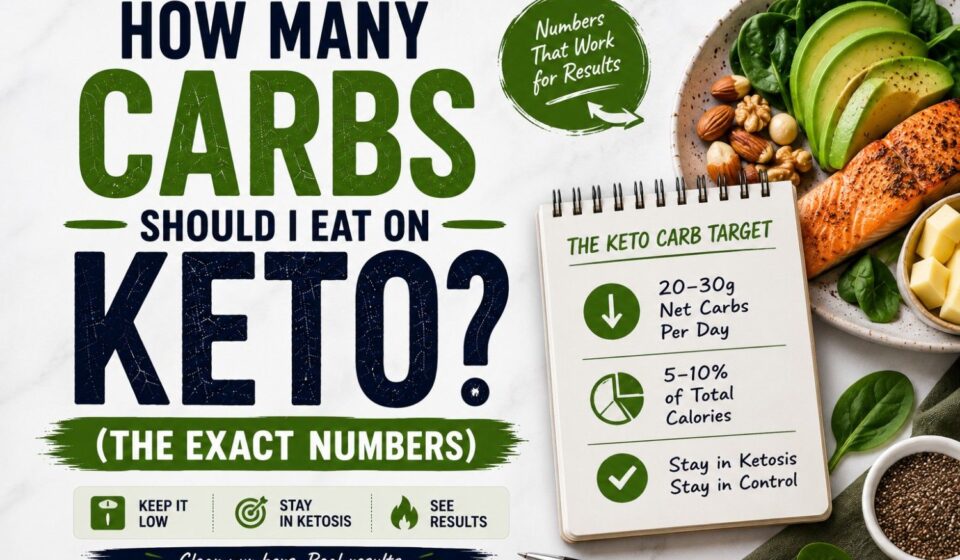

The most important keto question — with a more nuanced answer than most guides give

“Just stay under 20g of carbs” is the standard keto advice. It’s not wrong — but it’s incomplete. The right carb limit for keto depends on your individual metabolism, your goals, and how strictly you want to manage ketosis. Here’s the complete, nuanced answer.
Net Carbs vs. Total Carbs — Which to Count?
Before carb targets, the most important concept in keto carb counting:
Total carbs: Every gram of carbohydrate in a food — including fiber.
Net carbs: Total carbohydrates minus fiber (and sometimes sugar alcohols).
Net carbs = Total carbs − Fiber
Fiber doesn’t raise blood glucose or stimulate insulin — it passes through the digestive system largely unabsorbed. Counting only net carbs gives a more accurate picture of what actually affects ketosis.
Example: 1 cup of broccoli
- Total carbs: 6g
- Fiber: 2.4g
- Net carbs: 3.6g
If you counted total carbs, broccoli would eat up your budget quickly. Counting net carbs makes vegetables much more manageable.
The keto community standard: Count net carbs. This is the number referred to in virtually all keto guidelines and food tracking apps.

The Standard Keto Carb Targets
| Carb Level | Daily Net Carbs | Who It’s For |
|---|---|---|
| Strict keto | Under 20g | Most reliable ketosis, beginners, epilepsy |
| Standard keto | 20–30g | Works for most people |
| Liberal keto | 30–50g | Active people, some metabolic flexibility |
| Low carb (not keto) | 50–150g | General carb reduction without ketosis goal |
Why 20g Is the Standard Starting Point
20g net carbs per day is the most commonly recommended keto starting point — and for good reason:
It produces ketosis in virtually everyone. Individual variation exists in how low carbs need to go for ketosis — but under 20g is below the threshold for essentially all healthy adults. At 20–30g, most people reach ketosis; at 30–50g, some do and some don’t.
It provides a clear, measurable target. 20g is concrete and trackable. Higher, vaguer targets create ambiguity about whether you’re actually in ketosis.
It establishes the habit. Starting with strict tracking at 20g builds the nutritional awareness that makes keto sustainable — you learn where carbs hide, what your food choices actually contain, and how to navigate social eating.
Recommendation: Start at under 20g net carbs for the first 2–4 weeks. Once in ketosis and comfortable with keto eating patterns, you can experiment with slightly higher limits if desired.
Individual Variation: Your Personal Carb Threshold
Not everyone reaches or maintains ketosis at the same carb level. Several factors affect your personal threshold:
Metabolic Health and Insulin Sensitivity
People with better insulin sensitivity can often maintain ketosis at slightly higher carb intakes — their bodies use carbohydrates more efficiently and produce lower insulin responses per gram of carbohydrate.
People with insulin resistance or type 2 diabetes may need to stay closer to 20g (or even lower) to reliably maintain ketosis, as their carbohydrate metabolism is impaired.
Activity Level and Exercise
Regular exercisers — particularly those doing significant cardio or strength training — deplete glycogen more frequently, creating more capacity for dietary carbohydrates before ketosis is disrupted.
Active people often maintain ketosis at 30–50g net carbs, particularly on training days. This is sometimes called “targeted keto” — consuming slightly more carbs around workout times.
Body Size
Larger people with more muscle mass have larger glycogen stores and may tolerate slightly more dietary carbohydrate while maintaining ketosis. The carb-to-body-mass ratio matters more than absolute numbers for some people.
How Long You’ve Been on Keto
Fat-adapted people who have been on keto for months often maintain ketosis at slightly higher carb intakes than they did in the early weeks. The metabolic adaptation to fat burning means the body is less likely to switch back to glucose dependence from a small carb increase.
How to Find Your Personal Carb Threshold
Step 1: Start at under 20g net carbs for 2–4 weeks and confirm ketosis with urine strips or blood meter.
Step 2: Once consistently in ketosis and fat-adapted, incrementally increase carbs by 5g per week.
Step 3: Test ketones at each new level. When ketone levels drop significantly (below 0.5 mmol/L on blood meter) or you notice symptoms of leaving ketosis (return of carb cravings, reduced mental clarity, stalled weight loss), you’ve found your personal threshold.
Step 4: Stay 5g below your threshold for a reliable buffer.
This process takes 4–8 weeks but identifies your personal carb tolerance rather than relying on a generic number.
How to Track Net Carbs Accurately
Use a Food Scale
Eyeballing carb amounts is notoriously inaccurate — particularly for nuts, cheese, and other calorie-dense keto staples. Weighing food on a kitchen scale and entering exact weights into a tracking app produces significantly more accurate carb counts than estimating.
Use a Reliable Tracking App
MyFitnessPal, Cronometer, and Carb Manager all have extensive food databases with net carb calculations. Cronometer is particularly reliable for micronutrient tracking alongside carbs.
Watch Sugar Alcohol Counting
Sugar alcohols are often shown as reducing net carbs (total carbs − fiber − sugar alcohols = net carbs in many “keto” products). But not all sugar alcohols are equal:
- Erythritol: Minimal blood glucose effect — can subtract fully
- Allulose: Minimal effect — can subtract
- Xylitol: Partial effect — count approximately half
- Maltitol: Significant blood glucose effect — count most or all
- Sorbitol: Moderate effect — count approximately half
Many “keto” processed products use maltitol and claim very low net carbs — but these products can significantly impact blood sugar and ketosis for many people. As covered in our food list at what can you eat on a keto diet, being cautious with processed “keto” products is important.
Read Labels Carefully
Look for hidden carbs in:
- Sauces and marinades (often contain sugar)
- Commercial dressings
- Deli meats and processed meats (often contain dextrose or other sugars)
- Nuts and nut mixes (sometimes coated with sugar)
- “Zero carb” products (often contain carbs — check actual label)
Carb Distribution Throughout the Day
Once you have your daily carb target, how should those carbs be distributed?
Generally: Carb distribution throughout the day matters less than total daily net carbs. Eating 20g of net carbs evenly across meals vs. consuming them all at once produces similar ketone levels by end of day.
However: For people who are sensitive to being knocked out of ketosis, avoiding large carb amounts at single meals is wise — a 15g net carb bolus is more likely to temporarily suppress ketones than 5g spread across three meals.
Practical recommendation: Distribute carbs across meals naturally through vegetable consumption — rather than saving all carbs for one larger portion.
Carbs on Keto for Specific Situations
Before and After Exercise (Targeted Keto)
Some keto athletes consume 15–30g of fast-digesting carbs (fruit, glucose) immediately before or after high-intensity training — providing glucose for performance without disrupting extended ketosis. This is “targeted keto” and works well for people doing CrossFit, HIIT, or heavy strength training.
Women’s Hormonal Cycles
Some women find their carb tolerance varies through the menstrual cycle — with slightly less ketosis sensitivity in the luteal phase (second half of cycle). This is individual and worth tracking if you notice cyclical ketosis disruption.
Illness and Stress
High stress and illness elevate cortisol — which raises blood glucose and can temporarily suppress ketone production even at normal carb intakes. During periods of high stress or illness, temporarily reducing carbs below your normal threshold may help maintain ketosis.
Common Carb Counting Mistakes on Keto
Forgetting drinks: Coffee with cream, protein shakes, and sparkling flavored water can contain carbs that aren’t accounted for.
Not tracking condiments: Ketchup (5g per tablespoon), BBQ sauce (10–15g per tablespoon), and commercial dressings add up fast.
Underestimating restaurant food: Restaurant sauces, marinades, and prepared foods often contain significant hidden sugar. When eating out, assume higher carb content than you’d expect.
Trusting “net carb” claims on packaged keto products: As discussed above — always check the sugar alcohol types and consider their actual impact.
Not accounting for cumulative small amounts: 1g here, 2g there from spices, condiments, and small amounts of higher-carb ingredients — these accumulate to meaningful amounts over a day.
The Bottom Line
How many carbs should you eat on keto?
Starting out: Under 20g net carbs per day — the most reliable path to ketosis for most people.
Once established: 20–30g for most people; some active, metabolically healthy individuals maintain ketosis at 30–50g.
Your personal threshold: Find it by starting at 20g and incrementally increasing while testing ketones — typically 4–8 weeks of experimentation.
Always count net carbs (total carbs minus fiber), track carefully especially at the start, and be cautious with processed “keto” products whose carb claims may not reflect their actual ketosis impact.
For the complete guide to starting keto successfully from day one, our article on how to lose weight on keto for beginners covers everything in one place.
What carb level do you find works best for maintaining ketosis — and did it take experimentation to find your personal threshold? Share in the comments.