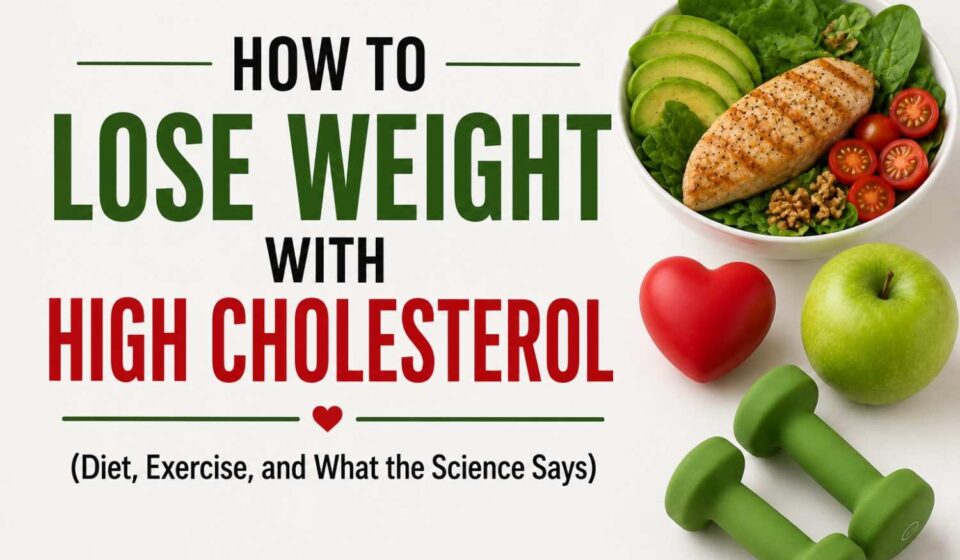
How to Lose Weight With High Cholesterol (Diet, Exercise, and What the Science Says)

High cholesterol and excess weight often go together — and the solution addresses both simultaneously
High cholesterol and excess body weight are closely connected — not because one directly causes the other, but because both are often driven by the same underlying factors: poor dietary quality, insufficient physical activity, excess visceral fat, and metabolic dysfunction.
The good news: most of the strategies that produce fat loss also directly improve cholesterol profiles. This means that a well-designed weight loss approach does double duty — reducing body weight while simultaneously addressing the cardiovascular risk that high cholesterol represents.
Understanding Cholesterol: What the Numbers Actually Mean
Before diving into strategies, a brief clarification on cholesterol — because much of the popular understanding is misleading.
LDL cholesterol (“bad”) — the primary target of concern. High LDL, particularly small dense LDL particles, is associated with arterial plaque formation and cardiovascular risk.
HDL cholesterol (“good”) — transports cholesterol away from arteries. Higher HDL is protective. Low HDL increases cardiovascular risk.
Triglycerides — fats in the blood. High triglycerides indicate poor metabolic health and increase cardiovascular risk, particularly when combined with low HDL.
Total cholesterol — a less useful number than the individual components. Someone with high HDL may have a high total cholesterol but excellent cardiovascular profile.
The most informative ratio: LDL-to-HDL ratio (or non-HDL cholesterol). This provides more useful cardiovascular risk information than total cholesterol alone.
How Weight Loss Affects Cholesterol
Weight loss — particularly reduction in visceral belly fat — produces consistent improvements across the cholesterol profile:
- LDL: Typically decreases with significant weight loss, though the effect varies by individual
- HDL: Often increases with weight loss and exercise — improving the protective component
- Triglycerides: Show the most dramatic and consistent improvement with weight loss — triglycerides are directly related to carbohydrate intake and visceral fat
Even modest weight loss (5–10% of body weight) produces measurable cholesterol improvements in most people. The greatest improvements tend to come from the combination of weight loss and dietary quality changes — which is why the approach below addresses both simultaneously.
Dietary Strategy for Weight Loss and Cholesterol Improvement
Reduce Saturated and Trans Fats
Saturated fat — primarily from red meat, full-fat dairy, butter, coconut oil, and palm oil — raises LDL cholesterol more directly than dietary cholesterol itself.
Key reductions:
- Red meat: limit to 2–3 times per week maximum; choose leaner cuts when you do eat it
- Full-fat dairy: switch to low-fat dairy or dairy alternatives for daily use (cheese in moderation is fine)
- Butter: use olive oil as the primary cooking fat
- Processed meat (bacon, sausages, deli meats): minimize — high saturated fat and sodium
Trans fats (partially hydrogenated oils) raise LDL and lower HDL simultaneously — the worst possible combination. While largely phased out of food products, some processed foods still contain small amounts. Check labels for “partially hydrogenated oil.”
Increase Soluble Fiber
Soluble fiber directly lowers LDL cholesterol by binding to cholesterol in the digestive system and removing it before it’s absorbed. This is one of the most evidence-backed dietary cholesterol-lowering interventions available.
Best soluble fiber sources:
- Oats and oat bran — beta-glucan in oats has the strongest LDL-lowering evidence of any soluble fiber. A daily bowl of oats provides 3–4g of beta-glucan — enough for meaningful LDL reduction with consistent use.
- Lentils and beans — exceptional soluble fiber content alongside high protein. As covered in our guide to the best foods to eat to lose weight fast, legumes are among the most nutritionally valuable foods for both weight loss and cardiovascular health.
- Apples and pears — pectin (soluble fiber) in fruit specifically lowers LDL
- Psyllium husk — available as a supplement; strong LDL-lowering evidence
- Barley — similar beta-glucan content to oats
Getting 5–10g of soluble fiber per day from these sources produces clinically meaningful LDL reductions of 5–10% in most people.
Increase Omega-3 Fatty Acids
Omega-3 fatty acids from fatty fish (salmon, sardines, mackerel, herring, tuna) are among the most powerful dietary interventions for high triglycerides — reducing them by 20–30% with consistent intake.
They also raise HDL modestly and have anti-inflammatory effects on arterial walls that reduce cardiovascular risk beyond the cholesterol numbers alone.
Practical target: 2–3 servings of fatty fish per week, or omega-3 supplementation (fish oil: 1–4g EPA+DHA per day for significant triglyceride reduction — discuss dose with your doctor).
Increase Plant Sterols and Stanols
Plant sterols and stanols — found naturally in small amounts in vegetable oils, nuts, seeds, and grains, and added to fortified foods like certain spreads and yogurts — directly block cholesterol absorption in the intestine.
Consuming 2g per day of plant sterols reduces LDL cholesterol by 8–10% independently of other dietary changes. Fortified foods (sterol-enriched spreads, certain yogurt drinks) are the most practical way to hit this target.
The Cholesterol-Weight Loss Dietary Overlap
Here’s where the approach becomes elegant: the dietary pattern that produces the best fat loss results largely overlaps with the dietary pattern that most improves cholesterol.
Both goals benefit from:
- High fiber from whole plant foods (oats, legumes, vegetables, fruit)
- Lean protein (fish, poultry, legumes) over red and processed meat
- Healthy fats (olive oil, avocado, nuts) over saturated fats
- Minimal processed food and added sugar
- Reduced refined carbohydrates
This is essentially the Mediterranean dietary pattern — as covered in our guide to how to lose weight with Mediterranean diet, which has the strongest evidence of any dietary pattern for simultaneous weight loss and cardiovascular risk reduction.
What About Dietary Cholesterol and Eggs?
The relationship between dietary cholesterol (cholesterol in food) and blood cholesterol is more complex than previously thought. For most people, dietary cholesterol has limited impact on LDL — it’s saturated fat that drives LDL elevation more directly.
Eggs — despite being high in dietary cholesterol — don’t significantly raise LDL in most people and provide excellent protein, healthy fats, and micronutrients. Current evidence supports moderate egg consumption (up to 1 per day for most people) as part of a healthy diet.
The exception: a minority of people are “hyper-responders” to dietary cholesterol — their LDL rises meaningfully with increased dietary cholesterol. If you have high cholesterol and eat many eggs, it may be worth monitoring lipid levels before and after reducing eggs to see if you’re in this group.
Exercise for Weight Loss and Cholesterol
Exercise improves cholesterol through multiple mechanisms — not just through the weight loss it enables.
Direct effects of regular exercise on cholesterol:
- HDL increases with consistent aerobic exercise — the most reliable exercise-induced cholesterol improvement
- Triglycerides decrease with both aerobic exercise and weight loss
- LDL particle size improves — exercise shifts LDL toward larger, less dangerous particles even when total LDL doesn’t change dramatically
Most effective exercise for cholesterol:
Aerobic exercise — the primary driver. Walking, cycling, swimming, jogging — 30 minutes of moderate intensity on most days produces meaningful cholesterol improvements within weeks. As covered in our guide to how to lose weight by walking, even consistent walking produces cardiovascular benefits that go beyond fat loss.
Strength training — improves insulin sensitivity and metabolic health that supports better cholesterol profiles. Also builds the lean muscle that raises resting metabolic rate and supports long-term weight management.
The combination of aerobic exercise and strength training produces better cholesterol outcomes than either alone.
Specific Foods That Lower Cholesterol
Beyond the general dietary approach, specific foods have strong evidence for cholesterol reduction:
Walnuts — reduce LDL and improve the LDL-to-HDL ratio. A small handful (28g) daily is the evidence-based amount.
Almonds — similar effect to walnuts, with specific evidence for LDL reduction.
Avocado — monounsaturated fat in avocado reduces LDL and raises HDL. Daily avocado consumption has produced meaningful cholesterol improvements in clinical trials.
Olive oil — replaces saturated fat and raises HDL. Extra virgin olive oil specifically has polyphenols that provide additional cardiovascular benefits.
Garlic — modest but real LDL-lowering effect with consistent consumption.
Green tea — catechins in green tea have LDL-lowering evidence. As covered in our article on green tea and weight loss, green tea provides multiple metabolic benefits beyond cholesterol.
Dark chocolate (70%+ cocoa) — flavanols raise HDL and reduce LDL oxidation. 20–30g daily is the evidence-based amount.
What to Avoid
Trans fats — the most LDL-raising dietary fat. Essentially eliminated from most food supplies but still present in some processed products. Always check labels.
Refined carbohydrates and added sugar — particularly raise triglycerides and lower HDL. The classic Western diet high in refined carbs is directly associated with the high triglyceride / low HDL pattern that significantly increases cardiovascular risk.
Excess alcohol — raises triglycerides significantly, particularly in sensitive individuals. More than 1–2 drinks per day consistently worsens the triglyceride component of the lipid profile.
Coconut oil — despite its healthy reputation, coconut oil is extremely high in saturated fat and raises LDL significantly. The evidence does not support its use as a “healthy fat” for people with high cholesterol.
Creating a Calorie Deficit With High Cholesterol
The calorie deficit approach applies as with any fat loss goal — as covered in our guide to how to lose weight with a calorie deficit.
The key difference with high cholesterol: the quality of the calories matters more than with a pure weight loss goal. A calorie deficit achieved through lean protein, legumes, whole grains, fatty fish, and vegetables produces both fat loss and cholesterol improvement. The same deficit achieved through processed low-calorie food does the first without the second.
Prioritize protein at 0.7–1g per pound of bodyweight for muscle preservation and satiety. As covered in our guide to how much protein you actually need per day, protein is the most important dietary variable for fat loss quality regardless of additional health considerations.
When Lifestyle Changes Aren’t Enough
For some people, high cholesterol is primarily genetic (familial hypercholesterolaemia) — they produce too much LDL regardless of diet and lifestyle. For these individuals, dietary and lifestyle changes produce improvements but may not be sufficient to reach target levels without medication.
For others, significant cholesterol improvement requires sustained weight loss that diet alone (without exercise or medical support) hasn’t been able to achieve.
If you’ve implemented the dietary and lifestyle strategies consistently for 3+ months and cholesterol remains significantly elevated, medical options include:
- Statins — the most effective cholesterol-lowering medications
- PCSK9 inhibitors — for familial hypercholesterolaemia or statin intolerance
- Weight loss medication to enable more significant fat loss
Breeze Meds offers telehealth medical evaluations to assess whether prescription weight loss treatment is appropriate — including for people whose weight is contributing to cardiovascular risk through elevated cholesterol.
Check eligibility & pricing at Breeze Meds →Affiliate disclosure: We may earn a commission if you use this link. Breeze Meds provides telehealth weight-loss services. Prescription medication is only provided following an evaluation by a licensed healthcare professional and is not guaranteed.
Tracking Progress
Lipid panel testing: Get a full lipid panel (total cholesterol, LDL, HDL, triglycerides) before making dietary changes and again after 3 months of consistent changes. This shows the actual impact of your approach and provides motivation if improvements are visible.
What to watch: Triglycerides and HDL typically show the most dramatic improvements with dietary changes and exercise. LDL changes are more variable and often require longer timelines.
The Bottom Line
High cholesterol and excess weight are both addressed by the same core approach: a Mediterranean-style dietary pattern rich in soluble fiber, omega-3 fatty acids, lean protein, and healthy fats — with significant reduction of saturated fat, refined carbohydrates, and processed food.
The specific additions for cholesterol:
- Daily oats for beta-glucan (soluble fiber) LDL reduction
- 2–3 servings of fatty fish per week for triglyceride reduction and HDL improvement
- Plant sterols from fortified foods or supplements
- Walnuts, almonds, and avocado for direct LDL improvement
For the foundational fat loss framework that drives both weight reduction and cholesterol improvement, our guide to how to get rid of belly fat covers everything in one place.
Have you successfully reduced your cholesterol through dietary and lifestyle changes? Share what made the biggest difference in the comments.
Stop Wondering What to Eat This Week
Get my free 7-Day High-Protein Weight Loss Meal Plan delivered straight to your inbox — a simple week of satisfying, protein-focused meals designed to make healthy eating easier without complicated calorie tracking.
- 7 full days of breakfast, lunch, dinner & snacks
- One complete shopping list for the whole week
- A quick high-protein food cheat sheet
- Simple daily tips to help you stay on track
Free PDF • Delivered by email • Unsubscribe anytime
Check your inbox 💜
Your free 7-day high-protein meal plan is on its way.