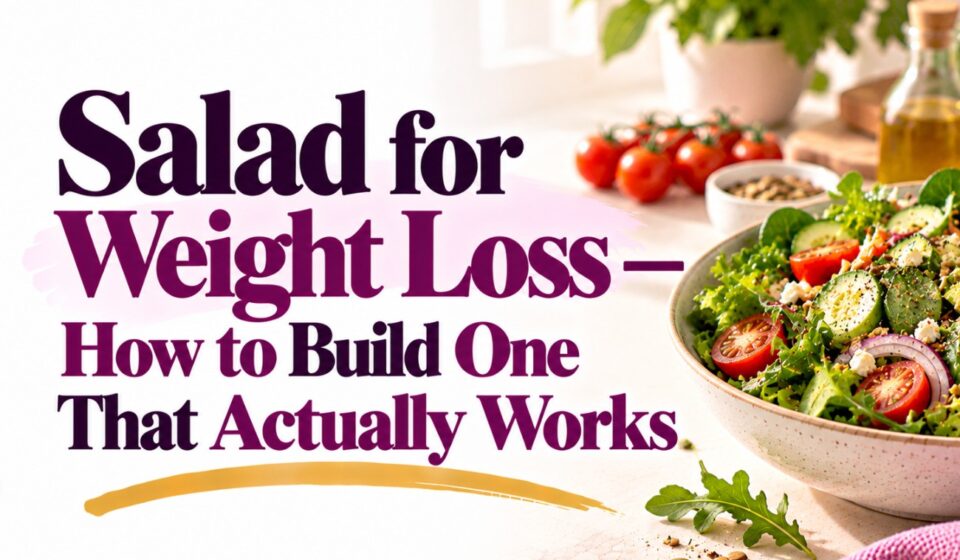

Not all salads are created equal — here’s the difference between a salad that drives fat loss and one that undermines it
“I’m eating salad every day and not losing weight” is one of the most common weight loss frustrations. And it’s entirely understandable — because the word “salad” covers everything from a genuinely weight-loss-friendly meal to a calorie bomb in a bowl.
A restaurant Caesar salad with croutons and full-fat dressing can contain 600-800 calories. A pasta salad from a deli can top 700 calories. A Greek salad with feta, olives, and generous olive oil dressing is nutritious but calorically denser than most people realize.

Meanwhile, a well-constructed protein salad with lean protein, abundant vegetables, and a light dressing can deliver 300-400 calories with 35-40g of protein and enormous satiety.
Same name. Completely different weight loss impact.
Here’s how to build a salad that actually works.
Why Salads Can Be Excellent for Weight Loss
The Volume Eating Foundation
As covered in our guide to volume eating — salads are the most practical application of the volume eating principle. Non-starchy vegetables have 10-35 calories per 100g — allowing enormous plate volume at minimal caloric cost.
A 400g base of lettuce, cucumber, tomatoes, and peppers contains approximately 80-100 calories — but fills a large bowl and provides genuine stomach stretch that activates satiety signals.
Pre-Meal Salad — The Documented Effect
Research consistently finds that eating a low-calorie salad before a main meal reduces total calorie intake at that meal. Studies have found:
- 100-calorie vegetable salad before a meal reduced total calorie intake by 7-12%
- The reduction more than offset the salad’s own calorie contribution — producing net calorie reduction
- Low-calorie (broth-based or light dressing) salads worked better than high-calorie (creamy dressing) salads as pre-meal courses
The mechanism:
The vegetable volume fills stomach space, activates stretch receptors, and allows satiety hormones time to begin signaling — reducing how much main course is consumed.
As covered in our guide to how to stop hunger while dieting — pre-meal volume is one of the most evidence-backed appetite management strategies available.
Fiber Density
A well-constructed salad with diverse vegetables, legumes, and seeds provides exceptional fiber density — producing sustained satiety well beyond the meal through slowed gastric emptying and satiety hormone stimulation.
As covered in our guide to types of fiber — soluble vs insoluble — the diverse fiber sources in a well-built salad provide both immediate satiety (insoluble fiber bulk) and sustained satiety (soluble fiber’s slowed gastric emptying).
Micronutrient Density
Well-constructed salads provide exceptional micronutrient value per calorie — vitamins, minerals, and phytonutrients that support the metabolic function underlying effective weight loss.
The Salad That Doesn’t Work — The Most Common Mistakes
Before building the right salad — understanding what makes them fail:
Mistake 1 — Not Enough Protein
This is the single most common reason salads don’t support weight loss effectively.
A salad of lettuce, cucumber, tomatoes, and dressing contains:
- Plenty of fiber and micronutrients ✅
- Very little protein ❌
- Minimal satiety duration ❌
Without protein — the salad fills you up briefly through volume but doesn’t provide the hormonal satiety (ghrelin suppression, GLP-1 and PYY stimulation) that protein triggers. Within 1-2 hours, hunger returns — despite having eaten a large plate of food.
As covered in our guide to how much protein you actually need per day — protein is the most satiating macronutrient. A salad meal needs 25-40g of protein to produce the sustained satiety that supports weight loss.
Mistake 2 — Calorie-Dense Dressing
This is where most calorie calculations go catastrophically wrong.
Common dressing calorie content:
- Ranch dressing (2 tbsp): 150 calories
- Caesar dressing (2 tbsp): 160 calories
- Blue cheese dressing (2 tbsp): 145 calories
- Thousand Island (2 tbsp): 120 calories
- Balsamic vinaigrette (2 tbsp): 90 calories
- Italian dressing (2 tbsp): 70 calories
- Olive oil + vinegar (1 tbsp each): 120 calories
The math:
A seemingly healthy salad with 3-4 tablespoons of ranch or Caesar dressing adds 225-320 calories purely from dressing — more than doubling the salad’s total calorie content.
Restaurant salads are particularly dangerous — dressings are often applied generously and not measured. A restaurant Caesar can receive 4-6 tablespoons of dressing.
Mistake 3 — High-Calorie Additions That Add Up
Each individually seems small — together they accumulate significantly:
| Addition | Calories per typical serving |
|---|---|
| Croutons (30g) | 130 |
| Shredded cheese (30g) | 110-120 |
| Bacon bits (2 tbsp) | 60 |
| Candied nuts (30g) | 160 |
| Avocado (half) | 120 |
| Tortilla strips (30g) | 140 |
| Dried cranberries (30g) | 100 |
| Sunflower seeds (2 tbsp) | 90 |
Two or three of these additions together add 250-400 calories to a salad that started with 80-100 calories of vegetables.
Note: Some of these (avocado, seeds) are nutritionally valuable and worth including in appropriate amounts. Others (croutons, candied nuts, dried cranberries, tortilla strips) add primarily empty or sugar calories with minimal nutritional value.
Mistake 4 — No Filling Carbohydrate
At the opposite end from calorie-dense additions — a purely vegetable and protein salad without any complex carbohydrate can leave some people unsatisfied and reaching for food within an hour.
Adding a modest amount of complex carbohydrate — whole grains, legumes, or starchy vegetables — extends satiety through additional fiber and energy density.
Mistake 5 — Restaurant Salad Assumptions
Restaurant salads are often among the highest-calorie items on the menu — masquerading as the “healthy choice.” The combination of generous dressing, high-calorie additions, and large portions produces meals that frequently exceed 600-800 calories.
As covered in our guide to how to eat healthy at restaurants — asking for dressing on the side and dipping rather than coating, avoiding croutons and candied nuts, and choosing protein-based salads over pasta-based salads are the most important restaurant salad strategies.
The Weight Loss Salad Formula
A well-constructed weight loss salad has five components:
Component 1 — The Base (Free Calories)
Volume: 150-300g (fills the bowl)
Calories: 30-60
Best options:
- Romaine lettuce — 17 cal/100g, good crunch, nutrient-dense
- Mixed greens/spring mix — 20-25 cal/100g, diverse nutrients
- Spinach — 23 cal/100g, high iron and magnesium
- Arugula — 25 cal/100g, peppery flavor
- Kale — 35 cal/100g, highest nutrient density
- Cabbage (shredded) — 25 cal/100g, very filling
The principle:
Fill the entire bowl with base before adding anything else. The base is essentially free — eat as much as desired.
Component 2 — The Vegetables (Free Calories)
Volume: 150-250g additional vegetables
Calories: 40-80
Best options:
- Cucumber — 15 cal/100g
- Cherry tomatoes — 18 cal/100g
- Bell peppers — 31 cal/100g
- Red onion — 40 cal/100g
- Radishes — 16 cal/100g
- Celery — 14 cal/100g
- Broccoli (raw or blanched) — 34 cal/100g — as covered in our guide to is broccoli good for weight loss
- Mushrooms — 22 cal/100g
- Asparagus (blanched) — 20 cal/100g
- Artichoke hearts — as covered in our guide to artichokes for weight loss — 40 cal/100g with exceptional fiber
The principle:
More vegetable variety = more fiber types, more phytonutrients, more flavors. Aim for 4-6 different vegetables.
Component 3 — The Protein (The Satiety Anchor)
Target: 25-40g protein per salad
Calories: 150-250 depending on source
Best protein options for salads:
Lean proteins:
- Grilled chicken breast (120g): 30g protein, 200 cal
- Canned tuna (100g): 25g protein, 116 cal
- Grilled salmon (100g): 20g protein, 208 cal — as covered in our guide to is salmon good for weight loss
- Shrimp (120g): 22g protein, 100 cal
- Hard-boiled eggs (2): 12g protein, 143 cal
- Turkey breast (100g): 22g protein, 135 cal
Plant proteins:
- Chickpeas (100g cooked): 9g protein, 164 cal — as covered in our guide to healthiest beans for weight loss
- Lentils (100g cooked): 9g protein, 116 cal
- Black beans (100g cooked): 9g protein, 132 cal
- Edamame (100g): 11g protein, 122 cal
- Tofu (100g firm): 8g protein, 76 cal
- Tempeh (100g): 19g protein, 193 cal
The principle:
Protein is the single most important addition to a weight loss salad. Never build a salad without a meaningful protein source.
Component 4 — The Smart Additions (Optional, Measured)
Target: Choose 1-2, measured portions
Calories: 50-150 total from this category
High-value additions:
- Avocado (1/4): 60 cal — healthy fat, potassium — as covered in our guide to is avocado good for weight loss
- Walnuts or almonds (15g): 90-100 cal — omega-3s, protein
- Pumpkin seeds (2 tbsp): 90 cal — zinc, magnesium
- Feta cheese (20g): 53 cal — calcium, flavor
- Parmesan (10g): 40 cal — strong flavor, small amount goes far
Complex carbohydrate additions:
- Quinoa (50g cooked): 60 cal, 4g protein — as covered in our guide to is quinoa good for weight loss
- Cooked lentils (alongside bean protein above)
- Roasted sweet potato cubes (80g): 70 cal
Skip:
- Croutons — refined carbs with minimal nutrition
- Candied or honey-glazed nuts — hidden sugar
- Tortilla strips — high-calorie processed addition
- Dried cranberries in quantity — concentrated sugar
Component 5 — The Dressing (Make or Control It)
Target: Maximum 2 tablespoons of homemade or light dressing
Calories: 30-100
The best weight loss dressings:
Lemon and olive oil (light version):
1 tsp olive oil + lemon juice + salt + herbs = 40 calories, 0g sugar. Bright, fresh, allows vegetable flavors to shine.
Apple cider vinegar dressing:
ACV + Dijon + garlic + small amount of olive oil = 45-60 calories. Tangy, digestively beneficial.
Greek yogurt ranch:
Greek yogurt base + herbs + garlic powder + lemon = 40-50 calories per 2 tbsp. Creamy without the calorie cost of traditional ranch.
Tahini dressing (measured):
Tahini + lemon + garlic + water to thin = 80 calories per 2 tbsp. High in protein and flavor — use in measured amounts.
Balsamic reduction:
Balsamic vinegar reduced to syrup — intense flavor requiring very small amounts. 20 calories per teaspoon.
Restaurant strategy:
Always ask for dressing on the side. Dip the fork in dressing then the salad — you use 75-80% less dressing than if it’s poured over, while still getting flavor in every bite.
Weight Loss Salad Formulas That Work
The High-Protein Power Salad
Approximately 380 calories, 38g protein
- 150g romaine + 100g spinach (base)
- 100g cherry tomatoes, 100g cucumber, 50g bell peppers
- 120g grilled chicken breast
- 1/4 avocado
- 15g pumpkin seeds
- Lemon + 1 tsp olive oil dressing
The Plant-Based Protein Salad
Approximately 420 calories, 25g protein
- 150g mixed greens
- 100g cherry tomatoes, 100g cucumber, 50g red onion
- 100g chickpeas + 100g edamame
- 50g quinoa (cooked)
- 20g feta
- ACV + Dijon dressing
The Mediterranean Salad
Approximately 350 calories, 22g protein
- 150g romaine + 50g arugula
- 100g cherry tomatoes, 100g cucumber, 50g red onion
- 100g canned tuna (in water)
- 5 kalamata olives
- 20g feta
- Lemon + 1 tsp olive oil + oregano
The Pre-Meal Appetite Management Salad
Approximately 80 calories
- 150g mixed greens
- 100g cucumber
- 100g cherry tomatoes
- ACV + Dijon dressing
Eat this 10-15 minutes before the main meal to reduce main course intake.
Making Salads More Satisfying — The Practical Tricks
Warm Protein on Cold Greens
Warm grilled chicken, shrimp, or salmon on cold greens creates temperature contrast that many people find more satisfying than cold-on-cold. The warmth also slightly wilts the greens — making them easier to eat in larger quantities.
Roasted Vegetables as Addition
Roasted cherry tomatoes, roasted bell peppers, or roasted broccoli add caramelized sweetness and deeper flavor to raw salads — making them significantly more satisfying without meaningful calorie addition.
Massaged Kale
Raw kale is tough and bitter. Massaging kale with a small amount of olive oil and salt for 2-3 minutes breaks down cell walls — making it tender, less bitter, and far more enjoyable. Massaged kale salads are genuinely delicious in ways that raw kale salads aren’t.
Big Batch Prepping Components
Prepping individual components (grilled chicken, roasted vegetables, cooked grains, washed greens) separately and assembling daily makes consistent salad eating practical rather than onerous. As covered in our guide to how to stock your pantry for weight loss — having components ready reduces the decision-making and effort that causes people to abandon healthy eating plans.
The Jar Salad Method
Layering salad in a mason jar (dressing at bottom, then hearty vegetables, then lighter greens at top) keeps components fresh for 3-5 days in the refrigerator. Shake to distribute dressing when ready to eat. Genuinely practical for weekday meal prep.
The Bottom Line
Salad for weight loss — what makes it work:
The five components:
- Large vegetable base (150-300g) — the free calories foundation
- Diverse vegetables (150-250g additional) — volume, fiber, micronutrients
- Adequate protein (25-40g) — the satiety anchor
- Smart measured additions (1-2, measured portions) — flavor and nutrition without calorie overload
- Light dressing (2 tbsp maximum) — flavor without the calorie bombs of full-fat dressings
What ruins a salad for weight loss:
- No protein — hungry within an hour
- Unlimited dressing — 200-400 hidden calories
- Multiple high-calorie additions — croutons + cheese + candied nuts = 300+ calories
- Assuming “salad” = healthy — restaurant versions often aren’t
The practical formula:
Large base + abundant vegetables + 25-40g protein + 1-2 measured healthy additions + 2 tbsp light dressing = 300-450 calories of genuinely filling, nutritious food.
As covered in our guide to volume eating — salad is the highest-expression of volume eating principles. Done right, it’s one of the most effective weight loss meals available. Done wrong, it’s a hidden calorie trap that produces frustration and undermines results.
What’s your go-to weight loss salad formula — and which addition do you find makes the biggest difference for staying full? Share in the comments.
Stop Wondering What to Eat This Week
Get my free 7-Day High-Protein Weight Loss Meal Plan delivered straight to your inbox — a simple week of satisfying, protein-focused meals designed to make healthy eating easier without complicated calorie tracking.
- 7 full days of breakfast, lunch, dinner & snacks
- One complete shopping list for the whole week
- A quick high-protein food cheat sheet
- Simple daily tips to help you stay on track
Free PDF • Delivered by email • Unsubscribe anytime
Check your inbox 💜
Your free 7-day high-protein meal plan is on its way.