
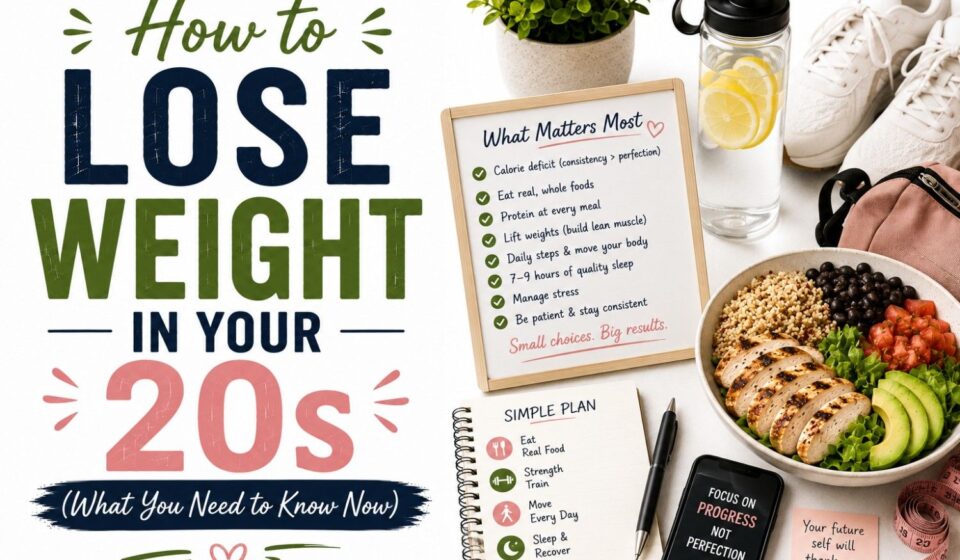

Losing weight in your 20s doesn’t require a special diet, an extreme workout routine, or taking advantage of a metabolism that’s supposedly about to slow down. The most effective approach is to build eating and activity habits that fit your life, support an appropriate calorie deficit, and don’t leave you constantly hungry or exhausted.
Your 20s can be an unusual time for weight management.
You might be moving away from home, starting college, working your first full-time job, managing a limited budget, or adjusting to a schedule that changes every week.
Meals become something you have to organize yourself. Exercise competes with work and social plans. And suddenly, the routine that worked when you were younger may no longer fit your life.
But there’s good news: you don’t need to get everything right immediately.
If weight loss is appropriate for you, a few practical changes to your eating habits, movement, and daily routine can make a meaningful difference.
Here’s what actually matters—and which popular claims about weight loss in your 20s you can safely ignore.
Is It Easier to Lose Weight in Your 20s?
You might have heard that your 20s are the easiest decade for losing weight because your metabolism is at its peak.
The science doesn’t support that simple explanation.
A large study published in Science in 2021 examined energy expenditure across the human lifespan.
After accounting for differences in body size and composition, researchers found that daily energy expenditure remained relatively stable between approximately ages 20 and 60.
That challenges the popular idea that metabolism automatically begins slowing dramatically in your late 20s or early 30s.
Turning 30 doesn’t suddenly make fat loss substantially harder.
Of course, people can still experience changes in weight and energy requirements as they age.
But those changes may involve physical activity, muscle mass, body size, medical conditions, medications, and lifestyle—not simply a birthday.

Why Weight Gain Can Still Happen in Your 20s
The more relevant issue is that daily routines often change significantly during early adulthood.
Consider someone who played sports throughout high school and walked between classes every day.
After graduation, they begin working eight hours at a desk, drive to work, and spend most evenings sitting.
Their physical activity may decrease even if their eating habits stay the same.
Another person might move into their first apartment and rely more heavily on takeout because they haven’t learned to cook yet.
These changes can affect energy balance without any dramatic change in metabolism.
The solution isn’t trying to restore a teenage metabolism.
It’s building a routine that works for the life you’re living now.
Step 1: Create a Calorie Deficit Without Crash Dieting
If your goal is to lose body fat, you generally need to consume less energy than your body uses over time.
That’s called a calorie deficit.
But the size of your deficit matters.
Eating far too little may leave you tired, hungry, distracted, and struggling to get adequate nutrients.
You don’t need to pursue the fastest possible rate of weight loss.
How Many Calories Should You Eat?
Your calorie needs depend on several factors:
- Body size and composition.
- Age and sex.
- Daily movement and exercise.
- Health conditions and medications.
- Individual differences in energy expenditure.
For some adults, reducing average intake by approximately 300–500 calories per day may be a reasonable starting approach.
But that’s not a universal prescription. Smaller adjustments may be more appropriate, and some people shouldn’t be attempting weight loss.
You can use our free calorie deficit calculator to estimate a starting target.
Remember that calculator results aren’t exact measurements of your metabolism.
Your progress, hunger, energy levels, and nutritional needs should help determine whether an approach is appropriate.
Avoid the All-or-Nothing Diet Mentality
One mistake worth avoiding is treating weight loss as a temporary period of punishment.
For example, eating extremely little from Monday through Thursday and then feeling unable to control your hunger over the weekend can create an exhausting pattern.
Instead, aim for meals that are satisfying enough to repeat.
You don’t need to eliminate pasta, bread, rice, or your favorite dessert.
The best calorie deficit is one that supports your health and remains manageable in everyday life.
Step 2: Build Strength, Not Just a Lower Number on the Scale
Strength training is one of the most useful habits you can develop in your 20s.
But not because there’s a magical muscle-building window that closes at 30.
Resistance training helps improve strength, supports bone health, and can help maintain lean tissue during weight loss.
These benefits matter at every adult age.
Does Building Muscle Boost Your Metabolism?
Muscle tissue uses energy at rest, so having more muscle can contribute to resting energy expenditure.
However, the increase from gaining a few pounds of muscle is generally modest.
Strength training doesn’t permanently transform your metabolism into a fat-burning machine.
Its benefits are much broader: preserving muscle during weight loss, improving physical function, building strength, and supporting long-term health.
You can build muscle in your 30s, 40s, 50s, and beyond, too.
Starting in your 20s is useful because it gives you more years to enjoy those benefits—not because you’re about to miss your only chance.
A Simple Two-Day Strength Routine
The CDC recommends that adults perform muscle-strengthening activities on at least two days per week, alongside regular aerobic activity.
A beginner could start with two full-body sessions.
| Exercise | Beginner option |
|---|---|
| Squat | Chair squat or bodyweight squat |
| Hip hinge | Glute bridge or light dumbbell deadlift |
| Upper-body push | Wall push-up or dumbbell chest press |
| Upper-body pull | Resistance-band or dumbbell row |
| Core | Bird dog or modified plank |
Start with one or two manageable sets per exercise and gradually increase the challenge as your technique and fitness improve.
You don’t need a premium gym membership.
Dumbbells, resistance bands, and bodyweight exercises can be effective starting points.
Our guide to building a home workout routine can help you organize a practical program.
Step 3: Eat Enough Protein Without Obsessing Over It
Protein is useful for people trying to improve body composition.
It supports muscle maintenance and repair and can contribute to fullness after meals.
But you don’t need to consume enormous amounts to lose weight.
The appropriate intake depends on your size, activity, overall diet, and medical circumstances.
For example, the International Society of Sports Nutrition identifies approximately 1.4–2.0 grams per kilogram of body weight daily as a suitable range for many healthy exercising individuals.
That is a sports-nutrition recommendation, not a requirement for every person in their 20s.
People who are less active may have different needs, and certain medical conditions require individualized advice.
Use our protein calculator to explore an estimate appropriate to your situation.
Easy Protein Sources for Busy Days
You don’t need complicated meal preparation.
Practical options include:
- Eggs and Greek yogurt.
- Chicken, turkey, and fish.
- Cottage cheese.
- Tofu, tempeh, and edamame.
- Beans and lentils.
- Milk or fortified soy beverages.
- Canned tuna or salmon.
A typical day might include yogurt with breakfast, a chicken or tofu bowl at lunch, and a bean-based meal at dinner.
Protein powder can be convenient when appropriate, but it isn’t essential.
The goal is meeting your nutritional needs with foods you can comfortably afford and enjoy.
Step 4: Learn a Few Meals You Can Actually Cook
You don’t have to become an amazing cook to eat well.
But knowing how to prepare a handful of simple meals can reduce your dependence on expensive takeout and make your food choices easier to manage.
Start with meals that require familiar ingredients and little preparation.
Five Beginner-Friendly Meals
| Meal | Simple ingredients | Approximate active preparation |
|---|---|---|
| Overnight oats | Oats, yogurt, milk, berries | 5 minutes |
| Egg and vegetable wrap | Eggs, tortilla, vegetables | 10 minutes |
| Chicken or tofu rice bowl | Cooked rice, protein, frozen vegetables | 10–15 minutes |
| Bean and tuna salad | Canned beans, tuna, tomatoes, olive oil | 10 minutes |
| Lentil pasta | Pasta, canned lentils, tomato sauce | 15–20 minutes |
These times are approximate and assume any ingredients requiring additional cooking are prepared safely.
You can change the foods based on your preferences, allergies, or budget.
Notice that none of these meals requires a special diet product.
A few basic ingredients can be used in several different combinations.
What if You’re on a Tight Budget?
Frozen vegetables, dried or canned beans, oats, eggs, rice, potatoes, and seasonal fruit can be useful staples.
Buying nutritious food doesn’t automatically require buying organic produce, expensive powders, or specialty products.
If grocery costs are a concern, our guide to losing weight on a budget offers additional strategies.
You also don’t need to cook every meal.
Learning a few reliable options simply gives you more flexibility.
Step 5: Make Social Eating Work for You
For many people, social eating becomes a bigger part of life during their 20s.
Birthdays, dates, restaurant dinners, work events, and evenings with friends can all involve food and drinks.
You don’t need to avoid those experiences to manage your weight.
But it helps to approach them without the expectation that you must either eat perfectly or abandon your goals entirely.
Eating at Restaurants
A few practical strategies can make restaurant meals easier to navigate:
- Choose something you genuinely enjoy.
- Include a protein source and vegetables when practical.
- Pay attention to fullness rather than automatically finishing a large portion.
- Consider taking leftovers home if portions are generous.
- Avoid arriving excessively hungry because you’ve skipped food all day.
There’s no requirement to order salad every time.
Pizza, burgers, pasta, and other familiar meals can fit into an overall eating pattern.
For more ideas, read our guide to eating well at restaurants.
What About Alcohol?
Alcoholic drinks contribute calories, and alcohol can affect sleep, judgment, and health.
Cocktails may also contain substantial amounts of added sugar.
If you drink, consider how often, how much, and whether it’s affecting your eating habits or recovery.
Choosing not to drink is a perfectly reasonable option.
And drinking alcohol isn’t necessary for social connection.
You don’t need to compensate for a night out by starving yourself the next day.
Return to your normal routine and focus on your longer-term habits.
Step 6: Replace Some Sitting With Everyday Movement
A gym workout is valuable, but it doesn’t erase the fact that many jobs involve long periods of sitting.
Daily movement outside structured exercise contributes to energy expenditure and supports overall health.
You may hear this described as non-exercise activity thermogenesis, or NEAT.
It includes activities such as walking around your home, carrying groceries, doing household chores, and moving during the workday.
Do You Need 10,000 Steps Every Day?
No.
Ten thousand steps isn’t a universal requirement for weight loss.
A more useful goal is to gradually increase movement from your current baseline.
If you currently average 3,000 steps daily, you might begin by aiming for 4,000 or 4,500.
If you’re already walking 8,000 steps and enjoy it, there’s no reason you must stop.
You can use our steps-to-calories calculator to estimate the energy expenditure associated with walking.
Treat the result as an approximation, not an exact amount of food you need to earn or burn off.
Practical Movement for a Busy Schedule
You could try a 10-minute walk after lunch, walking part of your commute, taking short movement breaks during work, or meeting a friend for a walk.
If you have limited mobility or a health condition, appropriate seated or adapted activities can also provide benefits.
For general health, the CDC recommends at least 150 minutes of moderate-intensity aerobic activity per week for adults, or an equivalent amount of vigorous activity.
You can build toward that gradually.
You don’t need to transform every free hour into exercise. Small amounts of movement throughout the week still count.
Step 7: Take Sleep Seriously
Late work shifts, exams, social plans, and irregular schedules can make sleep difficult to prioritize.
But adequate sleep supports physical health, attention, recovery, and day-to-day functioning.
Insufficient sleep may also make appetite regulation and eating habits more difficult.
The CDC recommends at least seven hours of sleep for adults ages 18–60, with many adults functioning best around seven to nine hours.
That’s a general recommendation rather than a guarantee that a specific number of hours will cause weight loss.
If you’re regularly sleeping five or six hours, consider whether your routine allows enough time for rest.
A few adjustments can help:
- Keep a reasonably consistent wake-up time.
- Reduce caffeine close to bedtime.
- Create a comfortable, dark sleeping environment.
- Allow some time to wind down.
- Adjust sleep timing around shift work when necessary.
You can experiment with our free sleep calculator to plan bedtime and wake-up schedules.
Sleep won’t replace nutrition or exercise, but it can make daily habits easier to maintain.
What if You’re in College, Working Shifts, or Living With Roommates?
The right weight-loss routine depends on your actual circumstances.
Not everyone in their 20s has the same schedule, income, kitchen, or responsibilities.
| Situation | Common challenge | Practical solution |
|---|---|---|
| College student | Dining halls, studying, changing schedules | Build balanced meals from available options and keep easy snacks nearby |
| First full-time job | Long periods of sitting | Plan movement breaks and a few repeatable lunches |
| Shift worker | Irregular meals and sleep | Prioritize adequate rest and flexible meal planning |
| Living with roommates | Limited fridge or kitchen space | Use versatile, low-preparation ingredients |
| Limited budget | Grocery and gym costs | Choose affordable staples and home-based exercise |
| Busy social schedule | Frequent restaurants and events | Keep ordinary meals consistent without banning social occasions |
For a more specific college-focused approach, see our article on weight loss in college.
You don’t need to copy someone else’s daily schedule to make progress.
A Realistic Four-Week Plan to Get Started
Instead of overhauling your life overnight, spend the first month building a manageable routine.
| Week | Main focus | What to do |
|---|---|---|
| Week 1 | Understand your habits | Review typical meals, drinks, activity, and sleep |
| Week 2 | Make food easier | Choose three simple meals and include protein and fiber regularly |
| Week 3 | Establish movement | Add walking or other activity and begin manageable strength sessions |
| Week 4 | Review and adjust | Check how you feel, assess your progress, and identify habits worth keeping |
You can start several of these changes together if you’re comfortable.
The purpose of the schedule is to make improvements approachable, not to delay physical activity or healthier meals until a particular week.
What if Your Schedule Falls Apart?
Maybe you have exams, an unexpected work deadline, or a busy weekend.
That doesn’t mean you need to start over.
During especially hectic weeks, a smaller version of your routine may be more realistic:
- Keep a few easy, nutritious foods available.
- Fit in short walks when possible.
- Complete one manageable strength workout if two aren’t realistic.
- Protect as much sleep as your schedule allows.
- Resume your usual routine when circumstances improve.
This isn’t about lowering your standards forever.
It’s about having a plan that doesn’t collapse every time life gets complicated.
Your 20s aren’t a deadline to build the perfect body. They’re an opportunity to learn habits that can support your health for years to come.
How Fast Can You Realistically Lose Weight in Your 20s?
There isn’t a special weight-loss rate reserved for people in their 20s.
For adults who need to lose weight, the CDC generally recommends a gradual pace of approximately 1–2 pounds per week.
But that isn’t appropriate for everyone.
Someone who is already relatively lean may need a slower approach, while people with obesity or other medical circumstances may follow individualized treatment plans.
If you’re in your 20s, there’s no evidence that you should automatically expect faster fat loss than someone in their 30s or 40s following a comparable, appropriate plan.
What if the Scale Isn’t Changing?
Starting resistance training can create temporary water fluctuations.
Longer-term muscle changes may also affect total weight and body composition.
But an unchanged scale doesn’t automatically prove you’re building muscle.
If weight loss is an appropriate goal, consider longer-term weight trends, waist measurements, strength, and overall well-being.
If you’ve followed a consistent plan for several weeks with no meaningful changes, reassess your food intake, activity, and other factors rather than immediately cutting more calories.
Do You Actually Need to Lose Weight?
This question matters at every age.
If you’re already at a healthy weight, improving strength, cardiovascular fitness, or eating habits may be more appropriate than pursuing a lower scale number.
Body mass index is one screening tool, but it doesn’t independently determine whether weight loss is necessary.
A healthcare professional can help assess your situation, especially if you have medical concerns or are uncertain about your goal.
Avoid intentional calorie restriction if you’re underweight or have a current or previous eating disorder without appropriate professional guidance.
The Most Important Habit to Build in Your 20s
There isn’t one magic habit that makes every other part of weight management effortless.
Strength training is valuable.
So is learning to cook.
Adequate sleep, regular movement, and balanced meals all matter.
But the skill that ties them together is learning how to maintain healthy routines without requiring perfect circumstances.
Maybe you can prepare meals most weekdays but eat out on Friday.
Maybe you exercise three times during a quiet week and only once during exams.
Maybe your routine looks different after changing jobs.
That’s normal.
The goal is to develop habits flexible enough to survive those changes.
Our guide to losing weight and keeping it off explores how to turn short-term changes into a sustainable routine.
The Bottom Line: How to Lose Weight in Your 20s
The fundamentals of weight loss in your 20s are largely the same as at other adult ages: appropriate energy intake, nutritious meals, physical activity, adequate sleep, and habits you can maintain.
You don’t have to take advantage of a disappearing metabolic window.
Research suggests that metabolism, after accounting for body size and composition, remains relatively stable throughout much of adulthood.
The challenges of your 20s are often practical: changing schedules, limited budgets, convenience foods, less daily movement, and trying to balance health with everything else.
Start with manageable changes.
Learn a few meals you enjoy. Make time for strength training and everyday movement. Eat enough protein and other essential nutrients. Allow room for restaurants, social occasions, and imperfect weeks.
And remember that improving your health doesn’t always require losing weight.
The best thing you can do in your 20s isn’t chase the fastest transformation. It’s develop a way of taking care of yourself that still works when life changes.
Stop Wondering What to Eat This Week
Get my free 7-Day High-Protein Weight Loss Meal Plan delivered straight to your inbox — a simple week of satisfying, protein-focused meals designed to make healthy eating easier without complicated calorie tracking.
- 7 full days of breakfast, lunch, dinner & snacks
- One complete shopping list for the whole week
- A quick high-protein food cheat sheet
- Simple daily tips to help you stay on track
Free PDF • Delivered by email • Unsubscribe anytime
Check your inbox 💜
Your free 7-day high-protein meal plan is on its way.