
Salads can be your best weight loss tool or a calorie bomb in disguise — here’s the difference

Salads have a complicated reputation in weight loss. On one hand, they’re the default “diet food” — ordered at restaurants to signal virtue, eaten reluctantly as punishment for enjoying food. On the other hand, restaurant salads regularly contain 800-1,200 calories — more than a burger — through dressings, toppings, and cheese that turn a nutritious base into a calorie disaster.
The truth is that a well-built salad is one of the most powerful weight loss meals available. A poorly built salad is a vehicle for hidden calories that gives people the psychological satisfaction of eating healthy without the actual metabolic benefit.
Here’s the complete guide to building salads that genuinely support weight loss — and the best specific salads to make.
Why Salads Work for Weight Loss (When Done Right)
Volume Eating at Minimum Calorie Cost
A large bowl of mixed greens, cucumber, tomato, and other non-starchy vegetables might contain 50-80 calories — an enormous physical volume for virtually no calorie cost. The stomach stretching from this volume activates stretch receptors that signal fullness, reducing appetite for the rest of the meal.
As covered in our guide to the best vegetables for weight loss, non-starchy vegetables are essentially calorie-free in practical amounts — and salads are the most efficient delivery system for large amounts of these vegetables.
Pre-Meal Appetite Reduction
Studies consistently find that eating a large, low-calorie salad before a main meal reduces calorie intake at that meal by 7-12% — through physical fullness from volume and the fiber content that slows subsequent digestion.
Fiber and Satiety
A well-built salad with vegetables, legumes, and seeds provides substantial fiber that feeds beneficial gut bacteria, stabilizes blood sugar, and extends fullness beyond the meal.
Nutrient Density
Salads built around dark leafy greens — spinach, kale, arugula, romaine — provide extraordinary micronutrient density per calorie: iron, magnesium, folate, vitamin K, vitamin C, and antioxidants that support the metabolic processes underlying fat loss.
The Salad Builder Framework
The Base — Maximize Nutrition, Minimize Calories
Best bases for weight loss (listed by nutritional density):

Spinach: 7 calories per cup raw — highest iron, magnesium, and antioxidant content of common salad greens. Mild enough to use as the primary base without overpowering other flavors.
Arugula: 5 calories per cup — peppery flavor, high in glucosinolates (same compounds as cruciferous vegetables) with specific anti-inflammatory benefit.
Kale (massaged): 33 calories per cup — most nutritionally dense salad green available. Massage with olive oil and lemon for 2 minutes before using — transforms the texture completely from tough to tender.
Romaine: 15 calories per cup — high in vitamin K and folate, satisfying crunch.
Mixed greens: Varied nutritional profile combining multiple greens.
Avoid as primary base:
- Iceberg lettuce alone — lowest nutritional content of all lettuce varieties. Fine as a component but shouldn’t be the primary base.
The Protein — The Most Important Addition
This is where most weight loss salads fail — they’re vegetable-only, providing minimal protein, resulting in hunger returning within 2 hours.
As covered in our guide to how much protein you actually need per day, adequate protein is the most important macronutrient for fat loss satiety. A salad without protein is a snack, not a meal.
Best protein additions for weight loss salads:
- Grilled chicken breast: 47g protein per 150g — the classic high-protein salad addition
- Canned or fresh tuna: 34g protein per 140g can — highest protein-to-calorie ratio of common proteins
- Hard-boiled eggs: 6g protein per egg — 2-3 eggs adds 12-18g protein at modest calorie cost
- Salmon (grilled or canned): 30g protein per 150g — protein + omega-3 anti-inflammatory benefit
- Chickpeas: 12g protein per half cup + 6g fiber — plant-based protein with fiber bonus
- Edamame: 9g protein per half cup — fastest plant protein addition
- Cottage cheese: 11g protein per half cup — works surprisingly well as a salad component
- Shrimp: 20g protein per 100g — low calorie, high protein
Target: 25-40g protein per salad meal.
The Vegetables — More Is More
Beyond the base, add as many non-starchy vegetables as possible — they add volume, fiber, micronutrients, and visual appeal at essentially zero calorie cost:
- Cherry tomatoes
- Cucumber
- Bell peppers (any color)
- Radishes
- Red onion
- Celery
- Broccoli florets (raw)
- Carrots
- Asparagus
- Artichoke hearts
The Healthy Fat — Necessary But Measured
Fat in salads serves two functions: absorbing fat-soluble vitamins from vegetables (vitamins A, D, E, K require fat for absorption) and adding satiety. But fat is calorie-dense and where salads most easily become calorie bombs.
Best fat additions:
- Avocado: Half an avocado (117 calories) — fiber + monounsaturated fat + satiety
- Olive oil in dressing: 1 tablespoon (119 calories) — if measured carefully
- Nuts (1 tablespoon): Walnuts, almonds, pecans — crunch + healthy fat + protein
- Seeds (1 tablespoon): Pumpkin, sunflower, hemp seeds — healthy fat + minerals
The portion discipline: 1 tablespoon of olive oil or nuts is appropriate. 3-4 tablespoons of either adds 360-480 unnecessary calories.
The Fiber Boost — Optional But Valuable
Additional fiber additions beyond vegetables enhance satiety significantly:
- Chickpeas or other legumes (also count as protein)
- Lentils (cooked and cooled — slightly nutty flavor works well in salads)
- Chia seeds (1 tablespoon — nearly invisible, adds 5g fiber)
- Flaxseed (1 tablespoon ground)
- Quinoa (adds fiber + complete protein)
The Dressing — Where Salads Most Often Go Wrong
Dressing is the single most calorie-variable component of any salad — responsible for the difference between a 150-calorie and 800-calorie salad.
The restaurant dressing problem:
A typical restaurant side of dressing is 3-4 tablespoons. At 100-150 calories per tablespoon for creamy dressings:
- Ranch dressing (3 tbsp): 375 calories
- Caesar dressing (3 tbsp): 390 calories
- Balsamic vinaigrette (3 tbsp): 180 calories
This is why restaurant salads regularly exceed burger calorie counts — not from the vegetables but from the dressing portion.
Always ask for dressing on the side at restaurants — then use 1-2 tablespoons maximum.
Best dressings for weight loss:
Homemade vinaigrette (1 tablespoon): 1 tablespoon olive oil + 1 tablespoon lemon juice or vinegar + herbs + salt = approximately 60 calories, minimal processing, full control.
Lemon juice + olive oil: The simplest possible dressing — freshly squeezed lemon with a measured tablespoon of olive oil. Approximately 130 calories total for a full salad dressing.
Balsamic vinegar (without oil): 14 calories per tablespoon — the lowest calorie way to add flavor complexity to a salad. Works well when combined with a small amount of olive oil.
Greek yogurt dressings: Creamy texture at fraction of cream-based dressing calories. Greek yogurt + lemon + herbs + garlic = approximately 30-40 calories per serving.
What to avoid:
- Ranch, blue cheese, thousand island — 130-150 calories per tablespoon
- Pre-made “lite” dressings — often high in sugar to compensate for reduced fat
- Caesar dressing — anchovy and egg yolk base, 130 calories per tablespoon
The Best Specific Salads for Weight Loss
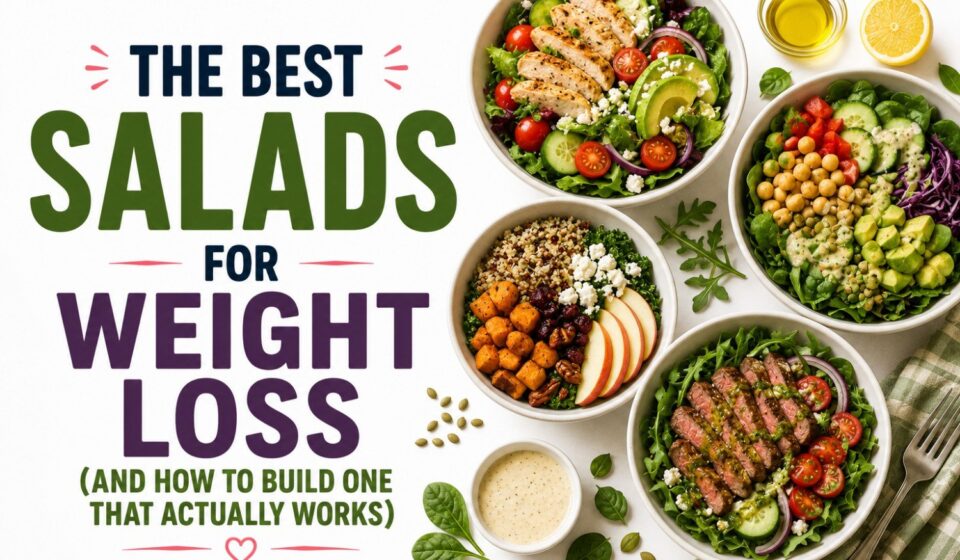
1. The Classic Tuna Salad (Not What You Think)
Not tuna salad with mayonnaise — this is:
- Large bed of spinach and romaine
- One can of tuna (drained)
- Cherry tomatoes, cucumber, red onion
- Hard-boiled egg
- Lemon juice + olive oil dressing
- Capers (for flavor, virtually no calories)
Approximate nutrition: 300-350 calories, 40g+ protein, 5g fiber
This is one of the highest protein-to-calorie ratio complete meals available in salad form.
2. The Mediterranean Salad
- Romaine and spinach base
- Grilled chicken or chickpeas
- Cucumber, cherry tomatoes, red onion, olives
- Feta cheese (small amount — 50 calories per tablespoon, meaningful flavor)
- Lemon juice + olive oil dressing
- Fresh herbs (oregano, parsley)
Approximate nutrition: 350-400 calories, 30-35g protein, 7g fiber
The Mediterranean dietary pattern has the strongest evidence of any dietary approach for weight management — this salad captures the core elements in practical form.
3. The Power Green Salad
- Massaged kale + spinach base
- Grilled salmon
- Avocado (quarter — approximately 60 calories)
- Pumpkin seeds (1 tablespoon)
- Blueberries (handful)
- Lemon vinaigrette
Approximate nutrition: 420-450 calories, 30g protein, 10g fiber
The combination of salmon’s omega-3s, kale’s extraordinary micronutrient density, avocado’s healthy fat, and blueberries’ antioxidants makes this one of the most nutritionally complete single-meal options available.
4. The High-Fiber Legume Salad
- Mixed greens base
- Chickpeas (half cup)
- Lentils (quarter cup, cooled)
- Cucumber, bell pepper, red onion
- Cherry tomatoes
- Feta (small amount)
- Red wine vinegar + olive oil
Approximate nutrition: 380-420 calories, 20g protein, 15g fiber
The double legume addition (chickpeas + lentils) produces extraordinary fiber content that extends satiety for 4-5 hours — one of the most satiating low-calorie meal options available.
5. The Pre-Meal Appetite Reducer
- Large bowl of mixed greens
- Cucumber and radishes
- Lemon juice only (no oil)
- Light sprinkle of salt and herbs
Approximate nutrition: 30-50 calories
Not a meal — but consumed 15 minutes before a main meal, this essentially zero-calorie salad volume reduces subsequent meal calorie intake by 7-12%. The most direct application of the pre-meal salad research.
6. The Asian-Inspired Salad
- Shredded cabbage + spinach base
- Edamame
- Grilled chicken or shrimp
- Shredded carrots, cucumber, scallions
- Sesame seeds (1 teaspoon)
- Rice vinegar + small amount of sesame oil + ginger dressing
Approximate nutrition: 320-370 calories, 35g protein, 8g fiber
The cruciferous base (cabbage) adds specific anti-inflammatory glucosinolates. The edamame provides plant protein alongside the animal protein for a complete amino acid profile.
The Most Common Salad Mistakes for Weight Loss
1. No protein: A vegetable-only salad is a snack. Add 25-40g protein to make it a meal.
2. Too much dressing: The most common calorie bomb. Measure 1-2 tablespoons maximum.
3. Croutons: 100-150 calories per serving of refined carbohydrates with no satiety benefit. Replace with nuts or seeds for crunch with nutritional value.
4. Cheese as a primary topping: A light sprinkle of feta or parmesan adds flavor at reasonable calorie cost. A full layer of shredded cheddar adds 200+ calories.
5. Dried fruit additions: Craisins and dried cranberries are extremely common salad additions — and essentially concentrated sugar. A quarter cup of craisins adds 130 calories and 26g sugar. Replace with fresh berries.
6. Candied nuts: Regular nuts in salads are beneficial. Candied or honey-roasted nuts add significant sugar. Check labels.
7. Iceberg-only base: Lowest nutritional density of any lettuce. Use as one component but not the primary base.
The Bottom Line
The best salads for weight loss are built on:
- Nutrient-dense greens (spinach, kale, arugula, romaine)
- 25-40g protein (chicken, tuna, salmon, eggs, chickpeas)
- Maximum non-starchy vegetables (eat as many as you want)
- Measured healthy fat (1 tablespoon olive oil or quarter avocado)
- Simple dressing (lemon + olive oil, measured carefully)
- Optional fiber boost (legumes, seeds)
Avoid: Excessive dressing, croutons, dried fruit, large amounts of cheese.
The difference between a 150-calorie weight loss salad and an 800-calorie calorie bomb is almost entirely about dressing amount and toppings — the vegetable base is always fine.
For the complete dietary framework that integrates salads with protein and calorie management, our guide to how to get rid of belly fat covers everything in one place.
What’s your go-to weight loss salad — and what toppings or dressings have you found work best for keeping you full? Share in the comments.