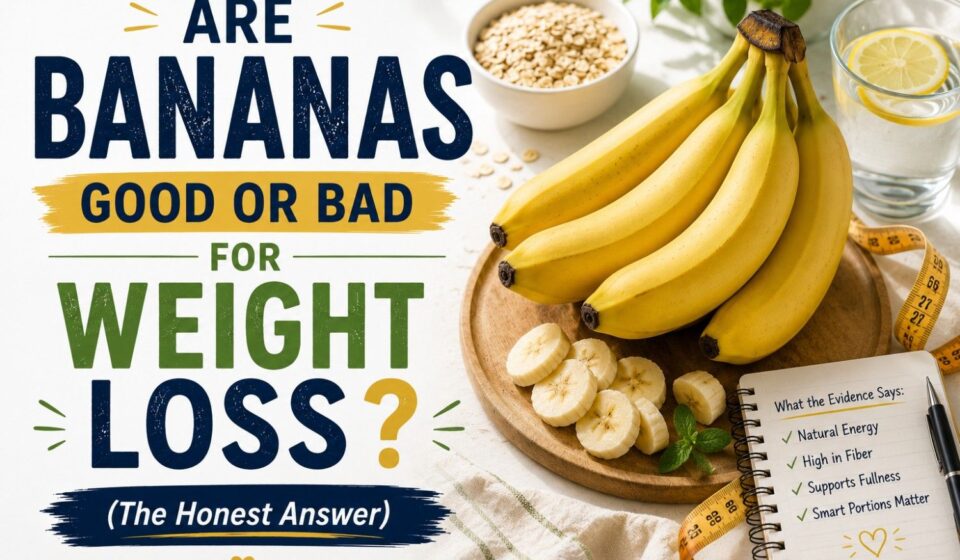

The most demonized fruit in low-carb culture — here’s what the evidence actually shows

Bananas are one of the most universally eaten fruits on the planet — and one of the most controversial in weight loss circles. Low-carb advocates avoid them as too high in sugar. Others eat them daily as a “healthy snack.” Both sides have partial points. Here’s the full picture.
The Nutritional Profile of a Banana
One medium banana (approximately 118g) contains:
- Calories: 105
- Carbohydrates: 27g
- Sugar: 14g (mix of fructose, glucose, sucrose)
- Fiber: 3g
- Protein: 1.3g
- Potassium: 422mg (12% of daily value)
- Vitamin B6: 0.4mg (20% of daily value)
- Vitamin C: 10mg (11% of daily value)
- Magnesium: 32mg (8% of daily value)
- Resistant starch: 2–6g (depending on ripeness — more in unripe bananas)
Bananas are genuinely nutritious — particularly for potassium and vitamin B6. The question is whether their sugar and carbohydrate content makes them problematic for weight loss.
The Case Against Bananas for Weight Loss
Higher in Sugar Than Most Fruits
At 14g of sugar per medium banana, bananas contain more sugar than most commonly eaten fruits:
| Fruit | Sugar per serving |
|---|---|
| Raspberries (1 cup) | 5g |
| Strawberries (1 cup) | 7g |
| Blueberries (1 cup) | 15g |
| Apple (medium) | 19g |
| Banana (medium) | 14g |
| Grapes (1 cup) | 23g |
| Mango (1 cup) | 23g |
Bananas are in the middle of the fruit sugar spectrum — higher than berries, lower than grapes or mango. The “bananas are high in sugar” framing is relative to other fruits rather than absolute.
Higher Glycemic Index Than Other Fruits
Bananas have a glycemic index of approximately 51–55 — moderate, and higher than most other commonly eaten fruits (berries, apples, and pears are all lower GI).
The GI increases significantly as bananas ripen:
- Green/unripe banana: GI ~30–40
- Yellow ripe banana: GI ~51–55
- Very ripe (spotted) banana: GI ~60–65
For people with insulin resistance or blood sugar management concerns, riper bananas produce a more significant glucose response than unripe ones.
Not Particularly Satiating Per Calorie
Compared to other 100-calorie snack options, a banana provides relatively modest protein (1.3g) and fat (0.3g) — the macronutrients most responsible for sustained satiety. The 3g fiber provides some satiety, but a banana alone often doesn’t prevent hunger for as long as higher-protein or higher-fat snacks at equivalent calories.

The Case For Bananas in a Weight Loss Diet
They’re a Whole Food With Real Nutrition
Despite the sugar concerns, bananas are whole, unprocessed food with genuine nutritional value — potassium, vitamin B6, vitamin C, fiber, and resistant starch. They’re fundamentally different from 105 calories of candy or processed food, even though the calorie counts might be similar.
Resistant Starch in Unripe Bananas
This is one of the most interesting things about bananas: unripe (green or slightly green) bananas are high in resistant starch — starch that isn’t digested and absorbed as glucose, but instead ferments in the large intestine like fiber.
Resistant starch:
- Produces no blood glucose spike (it’s not absorbed)
- Feeds beneficial gut bacteria
- Produces short-chain fatty acids that improve insulin sensitivity and reduce inflammation
- Contributes to satiety
A green banana has significantly different metabolic effects than a ripe one — essentially behaving more like fiber than sugar. As bananas ripen, the resistant starch converts to simple sugars — which is why ripe bananas taste much sweeter and have a higher GI.
Practical implication: If you eat bananas, slightly underripe is meaningfully better for blood sugar management and fat loss than very ripe.
Pre-Workout Energy
Bananas are one of the best pre-workout foods available — the combination of fast-digesting carbohydrates (for immediate energy), moderate fiber (for sustained energy), and potassium (which supports muscle function and reduces cramping) makes them ideal 30–60 minutes before exercise.
Using a banana as pre-workout fuel — rather than as a casual snack — optimizes its carbohydrate content for actual energy expenditure rather than storage.
Potassium for Fluid Balance and Blood Pressure
Bananas are one of the most accessible dietary potassium sources. Adequate potassium:
- Counteracts sodium-driven fluid retention (important for scale weight management)
- Supports healthy blood pressure
- Reduces muscle cramping during exercise
For people who exercise regularly and sweat, the potassium in bananas has practical performance and recovery value.
They Satisfy Sweet Cravings Naturally
At 105 calories with genuine sweetness, a banana satisfies a sweet craving far more nutritiously than most dessert alternatives. As covered in our article on how to lose weight with a sweet tooth, replacing processed sweets with whole fruit — including bananas — is one of the most effective sweet-craving management strategies.
Very Low Calorie Density for Their Volume
A medium banana — at 105 calories — is a physically substantial piece of food. The fiber and water content mean it takes up meaningful stomach space. Compare this to 105 calories of chocolate (a small amount) or chips (a handful) — the banana provides far more volume and satiety for the same calories.
The Ripeness Factor: A Key Distinction
The same banana at different stages of ripeness has meaningfully different metabolic properties:
| Ripeness | Resistant Starch | Simple Sugar | GI | Blood Sugar Impact |
|---|---|---|---|---|
| Green (unripe) | High (6g+) | Low | ~30–40 | Minimal |
| Yellow (ripe) | Low (1–2g) | Higher (14g) | ~51–55 | Moderate |
| Spotted (very ripe) | Very low | Highest | ~60–65 | Higher |
For weight loss, slightly underripe or just-ripe bananas are preferable to very ripe ones — the resistant starch content produces meaningfully different metabolic effects.
This is why frozen bananas (typically frozen when ripe) are not equivalent to fresh slightly-underripe bananas for blood sugar management — though they’re still nutritious and useful for smoothies and nice cream.
How to Use Bananas for Weight Loss
As pre-workout fuel: Half a banana 30–45 minutes before exercise provides ideal quick-energy carbohydrates that will be burned during the workout rather than stored.
In protein smoothies: A banana blended with protein powder, Greek yogurt, and milk creates a high-protein, genuinely filling meal. The banana provides natural sweetness and smooth texture. As covered in our guide to the best high protein breakfast ideas, a banana-protein smoothie is one of the quickest and most satisfying breakfast options.
Frozen banana “nice cream”: Blended frozen banana produces a genuinely ice-cream-like texture at approximately 100 calories per banana, zero added sugar. One of the best dessert substitutes available for weight loss.
Paired with protein: A banana alone provides modest satiety. A banana + Greek yogurt, or a banana + a tablespoon of peanut butter, adds protein and fat that significantly extends fullness. The combination is a much better snack than the banana alone.
What to avoid: Eating very ripe bananas as a regular snack without pairing with protein — the high simple sugar content without a protein buffer produces a modest blood sugar spike that leaves you hungry relatively quickly.
Bananas and Low-Carb Diets
For people following strict low-carb or ketogenic approaches, bananas don’t fit — one medium banana (27g carbohydrates) represents the majority of a day’s carb allowance on keto.
As covered in our guide to how to lose weight on a keto diet, berries are the typical keto-friendly fruit choice — much lower in carbohydrates at equivalent serving sizes.
For everyone not following a low-carb approach, bananas fit comfortably within a fat loss diet.
The Bottom Line
Are bananas good or bad for weight loss?
For most people following a balanced diet: neutral to beneficial. A medium banana at 105 calories is nutritious, moderately filling, and a far better choice than most snack alternatives at equivalent calories.
The key considerations:
- Choose slightly underripe over very ripe — lower GI, more resistant starch
- Pair with protein (Greek yogurt, peanut butter, protein powder) for better satiety
- Use strategically — pre-workout or as a sweet craving substitute rather than mindless snacking
- Account for the calories and carbohydrates within your daily totals
- Not suitable for strict low-carb or keto approaches
The bottom line: Bananas are not the diet villain low-carb culture makes them out to be. They’re a nutritious, moderately caloric whole food that fits comfortably in most fat loss dietary patterns when eaten mindfully and accounted for.
For the complete framework for including fruit within a fat loss diet, our article on is fruit bad for weight loss covers the full picture — and our guide to how to get rid of belly fat covers the overall fat loss approach.
Do you eat bananas while losing weight — or have you cut them out? Share in the comments.