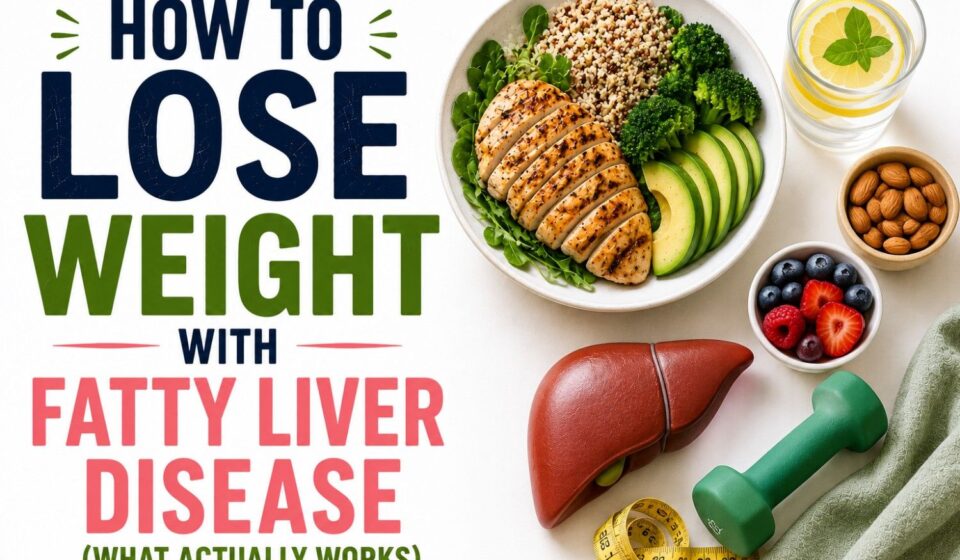
How to Lose Weight With Fatty Liver Disease (What Actually Works)

The condition where weight loss is both the treatment and the challenge — here’s the specific approach that reverses it
Non-alcoholic fatty liver disease (NAFLD) — now increasingly called Metabolic-Associated Steatotic Liver Disease (MASLD) — is the most common liver condition in the world, affecting approximately 25% of the global adult population. It’s also one of the clearest examples in medicine where weight loss is not just beneficial but genuinely curative — studies show that losing 7–10% of body weight can reverse fatty liver disease completely in many people.
The challenge: fatty liver disease both causes and is caused by the same metabolic dysfunction that makes weight loss harder. Here’s how to break that cycle.

What Is Fatty Liver Disease?
Fatty liver disease exists on a spectrum:
Simple steatosis (fatty liver): Fat accumulation in liver cells without significant inflammation. Reversible with weight loss.
NASH (Non-Alcoholic Steatohepatitis): Fat plus inflammation and liver cell damage. More serious — can progress to cirrhosis. Still reversible with sufficient weight loss.
Fibrosis/Cirrhosis: Scarring of liver tissue from chronic inflammation. Less reversible — prevention through early intervention is critical.
Most people with NAFLD have simple steatosis or early NASH — where the condition is completely reversible with appropriate lifestyle intervention.
Why Fatty Liver Makes Weight Loss Harder
Insulin Resistance — The Central Mechanism
Fatty liver disease is both caused by and causes severe insulin resistance — the most significant metabolic obstacle to fat loss.
Fat accumulated in the liver directly impairs insulin signaling in hepatocytes — causing the liver to continue glucose production despite high blood sugar (contributing to type 2 diabetes) and to continue fat synthesis from dietary carbohydrates (worsening the fat accumulation).
As covered in our guide to how to improve insulin sensitivity naturally, insulin resistance creates a hormonal environment that directly promotes fat storage and resists fat mobilization — making the calorie deficit needed for weight loss harder to achieve and harder to maintain.
Impaired Fat Metabolism
A fatty liver is metabolically dysfunctional — its ability to oxidize (burn) fat is impaired. The liver is the primary organ for fatty acid oxidation, and a liver stuffed with accumulated fat doesn’t process incoming dietary fat efficiently.
This creates a situation where dietary fat more readily ends up stored than burned — worsening both the fatty liver and the overall fat gain cycle.
Hormonal Disruption
NAFLD is associated with hormonal disruptions that further impair weight loss:
- Elevated insulin levels (from insulin resistance)
- Altered adipokine profiles (leptin resistance)
- Disrupted gut-liver axis signaling
Association With Other Metabolic Conditions
NAFLD rarely exists in isolation — it’s strongly associated with:
- Type 2 diabetes or prediabetes
- Metabolic syndrome
- PCOS (in women)
- Cardiovascular disease
Each of these co-conditions adds additional metabolic obstacles to weight loss.
The Good News: Weight Loss Reverses Fatty Liver
This is the most important fact about NAFLD and weight loss — and the strongest motivation for a specific, targeted approach:
5% weight loss: Reduces liver fat meaningfully, improves liver enzymes
7–10% weight loss: Resolves simple fatty liver in most people, significantly improves NASH
10%+ weight loss: Can resolve NASH and even improve early fibrosis in many patients
A meta-analysis of lifestyle interventions in NAFLD found that 7–10% weight loss was the threshold for histological improvement (actual liver tissue improvement on biopsy) — achievable for most people with consistent effort.
Unlike many chronic conditions where treatment just manages symptoms — weight loss in NAFLD is genuinely curative for most patients.
Dietary Approach for Fatty Liver Weight Loss
1. Eliminate Fructose and Added Sugar — The Highest Priority
This is the most important single dietary change for fatty liver disease — and the one with the strongest specific evidence.
Why fructose is particularly harmful for NAFLD:
Fructose is metabolized almost exclusively in the liver — unlike glucose, which is taken up by cells throughout the body. When large amounts of fructose arrive at the liver (from sugar, high-fructose corn syrup, fruit juice), it overwhelms the liver’s metabolic capacity and is converted to fat through de novo lipogenesis — directly worsening fatty liver.
This is why NAFLD has been called “alcohol-free alcohol liver disease” — fructose produces the same hepatic fat accumulation as alcohol, through the same liver pathway.
What to eliminate:
- Sugar-sweetened beverages (the highest priority — liquid fructose is the most direct driver of hepatic fat accumulation)
- Fruit juice (concentrated fructose without fiber)
- Added sugar in all forms (sucrose is 50% fructose)
- High-fructose corn syrup
- Honey, agave (high fructose)
- Ultra-processed food (virtually always contains added sugar)
The evidence: Multiple controlled trials show that reducing added sugar — particularly from beverages — reduces liver fat significantly within 8–12 weeks, independent of total calorie reduction.
2. Reduce Refined Carbohydrates Broadly
Beyond fructose specifically, refined carbohydrates generally worsen NAFLD through:
- Elevated insulin driving hepatic de novo lipogenesis (fat synthesis in the liver)
- Glucose excess converted to fat in the liver
- Blood sugar spikes and crashes that worsen insulin resistance
Replace with:
- Non-starchy vegetables
- Legumes (lower glycemic, high fiber)
- Whole grains in controlled amounts
- Berries (whole fruit with fiber — very different metabolically from juice)
3. Mediterranean Dietary Pattern — Best Evidence for NAFLD
The Mediterranean diet has the strongest dietary evidence specifically for NAFLD — multiple randomized controlled trials showing significant liver fat reduction alongside metabolic improvement.
Key elements beneficial for NAFLD:
- Extra virgin olive oil (oleic acid improves hepatic fat metabolism — directly reduces liver fat in studies)
- Fatty fish (omega-3s directly reduce hepatic triglyceride synthesis and liver inflammation)
- Vegetables and legumes (fiber supports gut microbiome changes that improve liver metabolism)
- Nuts (particularly walnuts — omega-3s and polyphenols)
- Minimal refined carbohydrates and added sugar
As covered in our guide to how to lose weight with the Mediterranean diet, this pattern simultaneously addresses weight loss and the specific metabolic mechanisms of NAFLD.
4. Adequate Protein — Critical for Liver Health
Protein is essential for liver function — the liver synthesizes most of the body’s proteins, and adequate dietary protein supports hepatocyte (liver cell) health and regeneration.
During weight loss with NAFLD, protein also provides the satiety and muscle preservation benefits critical for sustainable fat loss. As covered in our guide to how much protein you actually need per day, targeting 0.8–1g per pound of bodyweight is appropriate.
Best protein sources for NAFLD:
- Fatty fish (protein + omega-3s — direct liver benefit)
- Eggs (choline — essential for liver fat export, see below)
- Chicken and turkey
- Legumes (protein + fiber + phytonutrients)
- Greek yogurt (protein + probiotics beneficial for gut-liver axis)
5. Choline — The Overlooked NAFLD Nutrient
Choline is an essential nutrient that most people have never heard of — and one of the most directly relevant to fatty liver disease.
Choline is required for synthesizing phosphatidylcholine — a component of VLDL (the lipoprotein that exports fat from the liver). Without adequate choline, fat accumulates in the liver because the liver cannot export it.
Choline deficiency is actually one of the experimental models used to induce fatty liver disease in animals — indicating how directly relevant it is.
Best dietary choline sources:
- Eggs (the richest common dietary source — one whole egg provides ~150mg)
- Beef liver
- Fish and seafood
- Chicken
- Dairy
Eating 2–3 whole eggs daily is one of the most practical ways to ensure adequate choline for NAFLD — making eggs an especially valuable food choice for this condition.
6. Coffee — The Surprising NAFLD-Protective Beverage
Coffee deserves specific mention for NAFLD: multiple studies show that regular coffee consumption (2–4 cups daily) is associated with significantly lower NAFLD prevalence and slower progression. Coffee’s polyphenols and diterpenes appear to directly reduce liver inflammation and fibrosis.
Black coffee — without added sugar or high-calorie additions — provides this benefit at zero caloric cost. It’s one of the few dietary habits that specifically protects liver health while also potentially supporting metabolism through caffeine.
7. Eliminate Alcohol Completely
This is obvious but essential: alcohol directly worsens fatty liver disease through the same hepatic fat accumulation mechanism as fructose. Even moderate alcohol consumption is contraindicated in NAFLD.
Complete alcohol elimination is recommended for all NAFLD patients — not reduction, elimination.
Exercise for Fatty Liver Weight Loss
Why Exercise Is Particularly Important for NAFLD
Exercise produces specific benefits for NAFLD beyond calorie burn:
Reduces hepatic fat directly: Multiple studies show that exercise reduces liver fat — even without significant weight loss. The exercise-driven improvement in insulin sensitivity reduces the hepatic de novo lipogenesis that accumulates liver fat.
Improves mitochondrial function: NAFLD is associated with impaired hepatic mitochondrial function. Exercise improves mitochondrial biogenesis in liver cells — directly addressing the metabolic dysfunction underlying NAFLD.
Reduces visceral fat: Exercise specifically reduces visceral fat — the fat most directly linked to hepatic fat accumulation through portal vein free fatty acid delivery to the liver.
Strength Training for NAFLD
Resistance training has particularly strong evidence for NAFLD — even more so than aerobic exercise in some studies:
- Builds muscle that dramatically improves insulin sensitivity (the primary metabolic driver of NAFLD)
- Reduces hepatic fat comparable to aerobic exercise
- Improves body composition beyond scale weight change
Target: 3 sessions per week of compound resistance exercises.
Aerobic Exercise for NAFLD
Aerobic exercise produces direct hepatic fat reduction:
Recommended: 150–300 minutes per week of moderate-intensity aerobic exercise (brisk walking, cycling, swimming)
Even without weight loss, this exercise volume produces meaningful liver fat reduction — adding to the fat loss-driven improvement.
As covered in our guide to how many steps to lose weight, daily walking at 8,000–10,000 steps provides meaningful aerobic benefit accessible to virtually everyone.
HIIT for NAFLD
High-intensity interval training produces particularly potent improvements in insulin sensitivity and visceral fat reduction — both directly relevant to NAFLD. As covered in our guide to HIIT for beginners, 2 sessions per week provides meaningful benefit with manageable recovery demands.
Supplements With Evidence for NAFLD
Vitamin E
The most evidence-backed supplement specifically for NASH — vitamin E (800 IU daily of alpha-tocopherol) reduces liver inflammation and improves liver enzymes in multiple trials. The PIVENS trial found vitamin E superior to placebo for histological improvement in NASH.
Important: High-dose vitamin E supplementation (above 400 IU daily) has shown modest increased cardiovascular risk in some studies — discuss with your doctor before starting.
Omega-3 Fatty Acids
EPA and DHA from fish oil directly reduce hepatic triglyceride synthesis — the primary driver of fat accumulation in the liver. 2–4g EPA+DHA daily reduces liver fat in multiple controlled trials.
Berberine
Strong evidence for NAFLD — berberine reduces liver fat and improves liver enzymes through AMPK activation that improves hepatic fat metabolism. 500mg 2–3 times daily.
Milk Thistle (Silymarin)
Traditional liver support herb with reasonable evidence for reducing liver enzymes and inflammation in NAFLD. 140–420mg silymarin daily.
Monitoring Progress
Liver enzymes (ALT, AST): Improve relatively quickly with dietary changes — can show improvement within 4–8 weeks. A useful early feedback marker.
Liver imaging (ultrasound, FibroScan): Shows changes in liver fat over months. More definitive than enzyme markers.
Metabolic markers (fasting glucose, insulin, triglycerides, HDL): Improve alongside liver fat reduction — useful progress indicators.
Body weight and waist circumference: The 7–10% weight loss target is most easily tracked as a percentage of starting weight.
When Medical Support Is Appropriate
For NAFLD patients who have implemented dietary and exercise changes without adequate weight loss — or who have advanced NASH or fibrosis requiring faster intervention — medical weight loss support is appropriate.
GLP-1 medications and NAFLD: Semaglutide (Ozempic/Wegovy) has specific and strong evidence for NAFLD/NASH — directly reducing liver fat beyond its weight loss effects. It’s currently in Phase 3 trials specifically for NASH treatment. For NAFLD patients who qualify, GLP-1 medications may offer both weight loss and direct liver benefit.
Breeze Meds offers telehealth evaluations to assess whether prescription weight loss support is appropriate alongside NAFLD management.
Check eligibility & pricing at Breeze Meds →Affiliate disclosure: We may earn a commission if you use this link. Breeze Meds provides telehealth weight-loss services. Prescription medication is only provided following an evaluation by a licensed healthcare professional and is not guaranteed.
The Bottom Line
Fatty liver disease is uniquely responsive to lifestyle intervention — weight loss is the treatment, not just a health benefit.
The NAFLD-specific approach:
- Eliminate fructose and added sugar — the most direct driver of hepatic fat accumulation
- Eliminate alcohol — completely
- Mediterranean dietary pattern — strongest dietary evidence for NAFLD
- Adequate protein (0.8–1g per pound) + choline-rich foods (eggs)
- Daily coffee (black) — specific liver-protective evidence
- Strength training 3x per week — improves insulin sensitivity and reduces liver fat
- 150–300 minutes weekly aerobic exercise — directly reduces liver fat
- 7–10% weight loss target — the threshold for liver fat resolution
- Vitamin E and omega-3 supplementation — specific NAFLD evidence
- Monitor liver enzymes — early feedback on dietary impact
For the complete metabolic health framework, our guide to what is metabolic syndrome and how to reverse it covers the broader metabolic picture.
Have you been diagnosed with fatty liver disease and found specific dietary or lifestyle changes that improved your liver enzymes? Share in the comments.
Stop Wondering What to Eat This Week
Get my free 7-Day High-Protein Weight Loss Meal Plan delivered straight to your inbox — a simple week of satisfying, protein-focused meals designed to make healthy eating easier without complicated calorie tracking.
- 7 full days of breakfast, lunch, dinner & snacks
- One complete shopping list for the whole week
- A quick high-protein food cheat sheet
- Simple daily tips to help you stay on track
Free PDF • Delivered by email • Unsubscribe anytime
Check your inbox 💜
Your free 7-day high-protein meal plan is on its way.