
Protecting your bones while losing fat — here’s the specific approach that does both simultaneously
Osteoporosis creates a genuine weight loss dilemma: excess weight increases fracture risk through fall risk and mechanical load on compromised bones — but losing weight also reduces bone density if done incorrectly. Standard weight loss approaches that prioritize rapid scale movement can actively worsen osteoporosis by accelerating bone loss alongside fat loss.
The good news: done correctly, weight loss with osteoporosis is achievable, beneficial, and can actually improve bone health rather than undermining it. Here’s the complete guide.

The Osteoporosis-Weight Relationship
Understanding the bidirectional relationship between weight and bone health guides the approach:
How Excess Weight Affects Bone Health
Mechanical loading is protective: Weight-bearing exercise and body weight itself stimulates bone formation — heavier people tend to have higher bone density than lighter people partly from the mechanical loading of carrying more weight. This is why weight loss with osteoporosis requires careful management.
Fall risk: Excess weight — particularly obesity — increases fall risk through reduced balance, mobility limitations, and muscle weakness relative to body weight. Falls are the primary mechanism of osteoporotic fracture. Losing weight that reduces fall risk is directly beneficial.
Visceral fat and bone: Counterintuitively, visceral fat is associated with lower bone density despite the mechanical loading effect of overall weight. Visceral fat produces inflammatory cytokines that directly promote bone resorption (breakdown). Reducing visceral fat is protective for bones.
Muscle mass: The relationship between weight, muscle, and bones is critical. Muscle contractions stimulate bone formation — people with more muscle have better bone density. Weight loss that preserves or builds muscle is very different from weight loss that loses muscle alongside fat.
How Weight Loss Affects Bone Density
The concern: Every weight loss intervention produces some reduction in bone density — both from reduced mechanical loading (less body weight) and from the calorie restriction that reduces calcium and other bone-building nutrients.
Rapid weight loss: Produces the most significant bone density loss — particularly when aggressive calorie restriction provides inadequate calcium, vitamin D, and protein.
Slow, gradual weight loss: Minimizes bone density loss significantly.
Weight loss with strength training: Substantially protects and can improve bone density despite the reduction in mechanical loading from less body weight — because the mechanical stimulus from resistance exercise more than compensates.
Before Starting: Essential Medical Considerations
Always discuss weight loss with your doctor and ideally an endocrinologist or rheumatologist managing your osteoporosis. Specific considerations:
- Current bone density (DEXA scan) and T-score — determines fracture risk level and informs appropriate exercise
- Current medications — bisphosphonates (Fosamax, Boniva), denosumab, teriparatide all have specific considerations
- Fracture history — affects exercise approach significantly
- Calcium and vitamin D status — must be optimized before and during weight loss
Dietary Approach for Weight Loss With Osteoporosis
1. Adequate Calcium — Non-Negotiable
Calcium is the primary structural mineral of bone. During calorie restriction, ensuring adequate calcium intake is essential — calorie reduction must not come at the cost of calcium adequacy.
Target: 1,200mg calcium daily for women over 50 with osteoporosis (higher than the general adult recommendation of 1,000mg)
Best dietary calcium sources:
- Dairy (milk, yogurt, cheese) — most bioavailable form
- Fortified plant milks (soy, almond, oat — check labels, varies significantly)
- Canned sardines and salmon with bones
- Tofu made with calcium sulfate
- Leafy greens (kale, bok choy, broccoli — lower bioavailability than dairy but meaningful)
- Fortified foods
Calcium supplementation: If dietary calcium consistently falls below target, supplements fill the gap. Calcium carbonate (with food) or calcium citrate (without food, better absorbed in people with low stomach acid). Maximum 500mg per supplement dose — the body absorbs calcium most efficiently in smaller amounts.
Important: Excessive calcium supplementation (above 2,500mg daily total) may increase cardiovascular risk in some studies. Don’t over-supplement — aim for dietary sources first with supplementation filling genuine gaps.
2. Vitamin D — Critical for Calcium Absorption
Vitamin D is essential for calcium absorption — without adequate vitamin D, even sufficient dietary calcium isn’t properly absorbed. Vitamin D deficiency is extremely common, particularly in older adults with osteoporosis.
Target: Blood level of 25-hydroxyvitamin D above 30 ng/mL (ideally 40–60 ng/mL)
Supplementation: Most adults with osteoporosis need 1,000–2,000 IU vitamin D3 daily. Some require higher doses — test blood levels before and 3 months after supplementation to confirm adequacy.
Sources: Sun exposure (15–20 minutes of midday sun on arms and legs) produces significant vitamin D, but many older adults don’t produce sufficient amounts from sun alone. Dietary sources (fatty fish, egg yolks, fortified foods) provide modest amounts. Supplementation is almost always necessary.
3. Adequate Protein — Protecting Muscle and Bone
This is the most underappreciated nutritional factor for bone health in weight loss — protein provides the matrix in which calcium is deposited in bone. Adequate protein is required for both bone maintenance and muscle preservation during calorie restriction.
As covered in our guide to how much protein you actually need per day, targeting 0.8–1g of protein per pound of bodyweight provides the amino acids needed for both muscle preservation and bone matrix maintenance during fat loss.
Best protein sources for osteoporosis:

- Dairy (protein + calcium — double benefit)
- Fish (particularly canned salmon and sardines with bones — protein + calcium + vitamin D)
- Eggs
- Lean poultry
- Legumes (protein + magnesium)
4. Key Bone-Supporting Micronutrients
Beyond calcium and vitamin D, several nutrients specifically support bone health during weight loss:
Magnesium: Required for calcium metabolism and bone mineralization. Found in leafy greens, nuts, seeds, and legumes. Deficiency is common — 300–400mg magnesium glycinate supplementation is often appropriate.
Vitamin K2 (MK-7 form): Directs calcium into bones and away from arteries. Found in fermented foods (particularly natto, some cheeses). Supplementation (100–200mcg MK-7 daily) is worth considering — particularly alongside calcium and vitamin D3.
Collagen peptides: Bone matrix is approximately 30% collagen. Supplementation of hydrolyzed collagen (10–15g daily with vitamin C) has emerging evidence for improving bone density markers.
Phosphorus: Works with calcium in bone formation. Found in most protein-containing foods — typically adequate if protein intake is sufficient.
5. Gradual Calorie Deficit — Not Aggressive Restriction
This is the most important dietary principle for osteoporosis weight loss: slow and steady protects bone density; aggressive restriction doesn’t.
Target deficit: 200–400 calories below maintenance — producing 0.4–0.8 lbs of fat loss per week.
This slower rate:
- Preserves bone density significantly better than rapid weight loss
- Allows adequate nutrition for calcium, vitamin D, and protein targets
- Reduces the cortisol elevation from severe restriction that accelerates bone resorption
Minimum calorie floor: 1,200 calories (women) — below which nutritional adequacy for bone health becomes very difficult to maintain.
As covered in our article on what happens if you eat too few calories, severe restriction causes hormonal changes that directly worsen bone density.
Exercise for Osteoporosis Weight Loss — The Most Important Component
Exercise is arguably more important than diet for osteoporosis weight loss — because the right exercise simultaneously supports fat loss, protects bone density, builds the muscle that loads bone, and reduces fall risk.
Weight-Bearing Exercise — The Primary Bone Builder
Weight-bearing exercise — activities where you support your own body weight against gravity — directly stimulates bone formation through mechanical loading.
High-impact weight-bearing (most bone-building for people without significant fracture risk):
- Walking (brisk)
- Dancing
- Low-impact aerobics
- Hiking
- Stair climbing
Important: High-impact activities (running, jumping) may be inappropriate for people with existing vertebral fractures or very low T-scores — discuss with your doctor.
Low-impact weight-bearing (appropriate for higher fracture risk):
- Walking
- Elliptical
- Low-impact aerobics
- Tai chi
As covered in our guide to how many steps to lose weight, consistent daily walking provides both metabolic benefit for fat loss and meaningful bone-building stimulus — making it the most accessible foundation for osteoporosis exercise.
Resistance Training — Essential for Both Fat Loss and Bone Density
Resistance training is the most powerful exercise intervention for bone density in people with osteoporosis:
- Muscle contractions directly stimulate osteoblast (bone-building cell) activity
- The mechanical stress of lifting loads bones more powerfully than body weight alone
- Builds the muscle mass that improves balance and reduces fall risk
- Raises resting metabolic rate supporting fat loss
Target: 2–3 sessions per week of progressive resistance training
Specific exercise considerations for osteoporosis:
Prioritize:
- Hip and spine loading exercises — the most fracture-prone sites benefit most from targeted loading
- Squats and leg press (hip loading)
- Deadlifts with good form (spine loading — if appropriate for your T-score)
- Rows and pulls (spine loading)
- Hip abduction/adduction (hip stability)
Approach with caution or avoid:
- Flexion-based spinal loading (crunches, sit-ups, toe touches) — risk of vertebral compression fractures in significant osteoporosis
- High-impact jumping or twisting movements with very low T-scores
- Exercises with significant fall risk
Work with a physical therapist experienced in osteoporosis before starting resistance training — appropriate exercise selection depends on your specific fracture history and bone density level.
Balance Training — Directly Reduces Fracture Risk
Falls cause most osteoporotic fractures — improving balance directly reduces fracture risk regardless of bone density improvement.
Evidence-based balance training for osteoporosis:
- Tai chi: Multiple randomized trials specifically in osteoporosis showing significant fall reduction (30–50% in some studies). Also provides gentle weight-bearing and mindfulness benefits.
- Single-leg standing: Progressive balance training — hold onto a chair initially, progress to free-standing
- Yoga: Modified yoga without high-fracture-risk poses (deep forward bends, extreme spinal twisting)
- Balance board training
As covered in our guide to how to lose weight with yoga, yoga provides balance, strength, and mindfulness benefits that are particularly valuable for osteoporosis management — with appropriate modification.
Fall Prevention Beyond Exercise
Since falls cause most fractures, fall prevention is a weight loss goal as much as a safety measure:
- Remove home trip hazards (loose rugs, clutter, poor lighting)
- Install grab bars in bathroom
- Wear supportive, non-slip footwear
- Have vision checked regularly (poor vision increases fall risk significantly)
- Review medications with doctor — some medications increase fall risk
What to Avoid
Very low calorie diets: Inadequate nutrition during aggressive restriction directly accelerates bone loss.
High-sodium diet: Sodium increases urinary calcium excretion — high sodium intake directly increases calcium loss. Reducing processed food reduces sodium and supports calcium retention.
Excessive caffeine: High caffeine intake (>400mg daily) mildly increases calcium excretion. Moderate coffee consumption is fine; very high intake warrants attention.
Excessive alcohol: Directly impairs bone formation and interferes with calcium and vitamin D metabolism. More than 1–2 drinks per day is harmful for bone health.
High-phosphate processed food: Very high phosphate intake (from processed food additives) impairs calcium absorption. Another reason to minimize ultra-processed food.
Spinal flexion exercises with significant osteoporosis: Crunches, sit-ups, aggressive forward bends — risk of vertebral compression fracture.
Monitoring Progress
DEXA scan: Bone density should be monitored every 1–2 years during weight loss — confirming bone density is maintained or improved alongside fat loss.
Weight tracking: Weekly average weight rather than daily measurements — slower rate of loss (0.4–0.8 lbs/week) is appropriate and expected.
Functional markers: Balance improvement, strength gains, and fall frequency are as important as bone density numbers.
When Additional Medical Support Is Appropriate
For people with osteoporosis who also have significant obesity or metabolic complications affecting both bone and overall health, additional medical support may be appropriate — coordinated with the physician managing osteoporosis.
Breeze Meds offers telehealth evaluations to assess whether prescription weight loss support is appropriate alongside osteoporosis management.
Check eligibility & pricing at Breeze Meds →Affiliate disclosure: We may earn a commission if you use this link. Breeze Meds provides telehealth weight-loss services. Prescription medication is only provided following an evaluation by a licensed healthcare professional and is not guaranteed.
The Bottom Line
Losing weight with osteoporosis is achievable and beneficial — when done with the specific approach that protects bone density alongside fat loss:
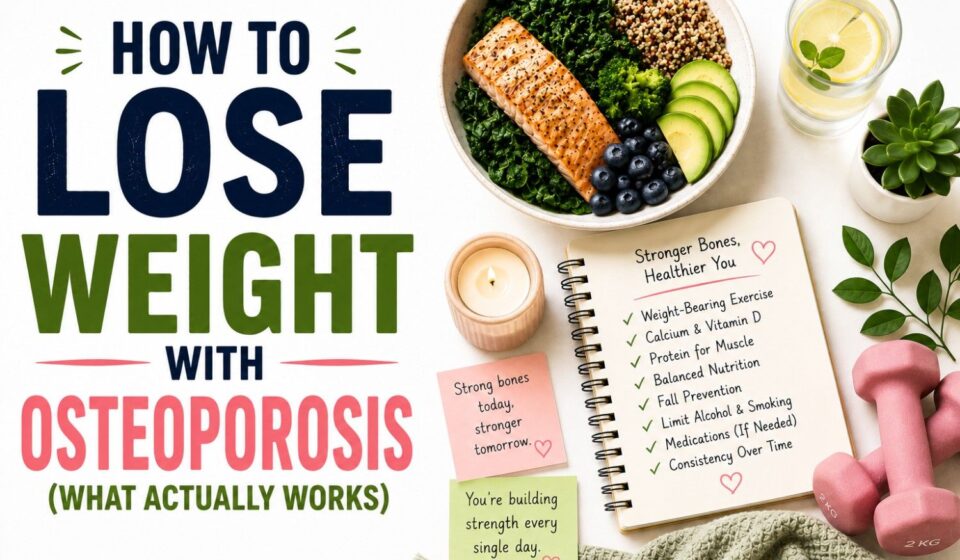
- Gradual deficit (200–400 calories) — slow loss protects bone density
- Adequate calcium (1,200mg daily) from dietary sources first
- Adequate vitamin D (1,000–2,000 IU daily, test levels)
- Adequate protein (0.8–1g per pound) — for bone matrix and muscle
- Vitamin K2, magnesium supplementation
- Resistance training 2–3x per week — most powerful bone-building exercise
- Weight-bearing exercise daily — walking, dancing, stair climbing
- Balance training (tai chi, yoga) — reduces fall and fracture risk
- Avoid spinal flexion exercises with significant osteoporosis
- Medical monitoring — DEXA scan every 1–2 years
For the complete framework that supports both metabolic health and bone health, our guide to how to get rid of belly fat covers the fat loss fundamentals.
Do you have osteoporosis and have found a weight loss approach that works without compromising bone health? Share in the comments.
Stop Wondering What to Eat This Week
Get my free 7-Day High-Protein Weight Loss Meal Plan delivered straight to your inbox — a simple week of satisfying, protein-focused meals designed to make healthy eating easier without complicated calorie tracking.
- 7 full days of breakfast, lunch, dinner & snacks
- One complete shopping list for the whole week
- A quick high-protein food cheat sheet
- Simple daily tips to help you stay on track
Free PDF • Delivered by email • Unsubscribe anytime
Check your inbox 💜
Your free 7-day high-protein meal plan is on its way.