
Two popular diets that overlap significantly — here’s exactly what separates them and which produces better results

Keto and paleo are often mentioned in the same breath — both eliminate grains, both are relatively high in protein and fat, and both are dramatically lower in carbohydrates than the standard Western diet. But they’re based on completely different principles and produce different metabolic effects. Understanding the distinction helps you choose the right approach.
The Core Philosophies
Keto: A metabolic approach. The goal is achieving and maintaining ketosis — a specific metabolic state where the body produces ketone bodies from fat as its primary fuel source. What you eat is determined entirely by whether it supports or disrupts ketosis.
Paleo: An evolutionary approach. The goal is eating foods consistent with what pre-agricultural humans consumed — whole, unprocessed foods available before farming. What you eat is determined by whether it would have been available to hunter-gatherers.
This fundamental difference in philosophy produces their key distinctions.
What They Have in Common
Both keto and paleo:
Eliminate processed foods and refined carbohydrates — both exclude bread, pasta, white rice, processed snacks, and most packaged foods. This dietary quality improvement alone produces significant health benefits.
Eliminate grains — both exclude wheat, corn, oats, rice, and other grains (though for different reasons — keto because grains are too high in carbs; paleo because they weren’t part of pre-agricultural diets).
Eliminate legumes — both exclude beans, lentils, and chickpeas (keto: too high in carbs; paleo: considered inflammatory and not part of ancestral diet).
Eliminate refined sugar and seed oils — both exclude vegetable oils (canola, soybean, corn oil) and added sugars.

Emphasize whole foods — both center around meat, fish, eggs, vegetables, nuts, and seeds.
Produce weight loss — both typically reduce calorie intake by eliminating calorie-dense processed foods, and both improve metabolic markers compared to the standard Western diet.
Key Differences
Dairy
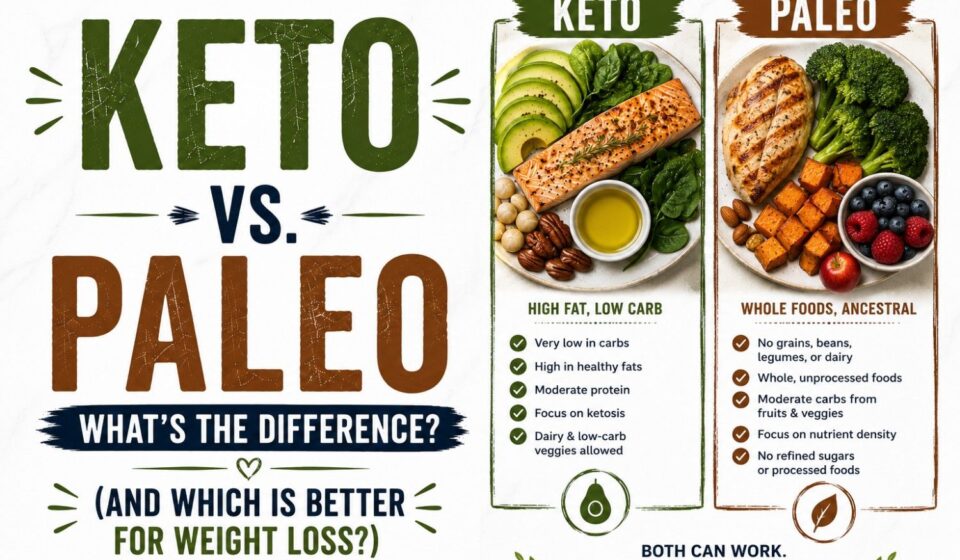
Keto: Dairy is allowed and often actively embraced — butter, heavy cream, cheese, and Greek yogurt are keto staples providing fat and protein.
Paleo: Dairy is excluded — it wasn’t part of pre-agricultural diets (humans didn’t domesticate dairy animals until relatively recently). Strict paleo eliminates all dairy including butter and cheese.
This is one of the most practical differences between the two diets.
Sweet Potatoes and Starchy Vegetables
Keto: Excluded — too high in carbohydrates (one medium sweet potato contains 26g net carbs, which would exceed most daily keto budgets).
Paleo: Allowed — sweet potatoes, yams, and other starchy tubers are ancestral foods that fit the paleo framework despite their carbohydrate content.
Fruit
Keto: Severely restricted — most fruit is too high in carbohydrates. Only small amounts of berries fit in a keto day.
Paleo: Allowed freely — fruit is a natural, ancestral food. Paleo doesn’t restrict fruit based on sugar content.
Natural Sweeteners
Keto: Excluded or very limited — honey, maple syrup, and other natural sweeteners spike blood sugar and disrupt ketosis.
Paleo: Allowed in moderation — honey and maple syrup are “ancestral” sweeteners that fit the paleo framework, despite their sugar content.
Carbohydrate Level
This is the most significant metabolic difference:
| Approach | Typical Daily Carbs | Ketosis? |
|---|---|---|
| Standard keto | 20–30g net carbs | Yes |
| Paleo (standard) | 75–150g | Usually no |
| Paleo (lower carb) | 50–100g | Sometimes |
Paleo is naturally lower in carbohydrates than the standard Western diet — but typically not low enough to produce ketosis. A paleo dieter eating sweet potatoes, fruit, and natural sweeteners might consume 100–150g of carbohydrates daily — well above keto thresholds.
The Scientific Basis
Keto has a specific, well-understood mechanism (ketosis and its metabolic effects) supported by substantial clinical research.
Paleo is based on an evolutionary hypothesis — that our genes are best adapted to ancestral foods. The scientific evidence for the specific paleo framework is more limited, though the general principle of eating whole unprocessed foods has strong support.
Which Produces Better Weight Loss?
Short term: Keto typically produces faster initial weight loss — the larger glycogen depletion and ketone-driven appetite suppression produce more dramatic early results.
Medium and long term: Comparable outcomes when adherence is equivalent. Studies comparing paleo to other dietary approaches find significant weight loss — but not dramatically different from other whole-food dietary patterns at matched calorie intake.
Adherence: Paleo is generally considered more sustainable long-term than strict keto — because paleo allows fruit, sweet potatoes, and natural sweeteners that make the diet more flexible and socially manageable. Keto’s elimination of entire food categories creates more restriction pressure over time.
For specific metabolic conditions: Keto has stronger evidence for insulin resistance, type 2 diabetes, and metabolic syndrome — the specific mechanism of ketosis produces metabolic effects that paleo’s generally lower-carb approach may not fully replicate.
Can You Combine Them? (Keto-Paleo)
Yes — and many people do. A “keto-paleo” approach applies both frameworks simultaneously:
- Under 20–30g net carbs (keto threshold)
- No dairy (paleo restriction)
- No legumes, grains, processed foods (both)
- Meat, fish, eggs, non-starchy vegetables, nuts, seeds, coconut oil, avocado (both)
This is stricter than either approach alone but eliminates the most commonly questioned foods from both frameworks. It’s nutritionally sound but requires careful attention to calcium intake (no dairy) and electrolytes.
Practical Comparison: What a Day of Eating Looks Like
Keto Day:
- Breakfast: Bacon, eggs, and cheese omelette with coffee and heavy cream
- Lunch: Tuna salad with mayo on cucumber slices
- Dinner: Salmon with buttered zucchini and a side salad with parmesan
- Snack: String cheese and olives
Paleo Day:
- Breakfast: Eggs with avocado, berries, and herbal tea (no dairy)
- Lunch: Grilled chicken salad with olive oil dressing and sweet potato
- Dinner: Beef stir-fry with vegetables and coconut aminos
- Snack: Apple with almond butter
The paleo day includes dairy-free foods, fruit, and sweet potato — all excluded from keto. The keto day includes cheese and heavy cream — excluded from paleo.
Who Should Choose Keto
- You have insulin resistance, metabolic syndrome, or type 2 diabetes
- You want the specific appetite suppression effects of ketosis
- You don’t mind giving up fruit and most dairy
- You respond well to strict, clear rules
- You want the fastest possible initial weight loss results
Who Should Choose Paleo
- You want to dramatically improve diet quality without the most extreme restrictions
- You want to keep fruit, sweet potatoes, and more dietary variety
- Long-term sustainability is a priority over maximum short-term results
- You prefer an “ancestral health” framework over a metabolic one
- You’re sensitive to or avoiding dairy
Who Might Do Best With Neither (Or Both)
As covered in our article on what is the best diet for weight loss, adherence determines outcomes more than dietary composition. If neither keto nor paleo appeals to you, other evidence-based approaches — Mediterranean, low-carb, plant-based — produce excellent results for the right person.
A Mediterranean diet with reduced carbohydrates provides many of the benefits of both keto and paleo with more flexibility and stronger long-term evidence — worth considering as an alternative to both.
The Bottom Line
Keto vs. paleo — key distinctions:
| Keto | Paleo | |
|---|---|---|
| Core principle | Metabolic (ketosis) | Evolutionary (ancestral) |
| Carbs | Under 20–30g net | 75–150g typical |
| Ketosis | Yes | Usually no |
| Dairy | Allowed | Excluded |
| Fruit | Very limited | Allowed |
| Sweet potato | Excluded | Allowed |
| Natural sweeteners | Excluded | Allowed in moderation |
| Best for | Metabolic dysfunction, fast results | General health improvement, sustainability |
Both eliminate processed food and produce weight loss. Keto’s metabolic mechanism produces faster results and specific benefits for insulin resistance. Paleo’s flexibility makes it more sustainable for many people.
For the complete guide to starting keto, our article on how to lose weight on keto for beginners covers everything in one place.
Have you tried keto, paleo, or both — and which did you find more effective or more sustainable? Share in the comments.