
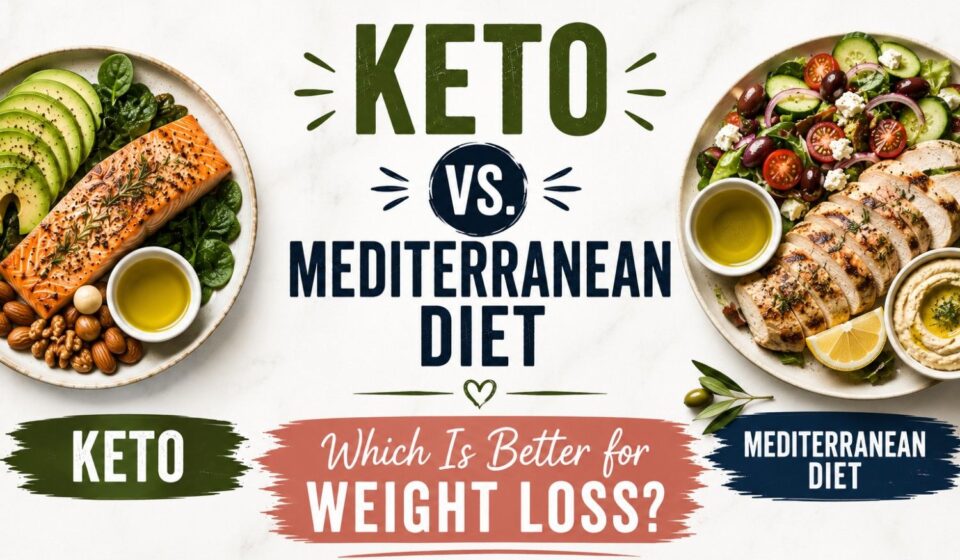

Two of the most evidence-backed diets compared head-to-head — here’s the honest verdict

If you’re choosing between the ketogenic diet and the Mediterranean diet, you’re choosing between two of the most studied and most effective dietary approaches available. They’re different in almost every way — philosophy, food choices, carbohydrate level, and long-term evidence. Here’s the complete, honest comparison.
The Core Philosophies
Keto: A metabolic approach targeting ketosis. Carbohydrates are severely restricted (under 20–30g net per day) to shift the body into fat-burning ketosis. The mechanism is metabolic — what matters is the hormonal and fuel-use state the diet produces.
Mediterranean: A dietary pattern based on the traditional eating habits of populations bordering the Mediterranean Sea — particularly southern Italy, Greece, and Spain. Emphasizes plant foods, olive oil, fish, and moderate dairy and red wine. No single macronutrient is severely restricted; the focus is on food quality and overall pattern.
What They Have in Common
Both diets:
- Emphasize whole, unprocessed foods
- Eliminate refined carbohydrates, processed snacks, and added sugar
- Include significant amounts of healthy fat (though different sources and amounts)
- Include fish and seafood as important protein sources
- Are associated with improved cardiovascular markers
- Produce weight loss compared to the standard Western diet
- Have genuine scientific evidence supporting their use
The Key Differences
Carbohydrate Level
This is the most fundamental difference:
| Keto | Mediterranean | |
|---|---|---|
| Daily carbs | 20–30g net | 200–300g (unrestricted) |
| Grains | Eliminated | Whole grains actively included |
| Legumes | Eliminated | Emphasized (lentils, chickpeas, beans) |
| Fruit | Very limited | Encouraged freely |
| Ketosis | Yes | No |
The Mediterranean diet includes whole grains, legumes, and fruit freely — all of which are eliminated or severely restricted on keto.
Fat Source and Type
Keto: Very high fat overall (65–75% of calories). Sources include butter, cream, cheese, fatty meats, coconut oil, and olive oil. Saturated fat intake is typically high.
Mediterranean: Moderate fat (35–40% of calories), with strong emphasis on olive oil as the primary fat. Saturated fat is low; monounsaturated fat (from olive oil) is the dominant fat type. Processed and animal fats are limited.
Protein Sources
Keto: Red meat, poultry, and dairy are central. Fatty cuts are preferred.

Mediterranean: Fish and seafood emphasized heavily (particularly fatty fish like sardines, mackerel, salmon). Red meat is limited to a few times per month. Legumes are a primary protein source.
Long-Term Evidence
This is where the Mediterranean diet has a significant advantage:
The Mediterranean diet has been studied for decades in large, long-term population studies and clinical trials. The landmark PREDIMED trial (7,447 participants, 5 years) found the Mediterranean diet significantly reduced cardiovascular events, stroke, and mortality.
The Mediterranean diet’s long-term cardiovascular benefit is well-established. Keto’s long-term cardiovascular data is more limited and mixed — as covered in our article on is keto safe long term, we don’t yet have robust 10–20 year data on keto outcomes.
Weight Loss Comparison
Short Term (1–6 Months)
Keto wins for initial weight loss. The combination of glycogen depletion (producing rapid early scale movement), ketone-driven appetite suppression, and the metabolic effects of ketosis typically produce faster early weight loss than Mediterranean.
A systematic review found keto produced significantly more weight loss than low-fat diets at 6 months — and the Mediterranean diet, while effective, doesn’t produce the same rapid early results.
Medium Term (6–24 Months)
Comparable. Multiple studies comparing keto to Mediterranean at 12–24 months find similar total weight loss when adherence is matched. The keto head start narrows significantly as adaptation occurs and adherence challenges emerge.
Long Term (2+ Years)
Mediterranean may have the edge — primarily through better adherence. The Mediterranean diet’s flexibility (fruit, grains, legumes, wine) makes it significantly easier to maintain as a lifelong eating pattern than strict keto.
Long-term weight maintenance — the hardest part of any weight loss journey — tends to favor dietary patterns people can sustain indefinitely. For most people, Mediterranean is more sustainable than keto.
For Specific Conditions
Keto advantages:
- Insulin resistance and metabolic syndrome — keto’s dramatic insulin reduction provides disproportionate benefits
- Type 2 diabetes — keto produces more significant blood sugar improvements in most studies
- Epilepsy — ketosis is required for therapeutic effect
- Rapid initial weight loss when speed matters
Mediterranean advantages:
- Cardiovascular disease — strongest evidence base of any dietary pattern for heart health
- Long-term weight maintenance — better adherence reduces regain
- General longevity — population data on Mediterranean populations shows exceptional health outcomes
- Inflammatory conditions — the anti-inflammatory food profile has broad benefits
The Practical Eating Comparison
Keto Day:
- Breakfast: Scrambled eggs with bacon and avocado
- Lunch: Chicken salad with olive oil dressing, no croutons
- Dinner: Salmon with buttered zucchini and a side salad
- Snack: Cheese and olives
Mediterranean Day:
- Breakfast: Greek yogurt with berries, honey, and walnuts
- Lunch: Lentil soup with whole grain bread and a large salad
- Dinner: Grilled fish with roasted vegetables, olive oil, and a glass of red wine
- Snack: Fruit and a handful of almonds
The Mediterranean day includes whole grain bread, lentils, fruit, honey, and wine — all excluded from keto. The keto day has no grains, no legumes, and no fruit.
Nutritional Completeness
Keto: With adequate vegetable intake, nutritionally sound — but requires attention to fiber, magnesium, and some micronutrients restricted food groups provide.
Mediterranean: Considered one of the most nutritionally complete dietary patterns — diverse plant foods, healthy fats, fish, and moderate dairy provide excellent micronutrient coverage without requiring supplementation.
From a nutritional completeness standpoint, Mediterranean has the advantage — the diversity of foods provides broader micronutrient coverage.
Sustainability and Social Ease
Keto: Challenging socially — restaurant eating, family meals, and celebrations all require navigating severe carbohydrate restriction. “Strict keto” and “normal social life” are in genuine tension.
Mediterranean: Highly compatible with social eating — the diet’s flexibility allows restaurants, celebrations, travel, and family meals without constant restriction management. A glass of wine is actually part of the diet.
For most people’s real lives, Mediterranean is dramatically more socially compatible.
Can You Combine Elements of Both?
Yes — a hybrid approach captures strengths of both:
Low-carb Mediterranean:
- Olive oil as primary fat
- Fish and seafood emphasized
- Vegetables, legumes in moderate amounts
- No refined grains or sugar
- Reduced but not eliminated whole grains
- Under 75–100g net carbs
This approach isn’t strictly keto (no ketosis) and isn’t traditional Mediterranean (lower carb than standard) — but captures Mediterranean’s anti-inflammatory, heart-protective food profile alongside meaningful carbohydrate reduction.
As covered in our guide to what is the best diet for weight loss, this kind of hybrid often produces the best of both worlds for people who want the metabolic benefits of lower carb eating with Mediterranean’s long-term sustainability and cardiovascular protection.
Which Should You Choose?
Choose keto if:
- You have significant insulin resistance, metabolic syndrome, or type 2 diabetes
- You want the fastest possible initial weight loss
- You respond well to strict, clear rules
- You’re managing epilepsy or investigating keto for neurological conditions
- You don’t mind severe food restriction
Choose Mediterranean if:
- Cardiovascular health is a primary concern
- Long-term sustainability matters most
- You want to eat a broad variety of whole foods including fruit, grains, and legumes
- Social eating and lifestyle compatibility are important
- You want the best-evidenced long-term dietary pattern available
Consider a low-carb Mediterranean hybrid if:
- You want carbohydrate reduction without extreme restriction
- You want Mediterranean’s cardiovascular protection alongside improved insulin sensitivity
- You want the most sustainable long-term approach with meaningful metabolic benefits
The Bottom Line
Keto vs. Mediterranean — the honest verdict:
| Keto | Mediterranean | |
|---|---|---|
| Initial weight loss | Faster | Slower |
| Long-term weight loss | Comparable | Comparable |
| Adherence | Harder | Easier |
| Cardiovascular evidence | Limited long-term | Exceptional |
| Blood sugar management | Superior | Good |
| Nutritional completeness | Good with planning | Excellent |
| Social compatibility | Difficult | Easy |
| Best for | Metabolic conditions, rapid results | Long-term health, cardiovascular protection |
Neither is universally superior — both are evidence-based, effective approaches for different goals and different people. For pure weight loss speed: keto wins short-term. For long-term health and sustainability: Mediterranean wins by most measures.
For the complete Mediterranean diet guide, our article on how to lose weight with the Mediterranean diet covers everything in one place. For the complete keto guide, our article on how to lose weight on keto for beginners covers that approach in full.
Have you tried both approaches — and which did you find more effective or more sustainable for your lifestyle? Share in the comments.